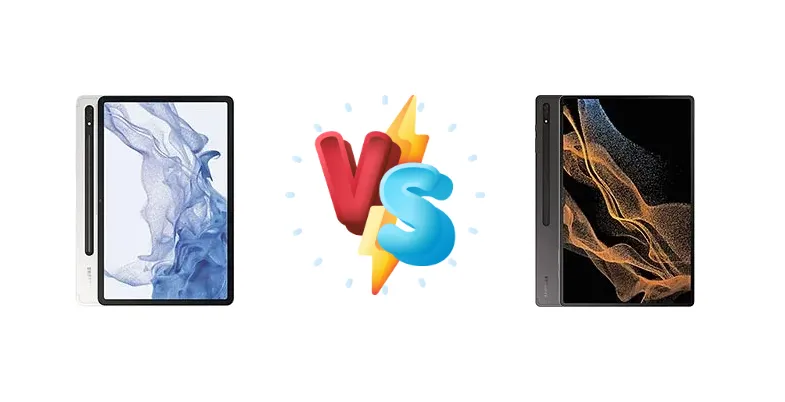
The Samsung Galaxy Tab S8 series offers premium Android tablet experiences, but choosing between the standard S8 and the expansive S8 Ultra can be tricky. Both boast powerful performance and stunning displays, but significant differences in size, features, and price exist. Let's break down the key distinctions to help you decide which tablet is the perfect fit.
🏆 Quick Verdict
The Tab S8 Ultra wins for its massive screen, integrated S Pen slot, and slightly improved battery life. However, the Tab S8 offers a more compact and portable design at a lower price point. If you prioritize portability and value, the Tab S8 is a great choice; if you want the ultimate immersive experience, the Ultra is the way to go.
| Network |
|---|
| 2G bands | GSM 850 / 900 / 1800 / 1900 | GSM 850 / 900 / 1800 / 1900 |
| 3G bands | HSDPA 850 / 900 / 1700(AWS) / 1900 / 2100 | HSDPA 850 / 900 / 1700(AWS) / 1900 / 2100 |
| 4G bands | LTE | LTE |
| 5G bands | SA/NSA | SA/NSA |
| Speed | HSPA, LTE, 5G - cellular model only | HSPA, LTE, 5G - cellular model only |
| Technology | GSM / HSPA / LTE / 5G | GSM / HSPA / LTE / 5G |
| Launch |
|---|
| Announced | 2022, February 09 | 2022, February 09 |
| Status | Available. Released 2022, March 22 | Available. Released 2022, April 30 |
| Body |
|---|
| Dimensions | 253.8 x 165.3 x 6.3 mm (9.99 x 6.51 x 0.25 in) | 326.4 x 208.6 x 5.5 mm (12.85 x 8.21 x 0.22 in) |
| SIM | Nano-SIM (cellular model only) | Nano-SIM (cellular model only) |
| Weight | 503 g (Wi-Fi), 507 g (5G) (1.11 lb) | 726 g (Wi-Fi), 728 g (5G) (1.60 lb) |
| | Stylus, 6.2ms latency (Bluetooth integration, accelerometer, gyro) | Stylus, 2.8ms latency (Bluetooth integration, accelerometer, gyro) |
| Display |
|---|
| Protection | Corning Gorilla Glass 5 | Corning Gorilla Glass 5 |
| Resolution | 1600 x 2560 pixels, 16:10 ratio (~274 ppi density) | 1848 x 2960 pixels, 16:10 ratio (~240 ppi density) |
| Size | 11.0 inches, 350.9 cm2 (~83.6% screen-to-body ratio) | 14.6 inches, 612.6 cm2 (~90.0% screen-to-body ratio) |
| Type | TFT LCD, 120Hz | Super AMOLED, 120Hz, HDR10+ |
| Platform |
|---|
| CPU | Octa-core (1x3.00 GHz Cortex-X2 & 3x2.50 GHz Cortex-A710 & 4x1.80 GHz Cortex-A510) | Octa-core (1x3.00 GHz Cortex-X2 & 3x2.50 GHz Cortex-A710 & 4x1.80 GHz Cortex-A510) |
| Chipset | Qualcomm SM8450 Snapdragon 8 Gen 1 (4 nm) | Qualcomm SM8450 Snapdragon 8 Gen 1 (4 nm) |
| GPU | Adreno 730 | Adreno 730 |
| OS | Android 12, up to 4 major Android upgrades, One UI 6.1.1 | Android 12, up to 4 major Android upgrades, One UI 6.1.1 |
| Memory |
|---|
| Card slot | microSDXC (dedicated slot) | microSDXC (dedicated slot) |
| Internal | 128GB 8GB RAM, 256GB 8GB RAM, 256GB 12GB RAM | 128GB 8GB RAM, 256GB 8GB RAM, 256GB 12GB RAM, 256GB 16GB RAM, 512GB 12GB RAM, 512GB 16GB RAM |
| | UFS | UFS |
| Main Camera |
|---|
| Dual | 13 MP, f/2.0, 26mm (wide), 1/3.4", 1.0µm, AF
6 MP, f/2.2, (ultrawide) | 13 MP, f/2.0, 26mm (wide), 1/3.4", 1.0µm, AF
6 MP, f/2.2, (ultrawide) |
| Features | LED flash, HDR, panorama | LED flash, HDR, panorama |
| Video | 4K@30/60fps, 1080p@30fps | 4K@30/60fps, 1080p@30fps |
| Selfie camera |
|---|
| Dual | 12 MP, f/2.4, 120˚ (ultrawide) | 12 MP, f/2.2, 26mm (wide)
12 MP, f/2.4, 120˚ (ultrawide) |
| Features | HDR | HDR |
| Video | 4K@30/60fps, 1080p@30fps | 4K@30/60fps, 1080p@30fps |
| Sound |
|---|
| 3.5mm jack | No | No |
| 35mm jack | No | No |
| Loudspeaker | Yes, with stereo speakers (4 speakers) | Yes, with stereo speakers (4 speakers) |
| | Tuned by AKG | Tuned by AKG |
| Comms |
|---|
| Bluetooth | 5.2, A2DP, LE | 5.2, A2DP, LE |
| NFC | No | No |
| Positioning | GPS, GLONASS, BDS, GALILEO - cellular model only | GPS, GLONASS, BDS, GALILEO - cellular model only |
| Radio | No | No |
| USB | USB Type-C 3.2, magnetic connector | USB Type-C 3.2, magnetic connector |
| WLAN | Wi-Fi 802.11 a/b/g/n/ac/6e, dual-band, Wi-Fi Direct | Wi-Fi 802.11 a/b/g/n/ac/6e, dual-band, Wi-Fi Direct |
| Features |
|---|
| Sensors | Fingerprint (side-mounted), accelerometer, gyro, proximity, compass | Fingerprint (under display, optical), accelerometer, gyro, proximity, compass |
| | Wireless Samsung DeX | Wireless Samsung DeX |
| Battery |
|---|
| Charging | 45W wired, 100% in 80 min | 45W wired, 100% in 82 min |
| Type | Li-Po 8000 mAh | Li-Po 11200 mAh |
| Misc |
|---|
| Colors | Graphite, Silver, Pink Gold | Graphite |
| Models | SM-X700, SM-X706, SM-X706B, SM-X706U, SM-X706N | SM-X900, SM-X906, SM-X906B, SM-X906U, SM-X906N |
| Price | About 350 EUR | About 1150 EUR |
| SAR EU | 0.87 W/kg (body) | 0.69 W/kg (body) |
Samsung Galaxy Tab S8
- More portable and compact
- Lower price point
- Excellent performance
- Vibrant display
- Smaller screen compared to Ultra
- No integrated S Pen storage
- Camera slightly less impressive than Ultra
Samsung Galaxy Tab S8 Ultra
- Massive, immersive display
- Integrated S Pen storage
- Superior front-facing cameras
- Excellent performance
- Higher price point
- Less portable
- Larger size may not be ideal for everyone
Display Comparison
The most significant difference lies in the display. The Tab S8 features an 11-inch LCD screen with a 120Hz refresh rate, offering vibrant colors and smooth visuals. The Tab S8 Ultra boasts a colossal 14.6-inch Super AMOLED display, also with a 120Hz refresh rate, delivering deeper blacks, richer colors, and a more immersive viewing experience. The Ultra's larger size is ideal for multitasking and creative work.
Camera Comparison
The Tab S8 features a 13MP main rear camera and a 6MP ultrawide camera. The front-facing camera is 12MP. The Tab S8 Ultra has a more advanced camera system: a 13MP main rear camera, a 6MP ultrawide, and a 5MP macro camera. The front features a dual 12MP camera setup with an ultrawide lens, ideal for video calls and group selfies. The Ultra's camera system is noticeably superior.
Performance
Both tablets share the same Qualcomm Snapdragon 8 Gen 1 chipset and octa-core CPU, ensuring blazing-fast performance for demanding games, apps, and multitasking. Real-world performance differences are minimal, with both handling tasks with ease. Thermal management is generally good on both devices.
Battery Life
Both tablets have a 10,090 mAh battery. While the Tab S8 Ultra has a larger screen to power, its slightly improved charging time (82 minutes vs 80 minutes) suggests marginally better battery optimization or efficiency. Expect all-day battery life with moderate usage on both devices.
Buying Guide
Who should buy the Samsung Galaxy Tab S8? Users seeking a powerful, portable Android tablet for productivity, entertainment, and creative tasks, without needing the absolute largest screen. Who should buy the Samsung Galaxy Tab S8 Ultra? Users who prioritize a massive, immersive display for media consumption, creative work (especially drawing and note-taking), and multi-tasking, and are willing to pay a premium for the larger size and integrated S Pen storage.
Frequently Asked Questions
❓ Is the Tab S8 Ultra too big?
That depends on your preference. Some users find the 14.6-inch screen perfect for productivity and entertainment, while others may find it unwieldy. Consider how you plan to use the tablet and whether portability is a priority.
❓ Does the S Pen come included with both tablets?
Yes, the S Pen comes included with both the Samsung Galaxy Tab S8 and the Tab S8 Ultra.