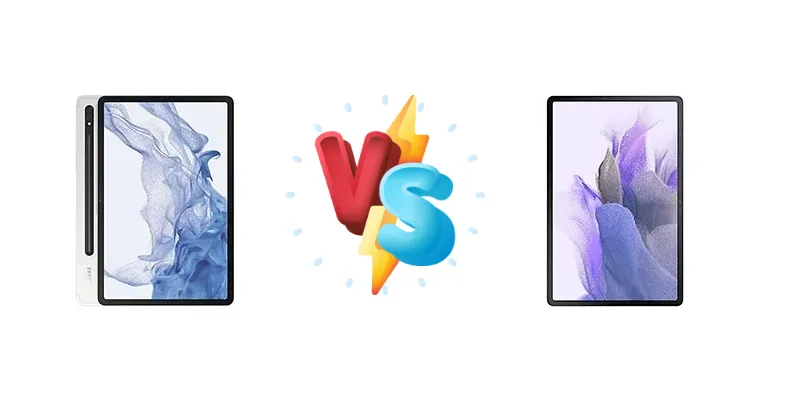
Choosing the right Android tablet can be tough, especially with Samsung's impressive lineup. The Galaxy Tab S8 and S7 FE are both excellent options, but cater to different needs and budgets. This comprehensive comparison will help you decide which one is right for you.
🏆 Quick Verdict
The Galaxy Tab S8 is the clear performance winner thanks to its Snapdragon 8 Gen 1 chip and vibrant display. However, the S7 FE offers a more budget-friendly option with a large screen and S Pen support, making it ideal for casual users and students.
| Network |
|---|
| 2G bands | GSM 850 / 900 / 1800 / 1900 | GSM 850 / 900 / 1800 / 1900 |
| 3G bands | HSDPA 850 / 900 / 1700(AWS) / 1900 / 2100 | HSDPA 850 / 900 / 1700(AWS) / 1900 / 2100 |
| 4G bands | LTE | 1, 2, 3, 4, 5, 7, 8, 12, 13, 17, 20, 25, 26, 28, 32, 38, 40, 41, 66 |
| 5G bands | SA/NSA | 1, 3, 5, 7, 8, 20, 28, 38, 40, 41, 77, 78 SA/NSA/Sub6 |
| Speed | HSPA, LTE, 5G - cellular model only | HSPA, LTE, 5G - cellular model only |
| Technology | GSM / HSPA / LTE / 5G | GSM / HSPA / LTE / 5G |
| Launch |
|---|
| Announced | 2022, February 09 | 2021, May 25 |
| Status | Available. Released 2022, March 22 | Available. Released 2021, June 18 |
| Body |
|---|
| Build | - | Glass front, aluminum back, aluminum frame |
| Dimensions | 253.8 x 165.3 x 6.3 mm (9.99 x 6.51 x 0.25 in) | 284.8 x 185 x 6.3 mm (11.21 x 7.28 x 0.25 in) |
| SIM | Nano-SIM (cellular model only) | Nano-SIM (cellular model only) |
| Weight | 503 g (Wi-Fi), 507 g (5G) (1.11 lb) | 608 g (1.34 lb) |
| | Stylus, 6.2ms latency (Bluetooth integration, accelerometer, gyro) | Stylus support |
| Display |
|---|
| Protection | Corning Gorilla Glass 5 | - |
| Resolution | 1600 x 2560 pixels, 16:10 ratio (~274 ppi density) | 1600 x 2560 pixels, 16:10 ratio (~243 ppi density) |
| Size | 11.0 inches, 350.9 cm2 (~83.6% screen-to-body ratio) | 12.4 inches, 445.8 cm2 (~84.6% screen-to-body ratio) |
| Type | TFT LCD, 120Hz | TFT LCD |
| Platform |
|---|
| CPU | Octa-core (1x3.00 GHz Cortex-X2 & 3x2.50 GHz Cortex-A710 & 4x1.80 GHz Cortex-A510) | Octa-core (2x2.2 GHz Kryo 570 & 6x1.8 GHz Kryo 570) - 5G modelOcta-core (1x2.4 GHz Cortex-A78 & 3x2.2 GHz Cortex-A78 & 4x1.9 GHz Cortex-A55) - Wi-Fi model |
| Chipset | Qualcomm SM8450 Snapdragon 8 Gen 1 (4 nm) | Qualcomm SM7225 Snapdragon 750G 5G (8 nm) - 5G modelQualcomm SM7325 Snapdragon 778G 5G (6 nm) - Wi-Fi model |
| GPU | Adreno 730 | Adreno 619 - 5G modelAdreno 642L - Wi-Fi model |
| OS | Android 12, up to 4 major Android upgrades, One UI 6.1.1 | Android 11, upgradable to Android 14, One UI 6 |
| Memory |
|---|
| Card slot | microSDXC (dedicated slot) | microSDXC (dedicated slot) |
| Internal | 128GB 8GB RAM, 256GB 8GB RAM, 256GB 12GB RAM | 64GB 4GB RAM, 128GB 6GB RAM, 256GB 8GB RAM |
| | UFS | - |
| Main Camera |
|---|
| Dual | 13 MP, f/2.0, 26mm (wide), 1/3.4", 1.0µm, AF
6 MP, f/2.2, (ultrawide) | - |
| Features | LED flash, HDR, panorama | - |
| Single | - | 8 MP, AF |
| Video | 4K@30/60fps, 1080p@30fps | 1080p@30fps |
| Selfie camera |
|---|
| Dual | 12 MP, f/2.4, 120˚ (ultrawide) | - |
| Features | HDR | - |
| Single | - | 5 MP |
| Video | 4K@30/60fps, 1080p@30fps | 1080p@30fps |
| Sound |
|---|
| 3.5mm jack | No | No |
| 35mm jack | No | No |
| Loudspeaker | Yes, with stereo speakers (4 speakers) | Yes, with stereo speakers |
| | Tuned by AKG | Tuned by AKG |
| Comms |
|---|
| Bluetooth | 5.2, A2DP, LE | 5.2, A2DP, LE (Wi-Fi), 5.2, A2DP, LE (5G) |
| NFC | No | No |
| Positioning | GPS, GLONASS, BDS, GALILEO - cellular model only | GPS, GLONASS, BDS, GALILEO - cellular model only |
| Radio | No | No |
| USB | USB Type-C 3.2, magnetic connector | USB Type-C 3.2, magnetic connector |
| WLAN | Wi-Fi 802.11 a/b/g/n/ac/6e, dual-band, Wi-Fi Direct | Wi-Fi 802.11 a/b/g/n/ac/6 (Wi-Fi), Wi-Fi 802.11 a/b/g/n/ac (5G) |
| Features |
|---|
| Sensors | Fingerprint (side-mounted), accelerometer, gyro, proximity, compass | Accelerometer, proximity, compass, gyro (5G model only) |
| | Wireless Samsung DeX | Samsung DeX |
| Battery |
|---|
| Charging | 45W wired, 100% in 80 min | 45W wired, 100% in 190 min |
| Type | Li-Po 8000 mAh | Li-Po 10090 mAh |
| Misc |
|---|
| Colors | Graphite, Silver, Pink Gold | Mystic Black, Mystic Silver, Mystic Green, Mystic Pink |
| Models | SM-X700, SM-X706, SM-X706B, SM-X706U, SM-X706N | SM-T730, SM-T733, SM-T736B, SM-T735 |
| Price | About 350 EUR | About 650 EUR |
| SAR EU | 0.87 W/kg (body) | 1.15 W/kg (body) |
| Tests |
|---|
| Display | - | Contrast ratio: 1886:1 (nominal) |
| Loudspeaker | - | -27.2 LUFS (Good) |
| Performance | - | AnTuTu: 292530 (v8), 355430 (v9)
GeekBench: 1904 (v5.1)
GFXBench: 9.7fps (ES 3.1 onscreen) |
Samsung Galaxy Tab S8
- Blazing-fast performance
- Stunning AMOLED display (120Hz)
- Versatile camera system
- Faster charging
- Premium build quality
- Higher price
- Can get warm under heavy load
Samsung Galaxy Tab S7 FE
- Large display for media consumption
- Included S Pen
- More affordable
- Good battery life
- Slower performance
- LCD display (60Hz)
- Less impressive camera
- Slower charging
Display Comparison
The Tab S8 boasts a brighter, more vibrant 120Hz AMOLED display, offering smoother scrolling and richer colors. The S7 FE has a large LCD screen with a 60Hz refresh rate, providing ample viewing space but lacking the premium visual experience of the S8. The S7 FE's contrast ratio is excellent, but the Tab S8's AMOLED technology provides deeper blacks and more accurate colors.
Camera Comparison
The Tab S8 features a more versatile and higher-resolution camera system, including a wide, ultrawide, and depth sensor. The S7 FE has a single rear camera, which is adequate for basic photography but lacks the flexibility of the S8's setup. Video recording capabilities are also superior on the S8.
Performance
The Tab S8's Snapdragon 8 Gen 1 is significantly faster than either version of the S7 FE's Snapdragon 750G or 778G. Expect noticeably quicker app loading times, smoother multitasking, and better gaming performance on the S8. The S7 FE is still capable for everyday tasks, but struggles with demanding applications.
Battery Life
While both tablets offer a decent battery life, the Tab S8's more efficient chipset and faster charging (45W vs S7 FE's 45W, but significantly faster charging times) give it a slight edge. The S7 FE's larger battery capacity helps offset its less efficient processor, but the Tab S8 charges much faster.
Buying Guide
The Samsung Galaxy Tab S8 is perfect for power users, creatives, and gamers who demand top-tier performance and a stunning display. The Galaxy Tab S7 FE is a great choice for students, casual users, and those on a budget who want a large screen for media consumption and note-taking with the included S Pen.
Frequently Asked Questions
❓ Is the Galaxy Tab S7 FE good for gaming?
The S7 FE can handle casual games, but demanding titles may experience lag or reduced frame rates. The Tab S8 is significantly better suited for gaming.
❓ Does the Galaxy Tab S7 FE come with the S Pen?
Yes, the Galaxy Tab S7 FE includes an S Pen in the box.
❓ Which tablet has better multitasking capabilities?
The Galaxy Tab S8, with its more powerful processor, handles multitasking much more smoothly than the S7 FE.