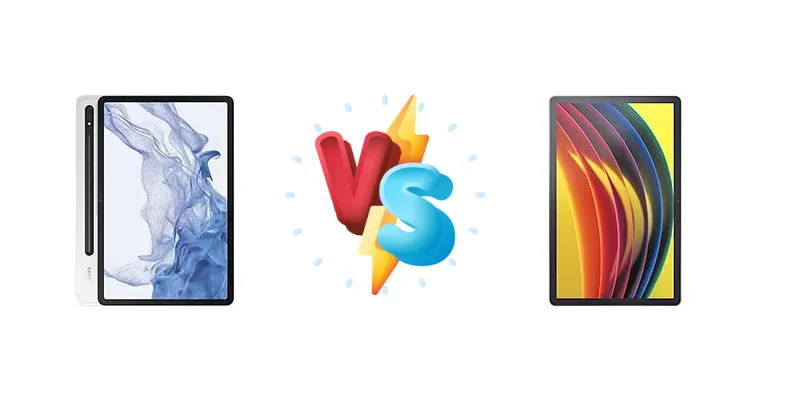
The Android tablet market offers a wide spectrum of choices, from premium flagships to budget-friendly options. The Samsung Galaxy Tab S8, powered by the Snapdragon 8 Gen 1, represents the former, aiming for uncompromising performance. Conversely, the Lenovo Tab P11 Plus targets the value-conscious consumer with its MediaTek Helio G90T chipset. This comparison dissects these two tablets to determine which best suits your needs and budget.
🏆 Quick Verdict
For users prioritizing raw power and future-proofing, the Samsung Galaxy Tab S8 is the clear winner. Its Snapdragon 8 Gen 1 chipset delivers significantly faster performance. However, the Lenovo Tab P11 Plus offers a compelling experience for everyday tasks and media consumption at a substantially lower price point.
| Network |
|---|
| 2G bands | GSM 850 / 900 / 1800 / 1900 | GSM 850 / 900 / 1800 / 1900 |
| 3G bands | HSDPA 850 / 900 / 1700(AWS) / 1900 / 2100 | HSDPA 850 / 900 / 1900 / 2100 |
| 4G bands | LTE | 1, 2, 3, 4, 5, 7, 8, 20, 28, 38, 40, 41 |
| 5G bands | SA/NSA | - |
| Speed | HSPA, LTE, 5G - cellular model only | HSPA, LTE - cellular model only |
| Technology | GSM / HSPA / LTE / 5G | GSM / HSPA / LTE |
| Launch |
|---|
| Announced | 2022, February 09 | 2021, June 28 |
| Status | Available. Released 2022, March 22 | Available. Released 2021, July 29 |
| Body |
|---|
| Dimensions | 253.8 x 165.3 x 6.3 mm (9.99 x 6.51 x 0.25 in) | 258.4 x 163 x 7.5 mm (10.17 x 6.42 x 0.30 in) |
| SIM | Nano-SIM (cellular model only) | Nano-SIM (cellular model only) |
| Weight | 503 g (Wi-Fi), 507 g (5G) (1.11 lb) | 490 g (1.08 lb) |
| | Stylus, 6.2ms latency (Bluetooth integration, accelerometer, gyro) | Stylus support |
| Display |
|---|
| Protection | Corning Gorilla Glass 5 | - |
| Resolution | 1600 x 2560 pixels, 16:10 ratio (~274 ppi density) | 1200 x 2000 pixels, 5:3 ratio (~212 ppi density) |
| Size | 11.0 inches, 350.9 cm2 (~83.6% screen-to-body ratio) | 11.0 inches, 344.4 cm2 (~81.8% screen-to-body ratio) |
| Type | TFT LCD, 120Hz | IPS LCD, 400 nits (typ) |
| Platform |
|---|
| CPU | Octa-core (1x3.00 GHz Cortex-X2 & 3x2.50 GHz Cortex-A710 & 4x1.80 GHz Cortex-A510) | Octa-core (2x2.05 GHz Cortex-A76 & 6x2.0 GHz Cortex-A55) |
| Chipset | Qualcomm SM8450 Snapdragon 8 Gen 1 (4 nm) | Mediatek MT6785 Helio G90T (12 nm) |
| GPU | Adreno 730 | Mali-G76 MC4 |
| OS | Android 12, up to 4 major Android upgrades, One UI 6.1.1 | Android 11 |
| Memory |
|---|
| Card slot | microSDXC (dedicated slot) | microSDXC (dedicated slot) |
| Internal | 128GB 8GB RAM, 256GB 8GB RAM, 256GB 12GB RAM | 64GB 4GB RAM, 128GB 4GB RAM, 128GB 6GB RAM |
| | UFS | - |
| Main Camera |
|---|
| Dual | 13 MP, f/2.0, 26mm (wide), 1/3.4", 1.0µm, AF
6 MP, f/2.2, (ultrawide) | - |
| Features | LED flash, HDR, panorama | LED flash |
| Single | - | 13 MP, (wide), AF |
| Video | 4K@30/60fps, 1080p@30fps | 1080p@30fps |
| Selfie camera |
|---|
| Dual | 12 MP, f/2.4, 120˚ (ultrawide) | - |
| Features | HDR | - |
| Single | - | 8 MP, (wide) |
| Video | 4K@30/60fps, 1080p@30fps | 1080p@30fps |
| Sound |
|---|
| 3.5mm jack | No | No |
| 35mm jack | No | No |
| Loudspeaker | Yes, with stereo speakers (4 speakers) | Yes, with stereo speakers (4 speakers) |
| | Tuned by AKG | - |
| Comms |
|---|
| Bluetooth | 5.2, A2DP, LE | 5.1, A2DP, LE |
| NFC | No | No |
| Positioning | GPS, GLONASS, BDS, GALILEO - cellular model only | GPS, GLONASS, BDS - cellular model only |
| Radio | No | FM radio |
| USB | USB Type-C 3.2, magnetic connector | USB Type-C 2.0 |
| WLAN | Wi-Fi 802.11 a/b/g/n/ac/6e, dual-band, Wi-Fi Direct | Wi-Fi 802.11 a/b/g/n/ac, dual-band, Wi-Fi Direct |
| Features |
|---|
| Sensors | Fingerprint (side-mounted), accelerometer, gyro, proximity, compass | Accelerometer, gyro, proximity |
| | Wireless Samsung DeX | - |
| Battery |
|---|
| Charging | 45W wired, 100% in 80 min | 20W wired |
| Type | Li-Po 8000 mAh | Li-Po 7700 mAh |
| Misc |
|---|
| Colors | Graphite, Silver, Pink Gold | Slate Grey, Platinum Grey, Modernist teal |
| Models | SM-X700, SM-X706, SM-X706B, SM-X706U, SM-X706N | ZA940124SE |
| Price | About 350 EUR | About 300 EUR |
| SAR EU | 0.87 W/kg (body) | - |
Samsung Galaxy Tab S8
- Significantly faster processor for demanding tasks
- Faster charging speeds (45W)
- Likely superior display quality and features
- Higher price point
- Potentially shorter battery life under heavy load (depending on battery capacity)
Lenovo Tab P11 Plus
- More affordable price
- Decent performance for everyday tasks
- Good value for money
- Slower processor compared to the Tab S8
- Slower charging speeds (20W)
- Likely lower display quality
Display Comparison
While display specifications weren't provided, the Tab S8, being a flagship, likely features a higher resolution and potentially an LTPO panel for adaptive refresh rates, contributing to smoother visuals and improved battery life. The P11 Plus, positioned as a mid-range device, likely utilizes a standard LCD panel. The Tab S8's display is expected to have superior color accuracy and brightness, making it better suited for HDR content and outdoor use. Bezels are also likely thinner on the S8, offering a more immersive viewing experience.
Camera Comparison
Camera details are limited, but given the market positioning, the Tab S8 is expected to have a more sophisticated camera system. While both tablets likely feature multi-camera setups, the Tab S8 likely boasts a larger main sensor and potentially optical image stabilization (OIS) for sharper images and videos. The P11 Plus will likely focus on providing adequate image quality for casual use. The image processing algorithms on the Tab S8 will also be more advanced, resulting in better dynamic range and low-light performance.
Performance
The core difference lies in the chipsets. The Samsung Galaxy Tab S8’s Qualcomm SM8450 Snapdragon 8 Gen 1 (4nm) is a significant leap ahead of the Lenovo Tab P11 Plus’s MediaTek MT6785 Helio G90T (12nm). The Snapdragon 8 Gen 1’s octa-core CPU, featuring a Cortex-X2 prime core, delivers substantially faster processing speeds for demanding applications. The 4nm fabrication process also translates to improved thermal efficiency, reducing throttling during sustained workloads. The P11 Plus’s Helio G90T, while capable, is designed for mid-range performance and will struggle with intensive tasks. The Tab S8 likely utilizes faster LPDDR5x RAM, further enhancing performance.
Battery Life
Battery capacity wasn't specified, but the charging speeds reveal a key difference. The Tab S8 supports 45W wired charging, achieving a 100% charge in approximately 80 minutes. The P11 Plus, with its 20W charging, will take considerably longer to fully charge. While a larger battery capacity on the P11 Plus could offset the slower charging, the Tab S8’s faster charging is a significant convenience factor. The Snapdragon 8 Gen 1’s improved efficiency may also contribute to comparable real-world battery life despite potentially having a smaller battery capacity.
Buying Guide
Buy the Samsung Galaxy Tab S8 if you need a tablet capable of demanding tasks like video editing, high-end gaming, or running multiple applications simultaneously. Its superior processing power and potential for accessories like a keyboard and S Pen make it a productivity powerhouse. Buy the Lenovo Tab P11 Plus if you prioritize affordability and a smooth experience for everyday tasks like browsing, streaming, and light gaming. It’s an excellent choice for families or users who need a portable entertainment device without breaking the bank.
Frequently Asked Questions
❓ Will the Lenovo Tab P11 Plus struggle with graphically intensive games like Genshin Impact?
The MediaTek Helio G90T in the Tab P11 Plus can handle some gaming, but demanding titles like Genshin Impact will likely require reduced graphics settings and may still experience occasional frame drops. It's best suited for less demanding games or casual gaming sessions.
❓ Is the Snapdragon 8 Gen 1 in the Tab S8 prone to overheating during extended gaming?
While the Snapdragon 8 Gen 1 is a powerful chip, Samsung has implemented thermal management solutions to mitigate overheating. However, prolonged gaming at maximum settings may still result in some thermal throttling, but it's unlikely to be a major issue for most users.
❓ Can either tablet be used with a keyboard and stylus for productivity?
Both tablets support keyboard and stylus accessories, but the experience will be superior on the Tab S8. Samsung offers its S Pen, designed specifically for its tablets, providing a more precise and responsive writing experience. The Tab S8's processing power will also handle multitasking and demanding productivity apps more effectively.