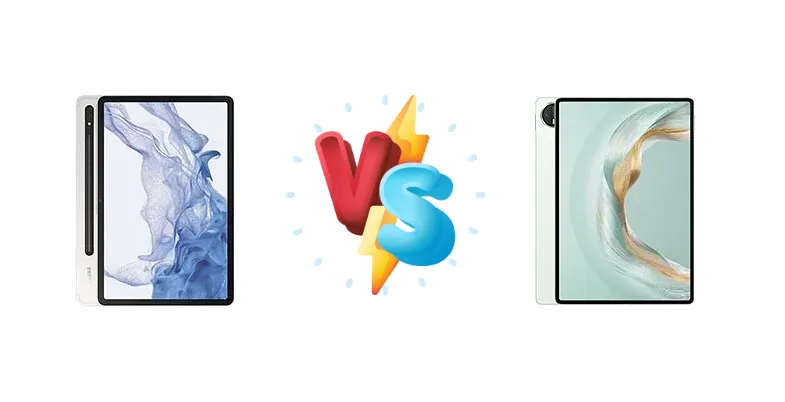
The Samsung Galaxy Tab S8, powered by the Snapdragon 8 Gen 1, represents a mature Android tablet experience. The Huawei MatePad Pro 12.2 (2025), however, enters the arena with a focus on extended battery life and ultra-fast charging, utilizing Huawei’s Kirin T92A chipset. This comparison dissects the strengths and weaknesses of each device to determine which tablet best suits your needs.
🏆 Quick Verdict
For users prioritizing raw processing power and a well-established ecosystem, the Samsung Galaxy Tab S8 remains a strong contender. However, the Huawei MatePad Pro 12.2 (2025) wins for most users due to its significantly faster charging (100W vs 45W) and impressive 11:24 hour active use battery life, making it ideal for on-the-go productivity and entertainment.
| Network |
|---|
| 2G bands | GSM 850 / 900 / 1800 / 1900 | N/A |
| 3G bands | HSDPA 850 / 900 / 1700(AWS) / 1900 / 2100 | N/A |
| 4G bands | LTE | N/A |
| 5G bands | SA/NSA | - |
| EDGE | - | No |
| GPRS | - | No |
| Speed | HSPA, LTE, 5G - cellular model only | - |
| Technology | GSM / HSPA / LTE / 5G | No cellular connectivity |
| Launch |
|---|
| Announced | 2022, February 09 | 2025, May 15 |
| Status | Available. Released 2022, March 22 | Available. Released 2025, May 15 |
| Body |
|---|
| Dimensions | 253.8 x 165.3 x 6.3 mm (9.99 x 6.51 x 0.25 in) | 271.3 x 182.5 x 5.5 mm (10.68 x 7.19 x 0.22 in) |
| SIM | Nano-SIM (cellular model only) | No |
| Weight | 503 g (Wi-Fi), 507 g (5G) (1.11 lb) | 508 g (1.12 lb) |
| | Stylus, 6.2ms latency (Bluetooth integration, accelerometer, gyro) | - |
| Display |
|---|
| Protection | Corning Gorilla Glass 5 | - |
| Resolution | 1600 x 2560 pixels, 16:10 ratio (~274 ppi density) | 2800 x 1840 pixels, 3:2 ratio (~275 ppi density) |
| Size | 11.0 inches, 350.9 cm2 (~83.6% screen-to-body ratio) | 12.2 inches, 440.7 cm2 (~89.0% screen-to-body ratio) |
| Type | TFT LCD, 120Hz | Double-layer OLED, 1B colors, 144Hz, 2000 nits (peak), HDR Vivid |
| Platform |
|---|
| CPU | Octa-core (1x3.00 GHz Cortex-X2 & 3x2.50 GHz Cortex-A710 & 4x1.80 GHz Cortex-A510) | Octa-core (1x2.4 GHz & 3x2.00 GHz & 4x1.6GHz) |
| Chipset | Qualcomm SM8450 Snapdragon 8 Gen 1 (4 nm) | Kirin T92A (7 nm) |
| GPU | Adreno 730 | Maleoon 920 |
| OS | Android 12, up to 4 major Android upgrades, One UI 6.1.1 | HarmonyOS 4.3 |
| Memory |
|---|
| Card slot | microSDXC (dedicated slot) | No |
| Internal | 128GB 8GB RAM, 256GB 8GB RAM, 256GB 12GB RAM | 256GB 12GB RAM, 512GB 12GB RAM, 1TB 16GB RAM |
| | UFS | - |
| Main Camera |
|---|
| Dual | 13 MP, f/2.0, 26mm (wide), 1/3.4", 1.0µm, AF
6 MP, f/2.2, (ultrawide) | 50 MP, f/1.8, (wide), PDAF
8 MP, f/2.2, (ultrawide) |
| Features | LED flash, HDR, panorama | LED flash, HDR, panorama |
| Video | 4K@30/60fps, 1080p@30fps | 4K@30fps, 1080p@30fps |
| Selfie camera |
|---|
| Dual | 12 MP, f/2.4, 120˚ (ultrawide) | - |
| Features | HDR | - |
| Single | - | 8 MP, f/2.0 |
| Video | 4K@30/60fps, 1080p@30fps | 1080p@30fps |
| Sound |
|---|
| 3.5mm jack | No | - |
| 35mm jack | No | No |
| Loudspeaker | Yes, with stereo speakers (4 speakers) | Yes, with stereo speakers (4 speakers) |
| | Tuned by AKG | - |
| Comms |
|---|
| Bluetooth | 5.2, A2DP, LE | 5.2, A2DP, LE |
| NFC | No | No |
| Positioning | GPS, GLONASS, BDS, GALILEO - cellular model only | GPS, GLONASS, BDS, GALILEO, QZSS |
| Radio | No | No |
| USB | USB Type-C 3.2, magnetic connector | USB Type-C 3.1, OTG |
| WLAN | Wi-Fi 802.11 a/b/g/n/ac/6e, dual-band, Wi-Fi Direct | Wi-Fi 802.11 a/b/g/n/ac/6/7, dual-band |
| Features |
|---|
| Sensors | Fingerprint (side-mounted), accelerometer, gyro, proximity, compass | Fingerprint (side-mounted), accelerometer, gyro, proximity (accessories only), compass |
| | Wireless Samsung DeX | - |
| Battery |
|---|
| Charging | 45W wired, 100% in 80 min | 100W wired, 85% in 40 min, 100% in 55 min
7.5W reverse wired |
| Type | Li-Po 8000 mAh | Li-Po 10100 mAh |
| Misc |
|---|
| Colors | Graphite, Silver, Pink Gold | Black, Green |
| Models | SM-X700, SM-X706, SM-X706B, SM-X706U, SM-X706N | MRDI-W09 |
| Price | About 350 EUR | About 850 EUR |
| SAR EU | 0.87 W/kg (body) | - |
Samsung Galaxy Tab S8
- Superior processing power with Snapdragon 8 Gen 1
- Established Android ecosystem and app compatibility
- Likely better camera performance (based on Samsung's history)
- Slower charging speed (45W)
- Potentially shorter battery life compared to MatePad Pro
Huawei MatePad Pro 12.2 (2025)
- Exceptional battery life (11:24h active use)
- Ultra-fast 100W charging
- Larger 12.2-inch, brighter display (1045 nits)
- Less powerful Kirin T92A chipset
- HarmonyOS may have limited app compatibility compared to Google Play Store
Display Comparison
The Huawei MatePad Pro 12.2 (2025) boasts a significantly brighter display, reaching a measured 1045 nits, compared to the Tab S8’s unspecified peak brightness (though typically around 800 nits for similar Samsung panels). While both likely utilize LCD technology, the higher brightness of the MatePad Pro translates to better outdoor visibility. The larger 12.2-inch screen of the MatePad Pro also offers more screen real estate for multitasking. Details regarding refresh rate and panel technology (LTPO) are missing for both, but the larger size and brightness give the MatePad Pro an edge for visual tasks.
Camera Comparison
Camera performance is not a primary focus for tablets, but the available information suggests a slight advantage for the Tab S8, assuming it utilizes a similar camera setup to other S8 series devices. Details on the Tab S8's camera are missing, but Samsung typically prioritizes camera quality in its tablets. The MatePad Pro’s camera specifications are unavailable, making a direct comparison impossible. Given Huawei’s history, image processing is likely to be heavily optimized, but sensor size and lens quality remain unknown factors.
Performance
The Samsung Galaxy Tab S8’s Qualcomm Snapdragon 8 Gen 1 (4nm) offers a substantial performance advantage over the Huawei MatePad Pro 12.2 (2025)’s Kirin T92A (7nm). The Snapdragon 8 Gen 1’s octa-core CPU, with its Cortex-X2 prime core clocked at 3.00 GHz, is designed for peak performance, while the Kirin T92A’s 2.4 GHz core is more focused on efficiency. This translates to faster app loading, smoother multitasking, and superior gaming performance on the Tab S8. However, the 7nm process of the Kirin T92A likely results in better thermal management and sustained performance under prolonged load, despite the lower clock speeds. The Tab S8's LPDDR5 RAM is standard for its class, while the MatePad Pro's RAM specification is unknown, but likely similar.
Battery Life
The Huawei MatePad Pro 12.2 (2025) shines in battery performance, achieving 11:24 hours of active use. This is a significant advantage over the Tab S8, which lacks published active use data but typically falls in the 8-9 hour range with similar chipsets and battery capacities. Furthermore, the MatePad Pro’s 100W wired charging is a game-changer, reaching 85% charge in just 40 minutes and 100% in 55 minutes, compared to the Tab S8’s 45W charging which takes 80 minutes for a full charge. The 7.5W reverse wired charging on the MatePad Pro adds a convenient feature for topping up smaller devices.
Buying Guide
Buy the Samsung Galaxy Tab S8 if you need a tablet deeply integrated with the Samsung ecosystem, benefit from the wider app compatibility of the Google Play Store without restrictions, and require the highest possible peak performance for demanding tasks. Buy the Huawei MatePad Pro 12.2 (2025) if you prioritize all-day battery life, incredibly fast charging, and a large, bright display for media consumption and productivity, and are comfortable with Huawei’s HarmonyOS.
Frequently Asked Questions
❓ Does the Kirin T92A chipset in the MatePad Pro struggle with demanding games like Genshin Impact?
While the Kirin T92A isn't as powerful as the Snapdragon 8 Gen 1, it's capable of running most games. However, you may need to lower graphics settings for a consistently smooth experience in graphically intensive titles like Genshin Impact. The 7nm process should help mitigate thermal throttling during extended gaming sessions.
❓ How does HarmonyOS compare to Android in terms of app availability and user experience?
HarmonyOS is Huawei’s operating system, and while it’s based on Android, it lacks full Google Mobile Services (GMS) support. This means you won’t have direct access to the Google Play Store. Huawei’s AppGallery is growing, and many popular apps are available, but some may require sideloading or have limited functionality. The user experience is similar to Android, but with Huawei’s own customizations.
❓ Is the 100W charging on the MatePad Pro compatible with standard USB-PD chargers?
While the MatePad Pro supports USB-PD, to achieve the full 100W charging speed, you'll need to use the included Huawei charger. Standard USB-PD chargers may charge the device at a slower rate.