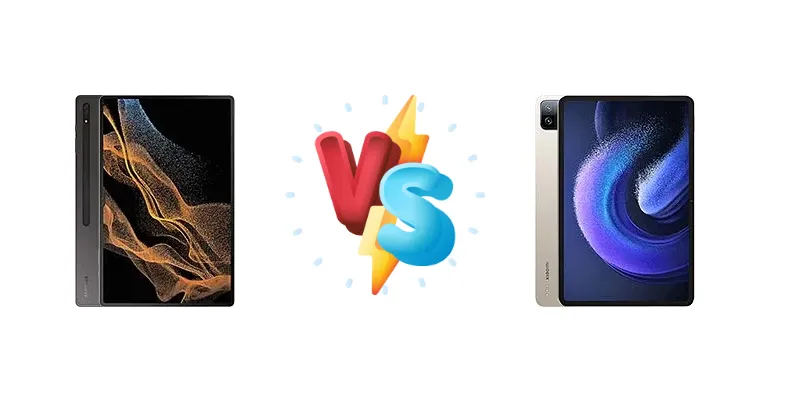
The Android tablet market is heating up! Two titans, the Samsung Galaxy Tab S8 Ultra and the Xiaomi Pad 6 Pro, are vying for your attention. Both offer premium features and impressive performance, but which one truly deserves your money? Let's dive into a comprehensive comparison.
🏆 Quick Verdict
The Xiaomi Pad 6 Pro offers a compelling package with faster charging and a slightly more powerful chipset at a more competitive price. However, the S8 Ultra’s superior display, S Pen integration, and broader software support make it a strong contender, especially for creative professionals.
| Network |
|---|
| 2G bands | GSM 850 / 900 / 1800 / 1900 | N/A |
| 3G bands | HSDPA 850 / 900 / 1700(AWS) / 1900 / 2100 | N/A |
| 4G bands | LTE | - |
| 5G bands | SA/NSA | - |
| EDGE | - | N/A |
| GPRS | - | N/A |
| Speed | HSPA, LTE, 5G - cellular model only | - |
| Technology | GSM / HSPA / LTE / 5G | No cellular connectivity |
| Launch |
|---|
| Announced | 2022, February 09 | 2023, April 18 |
| Status | Available. Released 2022, April 30 | Available. Released 2023, April 30 |
| Body |
|---|
| Build | - | Glass front (Gorilla Glass 3), aluminum frame, aluminum back |
| Dimensions | 326.4 x 208.6 x 5.5 mm (12.85 x 8.21 x 0.22 in) | 254 x 165.2 x 6.5 mm (10.0 x 6.50 x 0.26 in) |
| SIM | Nano-SIM (cellular model only) | No |
| Weight | 726 g (Wi-Fi), 728 g (5G) (1.60 lb) | 490 g (1.08 lb) |
| | Stylus, 2.8ms latency (Bluetooth integration, accelerometer, gyro) | Stylus support (magnetic) |
| Display |
|---|
| Protection | Corning Gorilla Glass 5 | Corning Gorilla Glass 3 |
| Resolution | 1848 x 2960 pixels, 16:10 ratio (~240 ppi density) | 1800 x 2880 pixels, 16:10 ratio (~309 ppi density) |
| Size | 14.6 inches, 612.6 cm2 (~90.0% screen-to-body ratio) | 11.0 inches, 350.9 cm2 (~83.6% screen-to-body ratio) |
| Type | Super AMOLED, 120Hz, HDR10+ | IPS LCD, 1B colors, 144Hz, HDR10, Dolby Vision, 550 nits |
| Platform |
|---|
| CPU | Octa-core (1x3.00 GHz Cortex-X2 & 3x2.50 GHz Cortex-A710 & 4x1.80 GHz Cortex-A510) | Octa-core (1x3.19 GHz Cortex-X2 & 3x2.75 GHz Cortex-A710 & 4x1.80 GHz Cortex-A510) |
| Chipset | Qualcomm SM8450 Snapdragon 8 Gen 1 (4 nm) | Qualcomm SM8475 Snapdragon 8+ Gen 1 (4 nm) |
| GPU | Adreno 730 | Adreno 730 |
| OS | Android 12, up to 4 major Android upgrades, One UI 6.1.1 | Android 13, MIUI 14 |
| Memory |
|---|
| Card slot | microSDXC (dedicated slot) | No |
| Internal | 128GB 8GB RAM, 256GB 8GB RAM, 256GB 12GB RAM, 256GB 16GB RAM, 512GB 12GB RAM, 512GB 16GB RAM | 128GB 8GB RAM, 256GB 8GB RAM, 256GB 12GB RAM, 512GB 12GB RAM |
| | UFS | UFS 3.1 |
| Main Camera |
|---|
| Dual | 13 MP, f/2.0, 26mm (wide), 1/3.4", 1.0µm, AF
6 MP, f/2.2, (ultrawide) | 50 MP, f/1.8, (wide), 1/2.76", 0.64µm, PDAF
Auxiliary lens |
| Features | LED flash, HDR, panorama | Dual-LED flash, HDR, panorama |
| Video | 4K@30/60fps, 1080p@30fps | 4K@30/60fps, 1080p@30/60fps |
| Selfie camera |
|---|
| Dual | 12 MP, f/2.2, 26mm (wide)
12 MP, f/2.4, 120˚ (ultrawide) | - |
| Features | HDR | - |
| Single | - | 20 MP, f/2.2, (wide), 1/3.4", 0.8µm |
| Video | 4K@30/60fps, 1080p@30fps | 1080p@30/60fps |
| Sound |
|---|
| 3.5mm jack | No | No |
| 35mm jack | No | No |
| Loudspeaker | Yes, with stereo speakers (4 speakers) | Yes, with stereo speakers (4 speakers) |
| | Tuned by AKG | 24-bit/192kHz audio |
| Comms |
|---|
| Bluetooth | 5.2, A2DP, LE | 5.3, A2DP, LE |
| NFC | No | No |
| Positioning | GPS, GLONASS, BDS, GALILEO - cellular model only | No |
| Radio | No | No |
| USB | USB Type-C 3.2, magnetic connector | USB Type-C 3.2, accessory connector |
| WLAN | Wi-Fi 802.11 a/b/g/n/ac/6e, dual-band, Wi-Fi Direct | Wi-Fi 802.11 a/b/g/n/a/6e, dual-band, Wi-Fi Direct |
| Features |
|---|
| Sensors | Fingerprint (under display, optical), accelerometer, gyro, proximity, compass | Accelerometer, gyro, proximity (accessories only) |
| | Wireless Samsung DeX | - |
| Battery |
|---|
| Charging | 45W wired, 100% in 82 min | 67W wired, PD3.0, QC4, 100% in 1 hour |
| Type | Li-Po 11200 mAh | Li-Po 8600 mAh |
| Misc |
|---|
| Colors | Graphite | Black, Blue, Gold |
| Models | SM-X900, SM-X906, SM-X906B, SM-X906U, SM-X906N | 23046RP50C |
| Price | About 1150 EUR | About 330 EUR |
| SAR EU | 0.69 W/kg (body) | - |
Samsung Galaxy Tab S8 Ultra
- Stunning AMOLED Display
- Integrated S Pen
- Versatile Camera System
- Mature Software Support
- Slower Charging
- Higher Price
- Can be bulky
Xiaomi Pad 6 Pro
- Faster Charging (67W)
- More Powerful Chipset (Snapdragon 8+ Gen 1)
- Excellent Value
- High Refresh Rate Display
- LCD Display (less vibrant)
- Less refined software
- No included stylus
Display Comparison
The Tab S8 Ultra boasts a massive 14.6-inch Super AMOLED display with a 120Hz refresh rate, delivering vibrant colors and exceptional clarity. The Pad 6 Pro features an 11-inch LCD display with a 144Hz refresh rate, offering smooth visuals but lacking the AMOLED's contrast and color accuracy. Samsung wins here.
Camera Comparison
The Tab S8 Ultra features a more versatile camera system with multiple lenses and higher resolution sensors. The Pad 6 Pro's cameras are competent but don't match the S8 Ultra's overall quality. Samsung wins in camera performance.
Performance
While both tablets utilize Snapdragon 8 Gen 1 series chips, the Pad 6 Pro's Snapdragon 8+ Gen 1 provides a noticeable performance boost, especially in demanding tasks like gaming. The S8 Ultra's chip is still powerful, but the 8+ Gen 1 edges it out. Xiaomi takes the lead.
Battery Life
The Pad 6 Pro shines with its 67W fast charging, significantly reducing charging times compared to the S8 Ultra's 45W charging. Both offer all-day battery life with moderate usage, but Xiaomi's charging speed is a major advantage. Xiaomi wins.
Buying Guide
The Samsung Galaxy Tab S8 Ultra is ideal for users who prioritize a stunning display, S Pen functionality for note-taking and drawing, and a more mature software experience. The Xiaomi Pad 6 Pro is a great choice for those seeking high performance, fast charging, and excellent value for money, particularly for gaming and media consumption.
Frequently Asked Questions
❓ Which tablet is better for gaming?
The Xiaomi Pad 6 Pro's Snapdragon 8+ Gen 1 and higher refresh rate display give it a slight edge for gaming performance.
❓ Is the S Pen worth the extra cost?
If you plan to take notes, sketch, or draw, the S Pen integration on the Tab S8 Ultra is a significant advantage.
❓ Which tablet has better software support?
Samsung generally offers longer software update support compared to Xiaomi.
❓ What is the difference between the displays?
The Tab S8 Ultra has an AMOLED display for richer colors and deeper blacks, while the Pad 6 Pro has an LCD display which is still very good but lacks the same vibrancy.