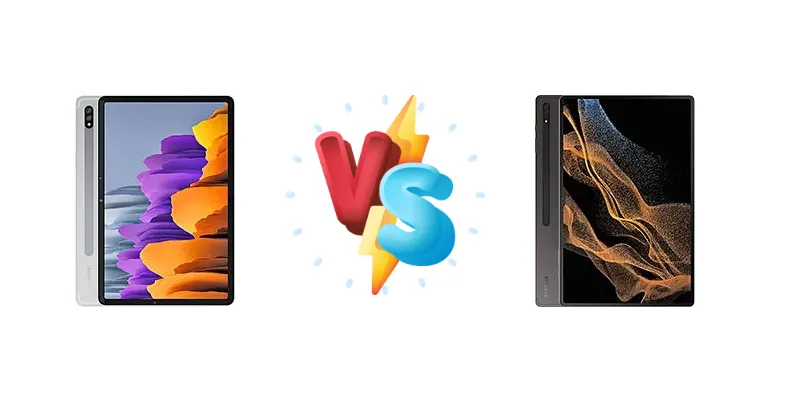
The Samsung Galaxy Tab S7 established itself as a premium Android tablet, but the arrival of the Galaxy Tab S8 Ultra raises the question: is the substantial price increase justified? We dissect the key differences between these two tablets, focusing on performance, display technology, and real-world usability to determine which one offers the best value for your needs.
🏆 Quick Verdict
For most users, the Galaxy Tab S8 Ultra is the superior choice. The Snapdragon 8 Gen 1 chipset delivers a noticeable performance boost over the S7’s Snapdragon 865, particularly in demanding tasks like video editing and gaming. While the S7 remains a capable device, the S8 Ultra’s advancements justify the higher price for power users.
| Network |
|---|
| 2G bands | GSM 850 / 900 / 1800 / 1900 | GSM 850 / 900 / 1800 / 1900 |
| 3G bands | HSDPA 850 / 900 / 1700(AWS) / 1900 / 2100 | HSDPA 850 / 900 / 1700(AWS) / 1900 / 2100 |
| 4G bands | 1, 2, 3, 4, 5, 7, 8, 12, 13, 20, 25, 26, 28, 38, 40, 41, 66 | LTE |
| 5G bands | 1, 3, 5, 7, 8, 20, 28, 40, 77, 78 SA/NSA | SA/NSA |
| Speed | HSPA 42.2/5.76 Mbps, LTE (6CA) Cat20 2000/150 Mbps, 5G - cellular model only | HSPA, LTE, 5G - cellular model only |
| Technology | GSM / HSPA / LTE / 5G | GSM / HSPA / LTE / 5G |
| Launch |
|---|
| Announced | 2020, August 05 | 2022, February 09 |
| Status | Available. Released 2020, August 21 | Available. Released 2022, April 30 |
| Body |
|---|
| Build | Glass front, aluminum back, aluminum frame | - |
| Dimensions | 253.8 x 165.3 x 6.3 mm (9.99 x 6.51 x 0.25 in) | 326.4 x 208.6 x 5.5 mm (12.85 x 8.21 x 0.22 in) |
| SIM | Nano-SIM (cellular model only) | Nano-SIM (cellular model only) |
| Weight | 498 g (Wi-Fi), 500 g (LTE), 502 g (5G) (1.10 lb) | 726 g (Wi-Fi), 728 g (5G) (1.60 lb) |
| | Stylus support, 9ms latency (Bluetooth integration, accelerometer, gyro) | Stylus, 2.8ms latency (Bluetooth integration, accelerometer, gyro) |
| Display |
|---|
| Protection | - | Corning Gorilla Glass 5 |
| Resolution | 1600 x 2560 pixels, 16:10 ratio (~274 ppi density) | 1848 x 2960 pixels, 16:10 ratio (~240 ppi density) |
| Size | 11.0 inches, 350.9 cm2 (~83.6% screen-to-body ratio) | 14.6 inches, 612.6 cm2 (~90.0% screen-to-body ratio) |
| Type | TFT LCD, 120Hz, HDR10+ | Super AMOLED, 120Hz, HDR10+ |
| Platform |
|---|
| CPU | Octa-core (1x3.09 GHz Cortex-A77 & 3x2.42 GHz Cortex-A77 & 4x1.80 GHz Cortex-A55 | Octa-core (1x3.00 GHz Cortex-X2 & 3x2.50 GHz Cortex-A710 & 4x1.80 GHz Cortex-A510) |
| Chipset | Qualcomm SM8250 Snapdragon 865 5G+ (7 nm+) | Qualcomm SM8450 Snapdragon 8 Gen 1 (4 nm) |
| GPU | Adreno 650 | Adreno 730 |
| OS | Android 10, upgradable to Android 13, One UI 5.1 | Android 12, up to 4 major Android upgrades, One UI 6.1.1 |
| Memory |
|---|
| Card slot | microSDXC (dedicated slot) | microSDXC (dedicated slot) |
| Internal | 128GB 6GB RAM, 256GB 8GB RAM, 512GB 8GB RAM | 128GB 8GB RAM, 256GB 8GB RAM, 256GB 12GB RAM, 256GB 16GB RAM, 512GB 12GB RAM, 512GB 16GB RAM |
| | UFS 3.0 | UFS |
| Main Camera |
|---|
| Dual | 13 MP, f/2.0, 26mm (wide), 1/3.4", 1.0µm, AF
5 MP, f/2.2, 12mm (ultrawide), 1.12µm | 13 MP, f/2.0, 26mm (wide), 1/3.4", 1.0µm, AF
6 MP, f/2.2, (ultrawide) |
| Features | HDR, panorama | LED flash, HDR, panorama |
| Video | 4K@30fps | 4K@30/60fps, 1080p@30fps |
| Selfie camera |
|---|
| Dual | - | 12 MP, f/2.2, 26mm (wide)
12 MP, f/2.4, 120˚ (ultrawide) |
| Features | - | HDR |
| Single | 8 MP, f/2.0, 26mm (wide), 1/4.0", 1.12µm | - |
| Video | 1080p@30fps | 4K@30/60fps, 1080p@30fps |
| Sound |
|---|
| 3.5mm jack | No | No |
| 35mm jack | No | No |
| Loudspeaker | Yes, with stereo speakers (4 speakers) | Yes, with stereo speakers (4 speakers) |
| | Tuned by AKG | Tuned by AKG |
| Comms |
|---|
| Bluetooth | 5.0, A2DP, LE | 5.2, A2DP, LE |
| NFC | No | No |
| Positioning | GPS, GLONASS, BDS, GALILEO - cellular model only | GPS, GLONASS, BDS, GALILEO - cellular model only |
| Radio | No | No |
| USB | USB Type-C 3.2, magnetic connector | USB Type-C 3.2, magnetic connector |
| WLAN | Wi-Fi 802.11 a/b/g/n/ac/6, dual-band, Wi-Fi Direct | Wi-Fi 802.11 a/b/g/n/ac/6e, dual-band, Wi-Fi Direct |
| Features |
|---|
| Sensors | Fingerprint (side-mounted), accelerometer, gyro, proximity, compass | Fingerprint (under display, optical), accelerometer, gyro, proximity, compass |
| | Samsung DeX | Wireless Samsung DeX |
| Battery |
|---|
| Charging | 45W wired | 45W wired, 100% in 82 min |
| Type | Li-Po 8000 mAh | Li-Po 11200 mAh |
| Misc |
|---|
| Colors | Mystic Black, Mystic Bronze, Mystic Silver, Phantom Navy | Graphite |
| Models | SM-T870, SM-T875, SM-T876B | SM-X900, SM-X906, SM-X906B, SM-X906U, SM-X906N |
| Price | About 700 EUR | About 1150 EUR |
| SAR | 1.26 W/kg (body) | - |
| SAR EU | 1.38 W/kg (body) | 0.69 W/kg (body) |
Samsung Galaxy Tab S7
- More affordable price point
- More portable and easier to handle
- Still a capable performer for everyday tasks
- Older Snapdragon 865 chipset
- LCD display lacks the vibrancy of AMOLED
- Smaller screen size
Samsung Galaxy Tab S8 Ultra
- Significantly faster Snapdragon 8 Gen 1 processor
- Large, vibrant 120Hz AMOLED display
- Faster charging time (82 minutes)
- Higher price tag
- Larger size and weight can be less convenient
- May require more frequent charging with heavy use
Display Comparison
While both tablets feature excellent displays, the S8 Ultra boasts a significantly larger 14.6-inch Super AMOLED panel compared to the S7’s 11-inch LTPS LCD. The S8 Ultra’s display benefits from a 120Hz refresh rate, offering smoother scrolling and animations. Although specific brightness nits aren't provided, the S8 Ultra’s AMOLED technology inherently delivers superior contrast and color accuracy. The S7’s LCD, while still vibrant, lacks the deep blacks and dynamic range of AMOLED. The S8 Ultra’s larger screen and higher refresh rate make it a more immersive experience for media consumption and creative work.
Camera Comparison
Neither tablet excels as a primary camera device, but the S8 Ultra likely offers a more refined experience. While specific camera specs are not provided, Samsung generally improves camera processing with each generation. The S7’s camera system is adequate for basic scanning and video calls. The S8 Ultra, benefiting from the newer chipset’s image signal processor (ISP), should deliver improved image quality and potentially better low-light performance. The focus here is on video conferencing and quick document capture, not professional photography.
Performance
The core difference lies in the chipsets. The Galaxy Tab S8 Ultra is powered by the Qualcomm SM8450 Snapdragon 8 Gen 1 (4nm), a significant leap over the S7’s SM8250 Snapdragon 865 5G+ (7nm+). The 4nm process node of the Gen 1 translates to improved power efficiency and reduced thermal throttling. The S8 Ultra’s CPU features a Cortex-X2 prime core clocked at 3.00 GHz, alongside three Cortex-A710 performance cores at 2.50 GHz, and four Cortex-A510 efficiency cores at 1.80 GHz. This contrasts with the S7’s Cortex-A77 cores. This architectural upgrade, combined with the smaller process node, results in a substantial performance increase in CPU-intensive tasks. Both devices utilize Octa-core CPUs, but the S8 Ultra’s newer architecture provides a clear advantage.
Battery Life
The S8 Ultra’s larger display and more powerful processor demand more energy. While both tablets support 45W wired charging, the S8 Ultra achieves a full charge in 82 minutes. The S7’s charging time is not specified, but is likely longer. The S8 Ultra’s improved power efficiency, thanks to the 4nm Snapdragon 8 Gen 1, helps mitigate the increased power draw. Real-world battery life will depend heavily on usage patterns, but the S8 Ultra’s more efficient chipset should provide comparable, if not slightly better, endurance despite the larger screen.
Buying Guide
Buy the Samsung Galaxy Tab S7 if you prioritize portability and a more reasonable price point for everyday tasks like browsing, streaming, and light productivity. It’s an excellent choice for students or casual users. Buy the Samsung Galaxy Tab S8 Ultra if you demand the absolute best performance, a larger and more immersive display, and are willing to pay a premium for a truly flagship Android tablet experience – ideal for creative professionals and power users.
Frequently Asked Questions
❓ Does the Snapdragon 8 Gen 1 in the S8 Ultra get noticeably hotter than the Snapdragon 865 in the S7 during extended gaming sessions?
While the Snapdragon 8 Gen 1 is more powerful, it's also known to generate more heat. However, the S8 Ultra’s larger chassis and improved thermal management system are designed to mitigate this. Users report less throttling in the S8 Ultra compared to other devices with the same chipset, but prolonged, demanding gaming will still result in some heat buildup. The S7, with its less powerful chip, will generally remain cooler.
❓ Is the S Pen experience significantly different between the S7 and S8 Ultra?
Both tablets support the S Pen, but the S8 Ultra benefits from lower latency due to the newer chipset and software optimizations. This results in a more natural and responsive writing experience. The S8 Ultra also features improved palm rejection, minimizing accidental input. While the S Pen functionality is excellent on both devices, the S8 Ultra offers a more refined and precise experience.
❓ Can the Galaxy Tab S8 Ultra effectively replace a laptop for basic productivity tasks?
For many users, the S8 Ultra can absolutely serve as a laptop replacement for tasks like email, document editing, web browsing, and video conferencing, especially when paired with the optional keyboard cover. The Snapdragon 8 Gen 1 provides ample power for multitasking, and the large display enhances productivity. However, for demanding tasks like video editing or software development, a traditional laptop may still be preferable.