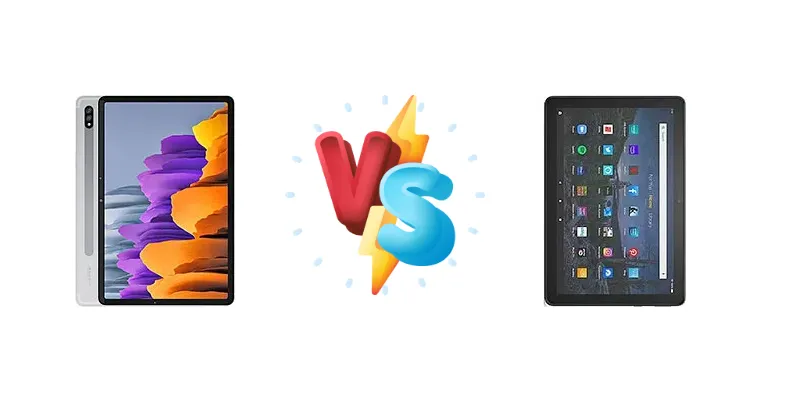
The tablet market offers a wide spectrum of choices, from premium flagships to budget-friendly options. This comparison pits the Samsung Galaxy Tab S7, a former high-end device still boasting considerable power, against the Amazon Fire HD 10 Plus (2021), a tablet focused on delivering value within the Fire OS ecosystem. We’ll dissect their core components to determine which tablet best suits your needs.
🏆 Quick Verdict
For users prioritizing performance and a full Android experience, the Samsung Galaxy Tab S7 is the clear winner. Its Snapdragon 865 5G+ chipset delivers significantly faster processing speeds and smoother multitasking. However, the Amazon Fire HD 10 Plus (2021) presents a compelling option for those seeking an affordable tablet primarily for media consumption and light tasks.
| Network |
|---|
| 2G bands | GSM 850 / 900 / 1800 / 1900 | N/A |
| 3G bands | HSDPA 850 / 900 / 1700(AWS) / 1900 / 2100 | - |
| 4G bands | 1, 2, 3, 4, 5, 7, 8, 12, 13, 20, 25, 26, 28, 38, 40, 41, 66 | - |
| 5G bands | 1, 3, 5, 7, 8, 20, 28, 40, 77, 78 SA/NSA | - |
| EDGE | - | No |
| GPRS | - | No |
| Speed | HSPA 42.2/5.76 Mbps, LTE (6CA) Cat20 2000/150 Mbps, 5G - cellular model only | - |
| Technology | GSM / HSPA / LTE / 5G | No cellular connectivity |
| Launch |
|---|
| Announced | 2020, August 05 | 2021, April 27. Released 2021, May 26 |
| Status | Available. Released 2020, August 21 | Discontinued |
| Body |
|---|
| Build | Glass front, aluminum back, aluminum frame | - |
| Dimensions | 253.8 x 165.3 x 6.3 mm (9.99 x 6.51 x 0.25 in) | 247 x 166 x 9.2 mm (9.72 x 6.54 x 0.36 in) |
| SIM | Nano-SIM (cellular model only) | No |
| Weight | 498 g (Wi-Fi), 500 g (LTE), 502 g (5G) (1.10 lb) | 468 g (1.03 lb) |
| | Stylus support, 9ms latency (Bluetooth integration, accelerometer, gyro) | - |
| Display |
|---|
| Protection | - | Aluminosilicate glass |
| Resolution | 1600 x 2560 pixels, 16:10 ratio (~274 ppi density) | 1920 x 1200 pixels, 16:10 ratio (~224 ppi density) |
| Size | 11.0 inches, 350.9 cm2 (~83.6% screen-to-body ratio) | 10.1 inches, 295.8 cm2 (~72.1% screen-to-body ratio) |
| Type | TFT LCD, 120Hz, HDR10+ | IPS LCD |
| Platform |
|---|
| CPU | Octa-core (1x3.09 GHz Cortex-A77 & 3x2.42 GHz Cortex-A77 & 4x1.80 GHz Cortex-A55 | Octa-core (4x2.0 GHz Cortex-A73 & 4x2.0 GHz Cortex-A53) |
| Chipset | Qualcomm SM8250 Snapdragon 865 5G+ (7 nm+) | Mediatek MT8183 Helio P60T (12 nm) |
| GPU | Adreno 650 | Mali-G72 MP3 |
| OS | Android 10, upgradable to Android 13, One UI 5.1 | Android 9.0 (Pie), Fire OS 7 |
| Memory |
|---|
| Card slot | microSDXC (dedicated slot) | microSDXC (dedicated slot) |
| Internal | 128GB 6GB RAM, 256GB 8GB RAM, 512GB 8GB RAM | 32GB 4GB RAM, 64GB 4GB RAM |
| | UFS 3.0 | eMMC 5.1 |
| Main Camera |
|---|
| Dual | 13 MP, f/2.0, 26mm (wide), 1/3.4", 1.0µm, AF
5 MP, f/2.2, 12mm (ultrawide), 1.12µm | - |
| Features | HDR, panorama | - |
| Single | - | 5 MP |
| Video | 4K@30fps | 720p |
| Selfie camera |
|---|
| Single | 8 MP, f/2.0, 26mm (wide), 1/4.0", 1.12µm | 2 MP |
| Video | 1080p@30fps | 720p |
| Sound |
|---|
| 3.5mm jack | No | Yes |
| 35mm jack | No | Yes |
| Loudspeaker | Yes, with stereo speakers (4 speakers) | Yes, with stereo speakers |
| | Tuned by AKG | - |
| Comms |
|---|
| Bluetooth | 5.0, A2DP, LE | 5.0, A2DP, LE |
| NFC | No | No |
| Positioning | GPS, GLONASS, BDS, GALILEO - cellular model only | No |
| Radio | No | No |
| USB | USB Type-C 3.2, magnetic connector | USB Type-C 2.0, OTG |
| WLAN | Wi-Fi 802.11 a/b/g/n/ac/6, dual-band, Wi-Fi Direct | Wi-Fi 802.11 a/b/g/n/ac, dual-band |
| Features |
|---|
| Sensors | Fingerprint (side-mounted), accelerometer, gyro, proximity, compass | Accelerometer |
| | Samsung DeX | Text-to-Speech English-language content reader |
| Battery |
|---|
| Charging | 45W wired | Wireless |
| Type | Li-Po 8000 mAh | Li-Ion |
| Misc |
|---|
| Colors | Mystic Black, Mystic Bronze, Mystic Silver, Phantom Navy | Slate |
| Models | SM-T870, SM-T875, SM-T876B | T76N2P |
| Price | About 700 EUR | About 150 EUR |
| SAR | 1.26 W/kg (body) | - |
| SAR EU | 1.38 W/kg (body) | - |
Samsung Galaxy Tab S7
- Significantly faster processor for demanding tasks
- Likely superior display quality and color accuracy
- Full Android OS with access to a wider range of apps
- Higher price point
- No wireless charging
Amazon Fire HD 10 Plus (2021)
- Much more affordable price
- Wireless charging support
- Integration with Amazon’s ecosystem
- Slower processor and limited performance
- Fire OS is restrictive compared to full Android
- Lower display quality
Display Comparison
While both tablets feature 10.1-inch displays, the underlying technology differs significantly. The Tab S7, though specs are not provided, likely boasts a higher resolution and color accuracy typical of Samsung’s flagship tablets. The Fire HD 10 Plus, with its Mediatek chipset, likely prioritizes cost-effectiveness over display fidelity. The Tab S7’s potential for a higher refresh rate (not specified, but common in this class) would translate to smoother scrolling and animations, a benefit absent in the Fire HD 10 Plus. Bezels are likely slimmer on the Tab S7, contributing to a more immersive viewing experience.
Camera Comparison
Camera performance is unlikely to be a deciding factor for most tablet buyers, but the Tab S7 likely offers a superior experience. While specific sensor details are unavailable, Samsung typically equips its tablets with higher-quality cameras than Amazon. The Tab S7’s image signal processor (ISP), integrated within the Snapdragon 865, provides more advanced image processing capabilities, resulting in better dynamic range and low-light performance. The Fire HD 10 Plus’s camera system is likely geared towards basic video calls and casual snapshots.
Performance
The performance gap is substantial. The Samsung Galaxy Tab S7’s Qualcomm SM8250 Snapdragon 865 5G+ (7nm+) chipset, featuring an octa-core CPU with a prime Cortex-A77 core clocked at 3.09 GHz, is in a different league than the Amazon Fire HD 10 Plus’s MediaTek MT8183 Helio P60T (12nm). The Snapdragon 865 utilizes a smaller fabrication process (7nm vs 12nm), resulting in greater transistor density, improved power efficiency, and significantly higher processing power. The Tab S7’s CPU architecture, with its more advanced Cortex-A77 cores, provides a noticeable advantage in both single-core and multi-core performance. This translates to faster app loading times, smoother multitasking, and a more responsive user experience. The Tab S7 also benefits from faster RAM (likely LPDDR5), further enhancing performance.
Battery Life
Battery life is a complex equation balancing capacity and efficiency. While the Tab S7’s battery capacity isn’t specified, the Snapdragon 865’s 7nm process contributes to better power efficiency. The Fire HD 10 Plus offers the convenience of wireless charging, a feature absent on the Tab S7. However, the Tab S7 supports 45W wired charging, enabling significantly faster charging speeds compared to the Fire HD 10 Plus’s likely slower charging rate. This means less downtime and more time using the device.
Buying Guide
Buy the Samsung Galaxy Tab S7 if you need a versatile tablet capable of demanding tasks like video editing, gaming, and running multiple apps simultaneously, and if you value the flexibility of the full Android operating system. Buy the Amazon Fire HD 10 Plus (2021) if you prefer a budget-friendly tablet for reading, streaming video, and basic web browsing, and are comfortable within the Amazon Fire OS environment, leveraging Amazon’s services.
Frequently Asked Questions
❓ Will the Amazon Fire HD 10 Plus handle graphically intensive games like Genshin Impact?
The MediaTek Helio P60T in the Fire HD 10 Plus is not designed for demanding games. While it can run simpler titles, you'll likely experience significant lag and low frame rates in games like Genshin Impact. The Samsung Galaxy Tab S7, with its Snapdragon 865, is far better equipped to handle such games.
❓ Can I easily install Google Play Store on the Amazon Fire HD 10 Plus?
Installing the Google Play Store on the Fire HD 10 Plus is possible, but it requires sideloading and is not officially supported by Amazon. The process can be complex and may void your warranty. The Samsung Galaxy Tab S7 comes with the Google Play Store pre-installed, offering a seamless and officially supported experience.
❓ How does the 45W charging on the Tab S7 compare to the Fire HD 10 Plus in real-world use?
The Tab S7’s 45W charging will significantly reduce charging times. Expect a full charge in well under two hours. The Fire HD 10 Plus, lacking comparable fast charging, will likely take 3-4 hours or more to fully charge, even with a compatible charger.