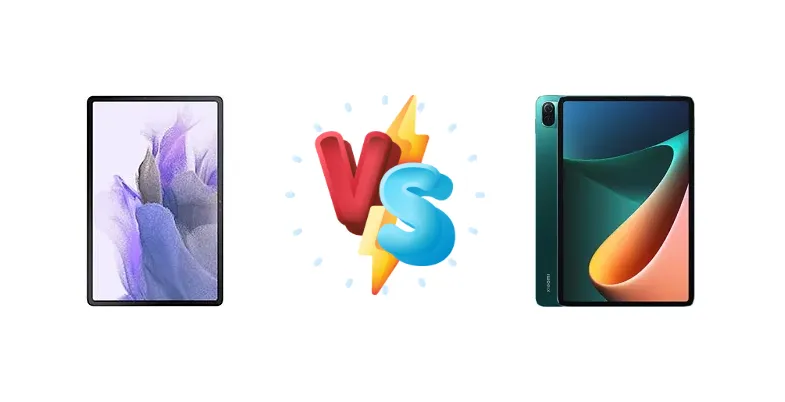
The tablet market has seen a resurgence, offering compelling alternatives to traditional laptops and smartphones. The Samsung Galaxy Tab S7 FE and Xiaomi Pad 5 represent two of the most popular choices in the mid-range segment, each aiming to deliver a premium experience without the flagship price tag. This comparison dissects their key differences, helping you determine which tablet best suits your needs.
🏆 Quick Verdict
For most users, the Xiaomi Pad 5 emerges as the stronger contender. Its Snapdragon 860 chipset delivers noticeably faster performance than both the 5G and Wi-Fi variants of the Tab S7 FE, making it better suited for gaming and demanding applications. While the Tab S7 FE boasts S Pen support, the Pad 5’s superior processing power provides a more fluid overall experience.
| Network |
|---|
| 2G bands | GSM 850 / 900 / 1800 / 1900 | N/A |
| 3G bands | HSDPA 850 / 900 / 1700(AWS) / 1900 / 2100 | N/A |
| 4G bands | 1, 2, 3, 4, 5, 7, 8, 12, 13, 17, 20, 25, 26, 28, 32, 38, 40, 41, 66 | - |
| 5G bands | 1, 3, 5, 7, 8, 20, 28, 38, 40, 41, 77, 78 SA/NSA/Sub6 | - |
| EDGE | - | N/A |
| GPRS | - | N/A |
| Speed | HSPA, LTE, 5G - cellular model only | - |
| Technology | GSM / HSPA / LTE / 5G | No cellular connectivity |
| Launch |
|---|
| Announced | 2021, May 25 | 2021, August 10 |
| Status | Available. Released 2021, June 18 | Available. Released 2021, August 10 |
| Body |
|---|
| Build | Glass front, aluminum back, aluminum frame | Glass front, aluminum frame, plastic back |
| Dimensions | 284.8 x 185 x 6.3 mm (11.21 x 7.28 x 0.25 in) | 254.7 x 166.3 x 6.9 mm (10.03 x 6.55 x 0.27 in) |
| SIM | Nano-SIM (cellular model only) | No |
| Weight | 608 g (1.34 lb) | 511 g (1.13 lb) |
| | Stylus support | Stylus support (magnetic) |
| Display |
|---|
| Resolution | 1600 x 2560 pixels, 16:10 ratio (~243 ppi density) | 1600 x 2560 pixels, 16:10 ratio (~274 ppi density) |
| Size | 12.4 inches, 445.8 cm2 (~84.6% screen-to-body ratio) | 11.0 inches, 350.9 cm2 (~82.8% screen-to-body ratio) |
| Type | TFT LCD | IPS LCD, 1B colors, 120Hz, HDR10, Dolby Vision |
| Platform |
|---|
| CPU | Octa-core (2x2.2 GHz Kryo 570 & 6x1.8 GHz Kryo 570) - 5G modelOcta-core (1x2.4 GHz Cortex-A78 & 3x2.2 GHz Cortex-A78 & 4x1.9 GHz Cortex-A55) - Wi-Fi model | Octa-core (1x2.96 GHz Kryo 485 Gold & 3x2.42 GHz Kryo 485 Gold & 4x1.78 GHz Kryo 485 Silver) |
| Chipset | Qualcomm SM7225 Snapdragon 750G 5G (8 nm) - 5G modelQualcomm SM7325 Snapdragon 778G 5G (6 nm) - Wi-Fi model | Qualcomm Snapdragon 860 (7 nm) |
| GPU | Adreno 619 - 5G modelAdreno 642L - Wi-Fi model | Adreno 640 |
| OS | Android 11, upgradable to Android 14, One UI 6 | Android 11, upgradable to Android 13, MIUI 14 |
| Memory |
|---|
| Card slot | microSDXC (dedicated slot) | No |
| Internal | 64GB 4GB RAM, 128GB 6GB RAM, 256GB 8GB RAM | 128GB 6GB RAM, 256GB 6GB RAM |
| | - | UFS 3.1 |
| Main Camera |
|---|
| Features | - | Dual-LED flash, HDR, panorama |
| Single | 8 MP, AF | 13 MP, f/2.0 |
| Video | 1080p@30fps | 4K@30fps, 1080p@30fps |
| Selfie camera |
|---|
| Single | 5 MP | 8 MP, f/2.0 |
| Video | 1080p@30fps | 1080p@30fps |
| Sound |
|---|
| 3.5mm jack | No | No |
| 35mm jack | No | No |
| Loudspeaker | Yes, with stereo speakers | Yes, with stereo speakers (4 speakers) |
| | Tuned by AKG | 24-bit/192kHz audio |
| Comms |
|---|
| Bluetooth | 5.2, A2DP, LE (Wi-Fi), 5.2, A2DP, LE (5G) | 5.0, A2DP, LE |
| NFC | No | No |
| Positioning | GPS, GLONASS, BDS, GALILEO - cellular model only | No |
| Radio | No | No |
| USB | USB Type-C 3.2, magnetic connector | USB Type-C |
| WLAN | Wi-Fi 802.11 a/b/g/n/ac/6 (Wi-Fi), Wi-Fi 802.11 a/b/g/n/ac (5G) | Wi-Fi 802.11 a/b/g/n/ac, dual-band, Wi-Fi Direct |
| Features |
|---|
| Sensors | Accelerometer, proximity, compass, gyro (5G model only) | Accelerometer, gyro, proximity, compass |
| | Samsung DeX | - |
| Battery |
|---|
| Charging | 45W wired, 100% in 190 min | 33W wired, PD3.0 |
| Type | Li-Po 10090 mAh | Li-Po 8720 mAh |
| Misc |
|---|
| Colors | Mystic Black, Mystic Silver, Mystic Green, Mystic Pink | Cosmic Gray, Pearl White, Green |
| Models | SM-T730, SM-T733, SM-T736B, SM-T735 | 21051182G, 21051182C |
| Price | About 650 EUR | About 350 EUR |
| SAR EU | 1.15 W/kg (body) | - |
| Tests |
|---|
| Display | Contrast ratio: 1886:1 (nominal) |
Contrast ratio: 1271:1 (nominal) |
| Loudspeaker | -27.2 LUFS (Good) |
-24.4 LUFS (Very good)
|
| Performance | AnTuTu: 292530 (v8), 355430 (v9)
GeekBench: 1904 (v5.1)
GFXBench: 9.7fps (ES 3.1 onscreen) |
AnTuTu: 473819 (v8), 555079 (v9)
GeekBench: 2583 (v5.1)
GFXBench: 24fps (ES 3.1 onscreen) |
Samsung Galaxy Tab S7 FE
- Included S Pen stylus for note-taking and drawing
- Larger 12.4-inch display for enhanced multitasking
- 5G connectivity option for on-the-go access (on select models)
- Less powerful processor compared to Xiaomi Pad 5
- Significantly slower charging speed (190 minutes to 100%)
- Lower contrast ratio than the Xiaomi Pad 5
Xiaomi Pad 5
- More powerful Snapdragon 860 processor for smoother performance
- Faster 33W charging with PD3.0 support
- More compact and portable design
- No included stylus support
- Smaller 11-inch display
- Lower peak brightness compared to Tab S7 FE
Display Comparison
Both tablets feature LCD panels, but differ in key metrics. The Samsung Tab S7 FE achieves a measured peak brightness of 522 nits and a 1886:1 contrast ratio, offering a slightly brighter and more contrast-rich image than the Xiaomi Pad 5’s 478 nits and 1271:1 contrast ratio. However, the difference is subtle in real-world use. Both lack OLED technology, meaning blacks won’t be truly deep. The Tab S7 FE’s larger 12.4-inch display versus the Pad 5’s 11-inch screen provides more screen real estate for multitasking and media consumption, but also impacts portability.
Camera Comparison
Neither tablet excels in the camera department, but both are adequate for video calls and casual snapshots. Detailed camera specs are not provided, so a direct comparison is limited. However, given Xiaomi’s focus on camera technology in its smartphones, it’s reasonable to assume the Pad 5’s camera system is slightly more refined than the Tab S7 FE’s. Both tablets likely feature similar sensor sizes and image processing capabilities, making this a minor differentiating factor.
Performance
This is where the Xiaomi Pad 5 pulls ahead significantly. The Snapdragon 860 (7nm) in the Pad 5 is a more powerful chipset than either the Snapdragon 750G (8nm) or 778G (6nm) found in the Tab S7 FE. The 860’s Kryo 485 Gold cores, clocked at up to 2.96 GHz, outperform the Tab S7 FE’s CPU configurations in both single-core and multi-core benchmarks. While the 6nm Snapdragon 778G in the Wi-Fi Tab S7 FE is more efficient than the 8nm 750G in the 5G model, neither can match the raw processing power of the 860. This translates to smoother gaming, faster app loading times, and a more responsive user interface on the Pad 5.
Battery Life
The Xiaomi Pad 5’s 33W wired charging with PD3.0 support is a clear advantage over the Tab S7 FE’s 45W charging, which takes a lengthy 190 minutes to reach 100%. While the Tab S7 FE may have a slightly larger battery capacity (specifics not provided), the Pad 5’s faster charging significantly reduces downtime. The Snapdragon 860’s 7nm process also contributes to better power efficiency, potentially offsetting any capacity difference.
Buying Guide
Buy the Samsung Galaxy Tab S7 FE if you prioritize stylus input for note-taking or creative work and value the integrated S Pen experience. Its larger screen size also benefits multitasking. Buy the Xiaomi Pad 5 if you prioritize raw performance for gaming, streaming, and general app responsiveness, and appreciate a more modern design and faster charging capabilities. The Pad 5 is the better choice for users who don't need a stylus.
Frequently Asked Questions
❓ Does the Snapdragon 860 in the Xiaomi Pad 5 get hot during extended gaming sessions?
While the Snapdragon 860 is a powerful chip, it's known for being relatively efficient. The Pad 5's thermal design is adequate for sustained gaming, but some throttling may occur during extremely demanding titles after prolonged use. It's generally well-managed and doesn't lead to significant performance drops.
❓ Is the S Pen on the Samsung Tab S7 FE worth the extra cost if I only occasionally take notes?
If you're a casual user who only occasionally needs a stylus, the S Pen's benefits may not justify the price premium. The Xiaomi Pad 5 can be paired with third-party styluses, though the experience won't be as seamless as with Samsung's native S Pen integration.
❓ Which tablet is better for watching videos and streaming content?
Both tablets are capable of delivering a good streaming experience. The Tab S7 FE’s larger screen provides a more immersive viewing experience, while the Pad 5’s brighter display and faster processor contribute to smoother playback and quicker app loading times. Ultimately, the choice depends on your preference for screen size versus performance.
❓ Can I expand the storage on either the Samsung Tab S7 FE or the Xiaomi Pad 5?
Storage expansion capabilities are not specified in the provided data. However, based on typical tablet configurations, it's likely that both tablets support microSD card expansion, allowing you to increase storage capacity as needed. Check the specific model specifications before purchasing.