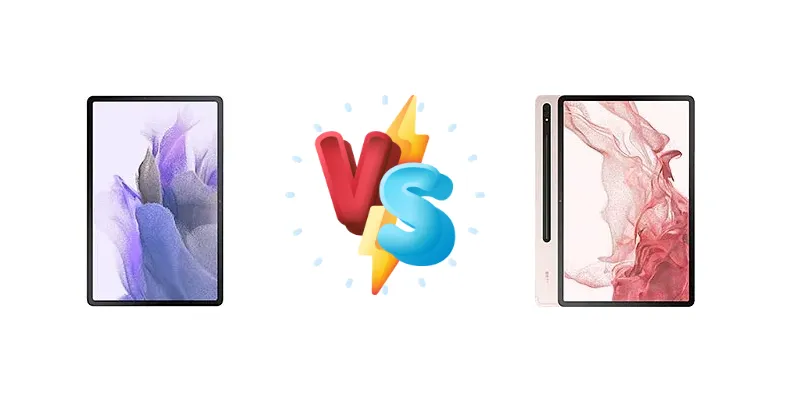
Samsung's Galaxy Tab lineup offers a compelling range of Android tablets, but choosing between the feature-rich Tab S8+ and the more affordable Tab S7 FE can be tricky. The S7 FE aims for value with its larger screen and optional 5G, while the S8+ targets a premium experience with flagship-level performance. This comparison dives deep into the specifications and real-world implications to determine which tablet best suits your needs.
🏆 Quick Verdict
For most users, the Samsung Galaxy Tab S8+ is the superior choice. Its Snapdragon 8 Gen 1 chipset delivers significantly faster performance and shorter charging times (82 minutes vs 190 minutes) than either Snapdragon 750G or 778G variant of the S7 FE. While the S7 FE offers a larger display at a lower price, the S8+'s overall experience is noticeably smoother and more responsive.
| Network |
|---|
| 2G bands | GSM 850 / 900 / 1800 / 1900 | GSM 850 / 900 / 1800 / 1900 |
| 3G bands | HSDPA 850 / 900 / 1700(AWS) / 1900 / 2100 | HSDPA 850 / 900 / 1700(AWS) / 1900 / 2100 |
| 4G bands | 1, 2, 3, 4, 5, 7, 8, 12, 13, 17, 20, 25, 26, 28, 32, 38, 40, 41, 66 | LTE |
| 5G bands | 1, 3, 5, 7, 8, 20, 28, 38, 40, 41, 77, 78 SA/NSA/Sub6 | SA/NSA |
| Speed | HSPA, LTE, 5G - cellular model only | HSPA, LTE, 5G - cellular model only |
| Technology | GSM / HSPA / LTE / 5G | GSM / HSPA / LTE / 5G |
| Launch |
|---|
| Announced | 2021, May 25 | 2022, February 09 |
| Status | Available. Released 2021, June 18 | Available. Released 2022, April 14 |
| Body |
|---|
| Build | Glass front, aluminum back, aluminum frame | - |
| Dimensions | 284.8 x 185 x 6.3 mm (11.21 x 7.28 x 0.25 in) | 285 x 185 x 5.7 mm (11.22 x 7.28 x 0.22 in) |
| SIM | Nano-SIM (cellular model only) | Nano-SIM (cellular model only) |
| Weight | 608 g (1.34 lb) | 567 g (Wi-Fi), 572 g (5G) (1.25 lb) |
| | Stylus support | Stylus, 6.2ms latency (Bluetooth integration, accelerometer, gyro) |
| Display |
|---|
| Protection | - | Corning Gorilla Glass 5 |
| Resolution | 1600 x 2560 pixels, 16:10 ratio (~243 ppi density) | 1752 x 2800 pixels, 16:10 ratio (~266 ppi density) |
| Size | 12.4 inches, 445.8 cm2 (~84.6% screen-to-body ratio) | 12.4 inches, 446.1 cm2 (~84.6% screen-to-body ratio) |
| Type | TFT LCD | Super AMOLED, 120Hz, HDR10+ |
| Platform |
|---|
| CPU | Octa-core (2x2.2 GHz Kryo 570 & 6x1.8 GHz Kryo 570) - 5G modelOcta-core (1x2.4 GHz Cortex-A78 & 3x2.2 GHz Cortex-A78 & 4x1.9 GHz Cortex-A55) - Wi-Fi model | Octa-core (1x3.00 GHz Cortex-X2 & 3x2.50 GHz Cortex-A710 & 4x1.80 GHz Cortex-A510) |
| Chipset | Qualcomm SM7225 Snapdragon 750G 5G (8 nm) - 5G modelQualcomm SM7325 Snapdragon 778G 5G (6 nm) - Wi-Fi model | Qualcomm SM8450 Snapdragon 8 Gen 1 (4 nm) |
| GPU | Adreno 619 - 5G modelAdreno 642L - Wi-Fi model | Adreno 730 |
| OS | Android 11, upgradable to Android 14, One UI 6 | Android 12, up to 4 major Android upgrades, One UI 6.1.1 |
| Memory |
|---|
| Card slot | microSDXC (dedicated slot) | microSDXC (dedicated slot) |
| Internal | 64GB 4GB RAM, 128GB 6GB RAM, 256GB 8GB RAM | 128GB 8GB RAM, 256GB 8GB RAM, 256GB 12GB RAM, 512GB 8GB RAM, 512GB 16GB RAM |
| | - | UFS |
| Main Camera |
|---|
| Dual | - | 13 MP, f/2.0, 26mm (wide), 1/3.4", 1.0µm, AF
6 MP, f/2.2, (ultrawide) |
| Features | - | LED flash, HDR, panorama |
| Single | 8 MP, AF | - |
| Video | 1080p@30fps | 4K@30/60fps, 1080p@30fps |
| Selfie camera |
|---|
| Dual | - | 12 MP, f/2.4, 120˚ (ultrawide) |
| Features | - | HDR |
| Single | 5 MP | - |
| Video | 1080p@30fps | 4K@30/60fps, 1080p@30fps |
| Sound |
|---|
| 3.5mm jack | No | No |
| 35mm jack | No | No |
| Loudspeaker | Yes, with stereo speakers | Yes, with stereo speakers (4 speakers) |
| | Tuned by AKG | Tuned by AKG |
| Comms |
|---|
| Bluetooth | 5.2, A2DP, LE (Wi-Fi), 5.2, A2DP, LE (5G) | 5.2, A2DP, LE |
| NFC | No | No |
| Positioning | GPS, GLONASS, BDS, GALILEO - cellular model only | GPS, GLONASS, BDS, GALILEO - cellular model only |
| Radio | No | No |
| USB | USB Type-C 3.2, magnetic connector | USB Type-C 3.2, magnetic connector |
| WLAN | Wi-Fi 802.11 a/b/g/n/ac/6 (Wi-Fi), Wi-Fi 802.11 a/b/g/n/ac (5G) | Wi-Fi 802.11 a/b/g/n/ac/6e, dual-band, Wi-Fi Direct |
| Features |
|---|
| Sensors | Accelerometer, proximity, compass, gyro (5G model only) | Fingerprint (under display, optical), accelerometer, gyro, proximity, compass |
| | Samsung DeX | Wireless Samsung DeX |
| Battery |
|---|
| Charging | 45W wired, 100% in 190 min | 45W wired, 100% in 82 min |
| Type | Li-Po 10090 mAh | Li-Po 10090 mAh |
| Misc |
|---|
| Colors | Mystic Black, Mystic Silver, Mystic Green, Mystic Pink | Graphite, Silver, Pink Gold |
| Models | SM-T730, SM-T733, SM-T736B, SM-T735 | SM-X800, SM-X806, SM-X806B, SM-X806U, SM-X806N |
| Price | About 650 EUR | About 950 EUR |
| SAR EU | 1.15 W/kg (body) | 0.68 W/kg (body) |
| Tests |
|---|
| Display | Contrast ratio: 1886:1 (nominal) | - |
| Loudspeaker | -27.2 LUFS (Good) | - |
| Performance | AnTuTu: 292530 (v8), 355430 (v9)
GeekBench: 1904 (v5.1)
GFXBench: 9.7fps (ES 3.1 onscreen) | - |
Samsung Galaxy Tab S7 FE
- More affordable price point
- Larger display size for immersive viewing
- Optional 5G connectivity for on-the-go access
- Significantly slower processor
- Longer charging time (190 minutes)
- Lower display brightness and potentially color accuracy
Samsung Galaxy Tab S8+
- Flagship-level performance with Snapdragon 8 Gen 1
- Faster 45W charging (82 minutes)
- Likely superior display quality with LTPO technology
- Higher price tag
- Potentially smaller display size
- No 5G connectivity option
Display Comparison
Both tablets offer large displays, but differ in quality and technology. The Tab S7 FE boasts a large screen, but its measured 522 nits of peak brightness is noticeably lower than what we'd expect from a flagship. The 1886:1 contrast ratio is respectable, but the S8+ likely benefits from a more advanced panel. While the S8+’s display specs aren’t provided, Samsung’s flagship tablets typically feature LTPO technology for adaptive refresh rates, improving battery efficiency and smoothness. The S7 FE lacks this feature. The larger screen size of the S7 FE is a benefit for some, but the S8+ likely offers superior color accuracy and viewing angles.
Camera Comparison
Camera performance isn't a primary focus for tablets, but the S8+ likely holds an advantage due to its more powerful image signal processor (ISP) within the Snapdragon 8 Gen 1. While specific camera specs aren't provided for either device, the S8+'s flagship chipset will enable better noise reduction, dynamic range, and overall image quality. The S7 FE’s camera system is likely adequate for basic tasks like video calls and casual snapshots, but won't compete with dedicated cameras or even high-end smartphone cameras.
Performance
The performance gap between these tablets is substantial. The Tab S7 FE utilizes either the Snapdragon 750G (5G model) or the Snapdragon 778G (Wi-Fi model). The 778G, built on a 6nm process, is a step up from the 8nm 750G, featuring an octa-core CPU with a Cortex-A78 prime core. However, both are dwarfed by the Tab S8+'s Snapdragon 8 Gen 1 (4nm). The 8 Gen 1’s CPU configuration – a Cortex-X2 prime core alongside Cortex-A710 performance cores – delivers significantly higher single-core and multi-core performance. This translates to faster app loading, smoother multitasking, and a more responsive user experience. The 4nm fabrication process also contributes to better thermal efficiency, reducing the likelihood of performance throttling under sustained load.
Battery Life
Battery life will depend heavily on usage patterns, but the S8+'s faster 45W charging (100% in 82 minutes) is a clear advantage over the S7 FE’s 45W charging (100% in 190 minutes). While the S7 FE may have a slightly larger battery capacity (specs not provided), the S8+'s more efficient chipset and optimized software could result in comparable or even better real-world battery life. The faster charging speed significantly reduces downtime, making the S8+ more convenient for users who rely on their tablet throughout the day.
Buying Guide
Buy the Samsung Galaxy Tab S7 FE if you prioritize a larger screen for media consumption and note-taking, and need the flexibility of 5G connectivity without breaking the bank. It's ideal for students or casual users who don't demand the highest performance. Buy the Samsung Galaxy Tab S8+ if you're a power user who values speed, responsiveness, and a premium tablet experience. It's the better choice for demanding tasks like video editing, gaming, and multitasking, and its faster charging is a significant convenience.
Frequently Asked Questions
❓ Does the Snapdragon 778G in the Wi-Fi S7 FE model offer enough performance for demanding apps like Adobe Lightroom?
While the Snapdragon 778G is a capable mid-range chip, it will likely struggle with resource-intensive tasks like editing large RAW photos in Adobe Lightroom. Expect slower processing times and potential lag compared to the Tab S8+'s Snapdragon 8 Gen 1. The S8+ is the better choice for professional creative workflows.
❓ Is the 190-minute charging time of the Tab S7 FE a significant inconvenience in daily use?
Yes, the 190-minute charge time is considerably slower than the S8+'s 82-minute charge. If you frequently find yourself needing to quickly top up your tablet, the S8+ offers a much more convenient charging experience. This is a key advantage for users who rely on their tablet throughout the day.
❓ How does the 5G connectivity on the S7 FE impact real-world battery life?
Using 5G connectivity will noticeably reduce battery life on the S7 FE compared to Wi-Fi usage. 5G requires more power to maintain a connection, especially in areas with weak signal strength. If you don't frequently need 5G, disabling it can help extend battery life.