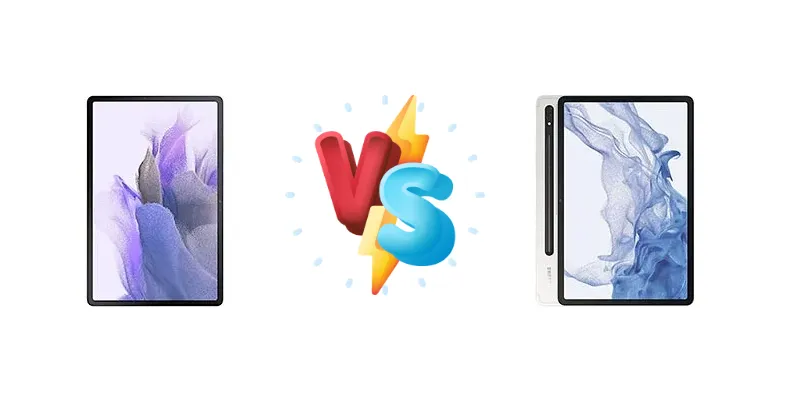
Samsung's Galaxy Tab lineup offers a compelling range of Android tablets, but choosing between the Tab S7 FE and the Tab S8 can be tricky. The S7 FE aims for affordability and all-day battery life, while the S8 prioritizes raw performance and a more premium experience. This comparison dives deep into the specifications and real-world implications to determine which tablet best suits your needs.
🏆 Quick Verdict
For most users, the Samsung Galaxy Tab S8 is the superior choice. Its Snapdragon 8 Gen 1 chipset delivers significantly faster performance, and its 80-minute charging time is a substantial improvement over the S7 FE's 190 minutes. While the S7 FE offers good value, the S8's performance uplift justifies the price premium for power users.
| Network |
|---|
| 2G bands | GSM 850 / 900 / 1800 / 1900 | GSM 850 / 900 / 1800 / 1900 |
| 3G bands | HSDPA 850 / 900 / 1700(AWS) / 1900 / 2100 | HSDPA 850 / 900 / 1700(AWS) / 1900 / 2100 |
| 4G bands | 1, 2, 3, 4, 5, 7, 8, 12, 13, 17, 20, 25, 26, 28, 32, 38, 40, 41, 66 | LTE |
| 5G bands | 1, 3, 5, 7, 8, 20, 28, 38, 40, 41, 77, 78 SA/NSA/Sub6 | SA/NSA |
| Speed | HSPA, LTE, 5G - cellular model only | HSPA, LTE, 5G - cellular model only |
| Technology | GSM / HSPA / LTE / 5G | GSM / HSPA / LTE / 5G |
| Launch |
|---|
| Announced | 2021, May 25 | 2022, February 09 |
| Status | Available. Released 2021, June 18 | Available. Released 2022, March 22 |
| Body |
|---|
| Build | Glass front, aluminum back, aluminum frame | - |
| Dimensions | 284.8 x 185 x 6.3 mm (11.21 x 7.28 x 0.25 in) | 253.8 x 165.3 x 6.3 mm (9.99 x 6.51 x 0.25 in) |
| SIM | Nano-SIM (cellular model only) | Nano-SIM (cellular model only) |
| Weight | 608 g (1.34 lb) | 503 g (Wi-Fi), 507 g (5G) (1.11 lb) |
| | Stylus support | Stylus, 6.2ms latency (Bluetooth integration, accelerometer, gyro) |
| Display |
|---|
| Protection | - | Corning Gorilla Glass 5 |
| Resolution | 1600 x 2560 pixels, 16:10 ratio (~243 ppi density) | 1600 x 2560 pixels, 16:10 ratio (~274 ppi density) |
| Size | 12.4 inches, 445.8 cm2 (~84.6% screen-to-body ratio) | 11.0 inches, 350.9 cm2 (~83.6% screen-to-body ratio) |
| Type | TFT LCD | TFT LCD, 120Hz |
| Platform |
|---|
| CPU | Octa-core (2x2.2 GHz Kryo 570 & 6x1.8 GHz Kryo 570) - 5G modelOcta-core (1x2.4 GHz Cortex-A78 & 3x2.2 GHz Cortex-A78 & 4x1.9 GHz Cortex-A55) - Wi-Fi model | Octa-core (1x3.00 GHz Cortex-X2 & 3x2.50 GHz Cortex-A710 & 4x1.80 GHz Cortex-A510) |
| Chipset | Qualcomm SM7225 Snapdragon 750G 5G (8 nm) - 5G modelQualcomm SM7325 Snapdragon 778G 5G (6 nm) - Wi-Fi model | Qualcomm SM8450 Snapdragon 8 Gen 1 (4 nm) |
| GPU | Adreno 619 - 5G modelAdreno 642L - Wi-Fi model | Adreno 730 |
| OS | Android 11, upgradable to Android 14, One UI 6 | Android 12, up to 4 major Android upgrades, One UI 6.1.1 |
| Memory |
|---|
| Card slot | microSDXC (dedicated slot) | microSDXC (dedicated slot) |
| Internal | 64GB 4GB RAM, 128GB 6GB RAM, 256GB 8GB RAM | 128GB 8GB RAM, 256GB 8GB RAM, 256GB 12GB RAM |
| | - | UFS |
| Main Camera |
|---|
| Dual | - | 13 MP, f/2.0, 26mm (wide), 1/3.4", 1.0µm, AF
6 MP, f/2.2, (ultrawide) |
| Features | - | LED flash, HDR, panorama |
| Single | 8 MP, AF | - |
| Video | 1080p@30fps | 4K@30/60fps, 1080p@30fps |
| Selfie camera |
|---|
| Dual | - | 12 MP, f/2.4, 120˚ (ultrawide) |
| Features | - | HDR |
| Single | 5 MP | - |
| Video | 1080p@30fps | 4K@30/60fps, 1080p@30fps |
| Sound |
|---|
| 3.5mm jack | No | No |
| 35mm jack | No | No |
| Loudspeaker | Yes, with stereo speakers | Yes, with stereo speakers (4 speakers) |
| | Tuned by AKG | Tuned by AKG |
| Comms |
|---|
| Bluetooth | 5.2, A2DP, LE (Wi-Fi), 5.2, A2DP, LE (5G) | 5.2, A2DP, LE |
| NFC | No | No |
| Positioning | GPS, GLONASS, BDS, GALILEO - cellular model only | GPS, GLONASS, BDS, GALILEO - cellular model only |
| Radio | No | No |
| USB | USB Type-C 3.2, magnetic connector | USB Type-C 3.2, magnetic connector |
| WLAN | Wi-Fi 802.11 a/b/g/n/ac/6 (Wi-Fi), Wi-Fi 802.11 a/b/g/n/ac (5G) | Wi-Fi 802.11 a/b/g/n/ac/6e, dual-band, Wi-Fi Direct |
| Features |
|---|
| Sensors | Accelerometer, proximity, compass, gyro (5G model only) | Fingerprint (side-mounted), accelerometer, gyro, proximity, compass |
| | Samsung DeX | Wireless Samsung DeX |
| Battery |
|---|
| Charging | 45W wired, 100% in 190 min | 45W wired, 100% in 80 min |
| Type | Li-Po 10090 mAh | Li-Po 8000 mAh |
| Misc |
|---|
| Colors | Mystic Black, Mystic Silver, Mystic Green, Mystic Pink | Graphite, Silver, Pink Gold |
| Models | SM-T730, SM-T733, SM-T736B, SM-T735 | SM-X700, SM-X706, SM-X706B, SM-X706U, SM-X706N |
| Price | About 650 EUR | About 350 EUR |
| SAR EU | 1.15 W/kg (body) | 0.87 W/kg (body) |
| Tests |
|---|
| Display | Contrast ratio: 1886:1 (nominal) | - |
| Loudspeaker | -27.2 LUFS (Good) | - |
| Performance | AnTuTu: 292530 (v8), 355430 (v9)
GeekBench: 1904 (v5.1)
GFXBench: 9.7fps (ES 3.1 onscreen) | - |
Samsung Galaxy Tab S7 FE
- More affordable price point
- Longer battery life (potentially)
- 5G connectivity option available
- Significantly slower performance
- Much slower charging time
- Less premium build quality
Samsung Galaxy Tab S8
- Exceptional performance with Snapdragon 8 Gen 1
- Faster 45W charging (80 minutes)
- Likely superior display quality
- Higher price tag
- Potentially shorter battery life (offset by faster charging)
- No 5G connectivity
Display Comparison
Both tablets offer large displays, but differ in their underlying technology. The Tab S7 FE boasts a measured peak brightness of 522 nits and a 1886:1 contrast ratio, providing a vibrant viewing experience. However, the Tab S8, while lacking published specs, benefits from Samsung’s superior display engineering, likely offering improved color accuracy and potentially higher peak brightness. The S7 FE’s LCD panel, while good, won’t match the contrast and viewing angles of a potential AMOLED panel on the S8 (though this is unconfirmed).
Camera Comparison
Neither tablet excels in the camera department, but the Tab S8 likely holds a slight edge due to its more powerful image signal processor (ISP) integrated within the Snapdragon 8 Gen 1. While specific camera specs are not provided for either device, the S8’s flagship chipset will enable better noise reduction and dynamic range. Focusing on the core processing power, the S8 will likely provide a better overall camera experience.
Performance
The performance gap is the most significant differentiator. The Tab S7 FE comes in two variants: a 5G model with the Snapdragon 750G and a Wi-Fi model with the Snapdragon 778G. The Wi-Fi model’s octa-core CPU (1x2.4 GHz Cortex-A78 & 3x2.2 GHz Cortex-A78 & 4x1.9 GHz Cortex-A55) is a capable mid-range performer, but it’s dwarfed by the Tab S8’s Snapdragon 8 Gen 1 (4nm). The 8 Gen 1’s octa-core CPU (1x3.00 GHz Cortex-X2 & 3x2.50 GHz Cortex-A710 & 4x1.80 GHz Cortex-A510) and 4nm process node deliver substantially faster processing speeds and improved power efficiency, resulting in smoother multitasking and more responsive gaming. The S8’s LPDDR5x RAM further enhances performance.
Battery Life
The Tab S7 FE prioritizes battery life, but the Tab S8 mitigates any potential disadvantage with significantly faster charging. Both support 45W wired charging, but the S7 FE takes 190 minutes to reach 100%, while the S8 achieves full charge in just 80 minutes. This faster charging speed is a major convenience factor, especially for users who need to quickly top up their tablet before heading out.
Buying Guide
Buy the Samsung Galaxy Tab S7 FE if you prioritize long battery life, a lower price point, and primarily use your tablet for media consumption, note-taking, and light productivity tasks. Buy the Samsung Galaxy Tab S8 if you demand the fastest possible performance for gaming, demanding creative applications, or heavy multitasking, and value faster charging speeds and a more responsive experience.
Frequently Asked Questions
❓ Does the Snapdragon 778G in the Wi-Fi S7 FE model offer enough performance for demanding games like Genshin Impact?
While the Snapdragon 778G is a capable chip, Genshin Impact and similar graphically intensive games will likely require significant graphics settings reductions for smooth gameplay on the Tab S7 FE. The Tab S8’s Snapdragon 8 Gen 1 provides a much more comfortable gaming experience at higher settings.
❓ Is the 190-minute charging time of the Tab S7 FE a dealbreaker for users who need quick top-ups?
For users who frequently need to charge their tablet on the go, the Tab S7 FE’s 190-minute charging time is a significant drawback. The Tab S8’s 80-minute charging time offers a much more convenient experience, allowing you to quickly regain a substantial amount of battery life.
❓ Which tablet is better suited for taking handwritten notes with the S Pen?
Both tablets support the S Pen, and the experience will be similar. However, the Tab S8’s faster processor may result in slightly lower latency when writing, making the experience feel more natural. The display quality on the S8 may also enhance the visual clarity of your notes.