
Samsung Galaxy Tab S7 FE vs S6: Which Samsung Tablet Reigns Supreme?
| Phones Images | |||||
|---|---|---|---|---|---|
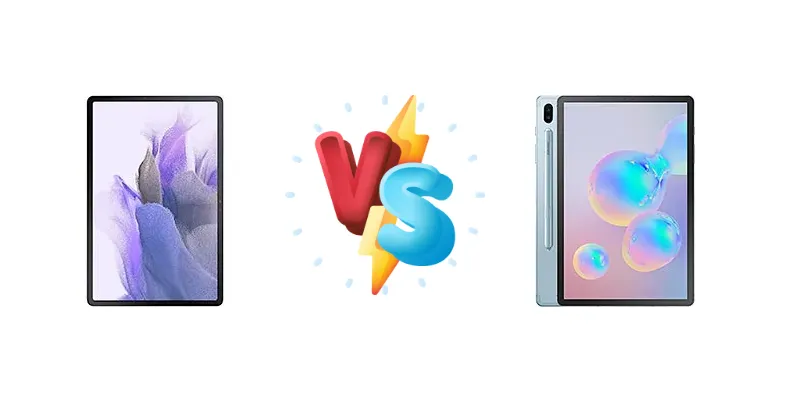
|
🏆 Quick Verdict
For most users, the Samsung Galaxy Tab S7 FE is the better buy. Its newer Snapdragon 778G (Wi-Fi model) or 750G (5G model) chipset offers comparable everyday performance to the Tab S6’s Snapdragon 855, coupled with a larger display and significantly faster charging, all at a typically lower price point.
| PHONES | ||
|---|---|---|
| Phone Names | Samsung Galaxy Tab S7 FE | Samsung Galaxy Tab S6 |
| Network | ||
|---|---|---|
| 2G bands | GSM 850 / 900 / 1800 / 1900 | GSM 850 / 900 / 1800 / 1900 |
| 3G bands | HSDPA 850 / 900 / 1700(AWS) / 1900 / 2100 | HSDPA 850 / 900 / 1700(AWS) / 1900 / 2100 |
| 4G bands | 1, 2, 3, 4, 5, 7, 8, 12, 13, 17, 20, 25, 26, 28, 32, 38, 40, 41, 66 | 1, 2, 3, 4, 5, 7, 8, 12, 13, 17, 20, 25, 26, 28, 32, 38, 40, 41, 66 |
| 5G bands | 1, 3, 5, 7, 8, 20, 28, 38, 40, 41, 77, 78 SA/NSA/Sub6 | - |
| Speed | HSPA, LTE, 5G - cellular model only | HSPA 42.2/5.76 Mbps, LTE (6CA) Cat20 2000/150 Mbps - cellular model only |
| Technology | GSM / HSPA / LTE / 5G | GSM / HSPA / LTE |
| Launch | ||
|---|---|---|
| Announced | 2021, May 25 | 2019, July 31. Released 2019, August |
| Status | Available. Released 2021, June 18 | Discontinued |
| Body | ||
|---|---|---|
| Build | Glass front, aluminum back, aluminum frame | Glass front, aluminum back, aluminum frame |
| Dimensions | 284.8 x 185 x 6.3 mm (11.21 x 7.28 x 0.25 in) | 244.5 x 159.5 x 5.7 mm (9.63 x 6.28 x 0.22 in) |
| SIM | Nano-SIM (cellular model only) | Nano-SIM (cellular model only) |
| Weight | 608 g (1.34 lb) | 420 g (14.82 oz) |
| Stylus support | Stylus support (Bluetooth integration; magnetic) | |
| Display | ||
|---|---|---|
| Resolution | 1600 x 2560 pixels, 16:10 ratio (~243 ppi density) | 1600 x 2560 pixels, 16:10 ratio (~287 ppi density) |
| Size | 12.4 inches, 445.8 cm2 (~84.6% screen-to-body ratio) | 10.5 inches, 321.9 cm2 (~82.5% screen-to-body ratio) |
| Type | TFT LCD | Super AMOLED |
| Platform | ||
|---|---|---|
| CPU | Octa-core (2x2.2 GHz Kryo 570 & 6x1.8 GHz Kryo 570) - 5G modelOcta-core (1x2.4 GHz Cortex-A78 & 3x2.2 GHz Cortex-A78 & 4x1.9 GHz Cortex-A55) - Wi-Fi model | Octa-core (1x2.84 GHz Kryo 485 & 3x2.42 GHz Kryo 485 & 4x1.78 GHz Kryo 485) |
| Chipset | Qualcomm SM7225 Snapdragon 750G 5G (8 nm) - 5G modelQualcomm SM7325 Snapdragon 778G 5G (6 nm) - Wi-Fi model | Qualcomm SM8150 Snapdragon 855 (7 nm) |
| GPU | Adreno 619 - 5G modelAdreno 642L - Wi-Fi model | Adreno 640 |
| OS | Android 11, upgradable to Android 14, One UI 6 | Android 9.0 (Pie), upgradable to Android 12, One UI 4.0 |
| Memory | ||
|---|---|---|
| Card slot | microSDXC (dedicated slot) | microSDXC (dedicated slot) |
| Internal | 64GB 4GB RAM, 128GB 6GB RAM, 256GB 8GB RAM | 64GB 4GB RAM, 128GB 6GB RAM, 256GB 8GB RAM |
| - | UFS 3.0 | |
| Main Camera | ||
|---|---|---|
| Dual | - | 13 MP, f/2.0, 26mm (wide), 1/3.4", 1.0µm, AF 5 MP, f/2.2, 12mm (ultrawide), 1.12µm |
| Features | - | HDR, panorama |
| Single | 8 MP, AF | - |
| Video | 1080p@30fps | 4K@30fps |
| Selfie camera | ||
|---|---|---|
| Single | 5 MP | 8 MP, f/2.0, 26mm (wide), 1/4.0", 1.12µm |
| Video | 1080p@30fps | 1080p@30fps |
| Sound | ||
|---|---|---|
| 3.5mm jack | No | No |
| 35mm jack | No | No |
| Loudspeaker | Yes, with stereo speakers | Yes, with stereo speakers (4 speakers) |
| Tuned by AKG | Tuned by AKG | |
| Comms | ||
|---|---|---|
| Bluetooth | 5.2, A2DP, LE (Wi-Fi), 5.2, A2DP, LE (5G) | 5.0, A2DP, LE |
| NFC | No | No |
| Positioning | GPS, GLONASS, BDS, GALILEO - cellular model only | GPS, GLONASS, BDS, GALILEO - cellular model only |
| Radio | No | No |
| USB | USB Type-C 3.2, magnetic connector | USB Type-C 3.1, magnetic connector |
| WLAN | Wi-Fi 802.11 a/b/g/n/ac/6 (Wi-Fi), Wi-Fi 802.11 a/b/g/n/ac (5G) | Wi-Fi 802.11 a/b/g/n/ac, dual-band, Wi-Fi Direct |
| Features | ||
|---|---|---|
| Sensors | Accelerometer, proximity, compass, gyro (5G model only) | Fingerprint (under display, optical), accelerometer, gyro, proximity, compass |
| Samsung DeX | Samsung DeX ANT+ | |
| Battery | ||
|---|---|---|
| Charging | 45W wired, 100% in 190 min | 15W wired |
| Type | Li-Po 10090 mAh | Li-Po 7040 mAh, non-removable |
| Misc | ||
|---|---|---|
| Colors | Mystic Black, Mystic Silver, Mystic Green, Mystic Pink | Mountain Gray, Cloud Blue, Rose Blush |
| Models | SM-T730, SM-T733, SM-T736B, SM-T735 | SM-T860, SM-T865 |
| Price | About 650 EUR | About 600 EUR |
| SAR | - | 0.70 W/kg (body) |
| SAR EU | 1.15 W/kg (body) | 1.22 W/kg (body) |
| Tests | ||
|---|---|---|
| Display | Contrast ratio: 1886:1 (nominal) | - |
| Loudspeaker | -27.2 LUFS (Good) | - |
| Performance | AnTuTu: 292530 (v8), 355430 (v9) GeekBench: 1904 (v5.1) GFXBench: 9.7fps (ES 3.1 onscreen) | - |
Samsung Galaxy Tab S7 FE
- Larger 10.9-inch display for enhanced multitasking
- Faster 45W charging for quicker power-ups
- Available 5G connectivity for on-the-go access
- Snapdragon 750G (5G model) is less powerful than the 778G or 855
- LCD panel lacks the vibrancy of OLED displays
Samsung Galaxy Tab S6
- Slightly higher peak CPU performance with Snapdragon 855
- More compact and portable design
- Generally lower price point (depending on availability)
- Significantly slower 15W charging
- Smaller 10.5-inch display
- No 5G connectivity
Display Comparison
Both tablets feature LCD panels, but the Tab S7 FE boasts a larger 10.9-inch display compared to the Tab S6’s 10.5-inch screen. The Tab S7 FE achieves a measured peak brightness of 522 nits and a 1886:1 contrast ratio, providing a vibrant viewing experience. While the Tab S6’s display quality is still excellent, the larger size and higher contrast of the S7 FE make it more suitable for media consumption and split-screen multitasking. Neither display utilizes LTPO technology, meaning refresh rate scaling isn't present.
Camera Comparison
Neither tablet excels in the camera department, and this comparison isn't a major deciding factor. Both feature relatively basic camera setups. Focusing on the main sensors, the Tab S6 and S7 FE both offer acceptable image quality for casual snapshots. The S7 FE doesn't offer any significant camera improvements over the S6, so users shouldn't expect a dramatic difference in photo or video quality.
Performance
The core difference lies in the chipsets. The Tab S6 utilizes the Qualcomm Snapdragon 855 (7nm), while the Tab S7 FE comes in two variants: a 5G model with the Snapdragon 750G (8nm) and a Wi-Fi model with the Snapdragon 778G (6nm). The Snapdragon 778G, found in the Wi-Fi S7 FE, employs Cortex-A78 cores, offering a noticeable architectural advantage over the Kryo 485 cores in the Snapdragon 855. While the 855 has a higher peak clock speed, the 778G’s more efficient 6nm process and modern core design deliver comparable, and in some cases, superior real-world performance. The 5G variant with the 750G will be slightly less performant than the 778G version. Both tablets benefit from ample RAM, though the specific configurations vary.
Battery Life
The Tab S7 FE’s larger size allows for a larger battery capacity (8000 mAh vs. 7040 mAh in the Tab S6). However, the real game-changer is the charging speed. The Tab S7 FE supports 45W wired charging, achieving a full charge in approximately 190 minutes, while the Tab S6 is limited to 15W charging. This faster charging significantly reduces downtime and makes the S7 FE more convenient for users who need to quickly top up their battery.
Buying Guide
Buy the Samsung Galaxy Tab S7 FE if you prioritize a larger screen for multitasking, need 5G connectivity for on-the-go productivity, or value faster charging speeds. Buy the Samsung Galaxy Tab S6 if you can find it at a substantial discount and absolutely require the slightly higher peak CPU performance for demanding tasks, and are willing to accept slower charging and a smaller display.