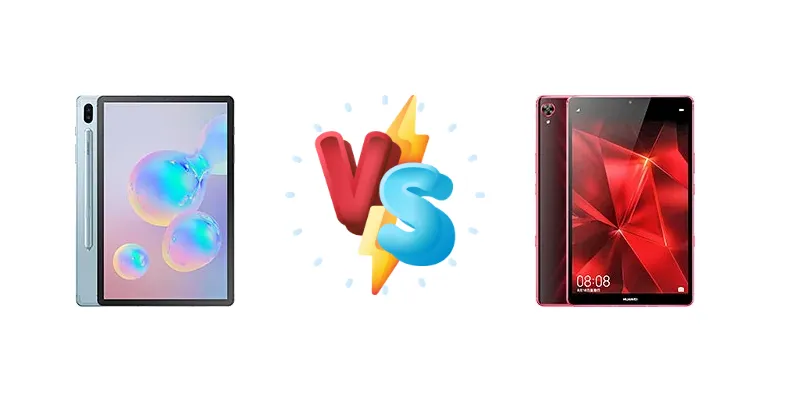
The Samsung Galaxy Tab S6 and Huawei MediaPad M6 Turbo 8.4 represent compelling options in the premium Android tablet space, albeit from different eras. The Tab S6, with its Snapdragon 855, aimed for flagship performance in 2019, while the MediaPad M6 Turbo, powered by the Kirin 980, offered a strong contender focused on a balance of power and efficiency. This comparison dissects their core components to determine which tablet holds up better today.
🏆 Quick Verdict
For the average user prioritizing sustained performance and broader software compatibility, the Samsung Galaxy Tab S6 emerges as the better choice. While the MediaPad M6 Turbo offers a competitive Kirin 980 chipset, the Snapdragon 855’s established ecosystem and slightly superior CPU architecture provide a smoother experience, especially with demanding applications.
| Network |
|---|
| 2G bands | GSM 850 / 900 / 1800 / 1900 | GSM 850 / 900 / 1800 / 1900 |
| 3G bands | HSDPA 850 / 900 / 1700(AWS) / 1900 / 2100 | HSDPA 800 / 850 / 900 / 1700(AWS) / 1900 / 2100 |
| 4G bands | 1, 2, 3, 4, 5, 7, 8, 12, 13, 17, 20, 25, 26, 28, 32, 38, 40, 41, 66 | 1, 3, 4, 5, 8, 19, 34, 38, 39, 40, 41 |
| Speed | HSPA 42.2/5.76 Mbps, LTE (6CA) Cat20 2000/150 Mbps - cellular model only | HSPA 42.2/5.76 Mbps, LTE (3CA) Cat12 600/75 Mbps - cellular model only |
| Technology | GSM / HSPA / LTE | GSM / CDMA / HSPA / LTE |
| | - | CDMA 800 & TD-SCDMA |
| Launch |
|---|
| Announced | 2019, July 31. Released 2019, August | 2019, September. Released 2019, September |
| Status | Discontinued | Discontinued |
| Body |
|---|
| Build | Glass front, aluminum back, aluminum frame | - |
| Dimensions | 244.5 x 159.5 x 5.7 mm (9.63 x 6.28 x 0.22 in) | 206.4 x 125.2 x 8.2 mm (8.13 x 4.93 x 0.32 in) |
| SIM | Nano-SIM (cellular model only) | Nano-SIM (cellular model only) |
| Weight | 420 g (14.82 oz) | 340 g (11.99 oz) |
| | Stylus support (Bluetooth integration; magnetic) | - |
| Display |
|---|
| Resolution | 1600 x 2560 pixels, 16:10 ratio (~287 ppi density) | 2560 x 1600 pixels, 16:10 ratio (~359 ppi density) |
| Size | 10.5 inches, 321.9 cm2 (~82.5% screen-to-body ratio) | 8.4 inches, 204.6 cm2 (~79.2% screen-to-body ratio) |
| Type | Super AMOLED | IPS LCD |
| Platform |
|---|
| CPU | Octa-core (1x2.84 GHz Kryo 485 & 3x2.42 GHz Kryo 485 & 4x1.78 GHz Kryo 485) | Octa-core (2x2.6 GHz Cortex-A76 & 2x1.92 GHz Cortex-A76 & 4x1.8 GHz Cortex-A55) |
| Chipset | Qualcomm SM8150 Snapdragon 855 (7 nm) | Kirin 980 (7 nm) |
| GPU | Adreno 640 | Mali-G76 MP10 |
| OS | Android 9.0 (Pie), upgradable to Android 12, One UI 4.0 | Android 9.0 (Pie), EMUI 9.1 |
| Memory |
|---|
| Card slot | microSDXC (dedicated slot) | microSDXC (dedicated slot) |
| Internal | 64GB 4GB RAM, 128GB 6GB RAM, 256GB 8GB RAM | 128GB 6GB RAM |
| | UFS 3.0 | UFS 2.1 |
| Main Camera |
|---|
| Dual | 13 MP, f/2.0, 26mm (wide), 1/3.4", 1.0µm, AF
5 MP, f/2.2, 12mm (ultrawide), 1.12µm | - |
| Features | HDR, panorama | LED flash, HDR, panorama |
| Single | - | 13 MP, f/1.8, PDAF |
| Video | 4K@30fps | 1080p@30fps |
| Selfie camera |
|---|
| Single | 8 MP, f/2.0, 26mm (wide), 1/4.0", 1.12µm | 8 MP, f/2.0 |
| Video | 1080p@30fps | 1080p@30fps |
| Sound |
|---|
| 3.5mm jack | No | No |
| 35mm jack | No | No |
| Loudspeaker | Yes, with stereo speakers (4 speakers) | Yes, with stereo speakers |
| | Tuned by AKG | Tuned by Harman Kardon
|
| Comms |
|---|
| Bluetooth | 5.0, A2DP, LE | 5.0, A2DP, LE |
| NFC | No | No |
| Positioning | GPS, GLONASS, BDS, GALILEO - cellular model only | GPS, GLONASS, BDS - cellular model only |
| Radio | No | No |
| USB | USB Type-C 3.1, magnetic connector | USB Type-C 2.0, OTG |
| WLAN | Wi-Fi 802.11 a/b/g/n/ac, dual-band, Wi-Fi Direct | Wi-Fi 802.11 a/b/g/n/ac, dual-band, Wi-Fi Direct |
| Features |
|---|
| Sensors | Fingerprint (under display, optical), accelerometer, gyro, proximity, compass | Accelerometer, gyro, proximity, compass |
| | Samsung DeX
ANT+ | - |
| Battery |
|---|
| Charging | 15W wired | - |
| Type | Li-Po 7040 mAh, non-removable | Li-Po 6100 mAh, non-removable |
| Misc |
|---|
| Colors | Mountain Gray, Cloud Blue, Rose Blush | Phantom Red, Phantom Blue |
| Models | SM-T860, SM-T865 | VRD-AL10, VRD-W10, VRD-W09, VRD-AL09 |
| Price | About 600 EUR | About 350 EUR |
| SAR | 0.70 W/kg (body) | - |
| SAR EU | 1.22 W/kg (body) | - |
Samsung Galaxy Tab S6
- Stronger CPU performance with Snapdragon 855
- Wider app compatibility and ecosystem support
- Established brand reputation and software updates
- Slower charging speed (15W)
- Potentially higher power consumption
Huawei MediaPad M6 Turbo 8.4
- Potentially better battery life due to Kirin 980 efficiency
- Huawei’s AI processing capabilities for camera and features
- Compact 8.4-inch form factor for portability
- Potential limitations with Google Mobile Services
- Slightly less powerful CPU compared to Snapdragon 855
Display Comparison
Detailed display specifications are missing, but both tablets likely feature IPS LCD panels given their release timelines. The key difference lies in potential software optimizations. Samsung historically excels in display calibration, potentially offering more accurate colors on the Tab S6. The 8.4-inch size of the MediaPad M6 Turbo suggests a more portable experience, while the Tab S6, typically available in larger sizes, prioritizes screen real estate. Bezels are likely comparable, reflecting design trends of their respective launch years.
Camera Comparison
Camera details are sparse, but given the tablet market, neither device is likely to excel in photography. The focus is more on video conferencing and casual snapshots. Without specific sensor information, it’s difficult to declare a clear winner. However, Huawei’s Kirin 980 includes a dedicated Neural Processing Unit (NPU) which *could* enhance image processing algorithms, potentially leading to slightly better low-light performance or more accurate color reproduction. The absence of Optical Image Stabilization (OIS) on either device suggests limited capabilities in challenging lighting conditions.
Performance
The core of this comparison rests on the chipsets. The Qualcomm Snapdragon 855 (7nm) in the Tab S6 boasts an octa-core configuration with a peak clock speed of 2.84 GHz. This is contrasted by the Huawei Kirin 980 (7nm) in the M6 Turbo, also an octa-core processor, but with a slightly different arrangement – 2x2.6 GHz Cortex-A76 cores and 2x1.92 GHz Cortex-A76 cores, alongside 4x1.8 GHz Cortex-A55 cores. While both are 7nm chips, the Snapdragon 855’s Kryo cores generally offer a slight edge in single-core performance, crucial for responsive UI and app loading. The Kirin 980’s dual-NPU configuration focuses on AI processing, potentially benefiting camera performance and smart features, but doesn’t translate to a significant overall performance advantage in typical tablet usage.
Battery Life
The Tab S6 features 15W wired charging. The MediaPad M6 Turbo’s charging speed is unknown, but Huawei often prioritizes fast charging in its devices. The actual battery capacity of both devices is also missing. However, the Kirin 980’s architecture is generally considered more power-efficient than the Snapdragon 855, meaning the M6 Turbo *could* offer longer battery life during less demanding tasks like video playback or web browsing. The Tab S6’s higher peak performance, however, will likely consume more power during gaming or intensive applications.
Buying Guide
Buy the Samsung Galaxy Tab S6 if you need a tablet with a proven track record for performance, a wider range of app compatibility, and access to the broader Samsung ecosystem. Buy the Huawei MediaPad M6 Turbo 8.4 if you prioritize a slightly more power-efficient chipset for extended battery life during lighter tasks and prefer Huawei’s user interface customizations, understanding potential limitations with Google Mobile Services.
Frequently Asked Questions
❓ Does the Kirin 980 chipset in the MediaPad M6 Turbo suffer from significant thermal throttling during extended gaming sessions?
While the Kirin 980 is a capable chipset, it's known to be more susceptible to thermal throttling under sustained load compared to the Snapdragon 855. This means performance may decrease over time during long gaming sessions as the device heats up. The Tab S6, with its Snapdragon 855, generally manages heat more effectively.
❓ How does the lack of Google Mobile Services (GMS) on the Huawei MediaPad M6 Turbo affect the user experience?
The absence of GMS means you won't have direct access to the Google Play Store and core Google apps like Gmail, YouTube, and Google Maps. Huawei provides its own app ecosystem (AppGallery) and workarounds for accessing some Google services, but the experience isn't as seamless or comprehensive. This is a significant consideration for users heavily reliant on Google's services.
❓ Is the 15W charging on the Samsung Galaxy Tab S6 noticeably slow compared to other tablets?
Yes, 15W charging is relatively slow by today's standards. While sufficient for overnight charging, it will take considerably longer to replenish the battery compared to tablets with 25W or faster charging capabilities. This is a drawback for users who need quick top-ups throughout the day.