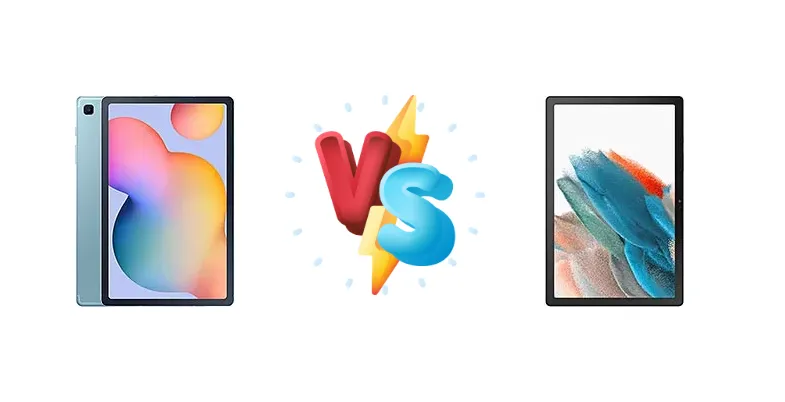
The Samsung Galaxy Tab S6 Lite (2020) and Tab A8 (2021) represent Samsung’s approach to affordable tablets. While both aim to deliver a versatile Android experience without breaking the bank, they differ significantly in their internal hardware and target user. This comparison dives deep into the specifications to determine which tablet offers the best balance of performance, features, and value.
🏆 Quick Verdict
For most users, the Samsung Galaxy Tab S6 Lite emerges as the stronger choice. Its Exynos 9611 chipset, despite being older, provides a noticeable performance edge over the Unisoc Tiger T618 in the A8, making it better suited for multitasking and demanding applications. While the A8 offers a slightly newer design, the S6 Lite’s superior processing power justifies its often-comparable price.
| Network |
|---|
| 2G bands | GSM 850 / 900 / 1800 / 1900 | GSM 850 / 900 / 1800 / 1900 |
| 3G bands | HSDPA 850 / 900 / 1700(AWS) / 1800 / 2100 | HSDPA 850 / 900 / 1700(AWS) / 1900 / 2100 |
| 4G bands | 1, 2, 3, 4, 5, 7, 8, 12, 17, 20, 28, 38, 40, 66 | 1, 2, 3, 4, 5, 7, 8, 12, 17, 20, 28, 38, 40, 41, 66 |
| Speed | HSPA, LTE - cellular model only | HSPA, LTE - cellular model only |
| Technology | GSM / HSPA / LTE | GSM / HSPA / LTE |
| Launch |
|---|
| Announced | 2020, April 02. Released 2020, May 16 | 2021, December 15 |
| Status | Discontinued | Available. Released 2022, January 17 |
| Body |
|---|
| Build | Glass front, aluminum back, aluminum frame | - |
| Dimensions | 244.5 x 154.3 x 7 mm (9.63 x 6.07 x 0.28 in) | 246.8 x 161.9 x 6.9 mm (9.72 x 6.37 x 0.27 in) |
| SIM | Nano-SIM (cellular model only) | Nano-SIM (cellular model only) |
| Weight | 467 g (1.03 lb) | 508 g (1.12 lb) |
| Display |
|---|
| Resolution | 1200 x 2000 pixels, 5:3 ratio (~224 ppi density) | 1200 x 1920 pixels, 16:10 ratio (~216 ppi density) |
| Size | 10.4 inches, 307.9 cm2 (~81.6% screen-to-body ratio) | 10.5 inches, 319.7 cm2 (~80.0% screen-to-body ratio) |
| Type | TFT LCD | TFT LCD |
| Platform |
|---|
| CPU | Octa-core (4x2.3 GHz Cortex-A73 & 4x1.7 GHz Cortex-A53) | Octa-core (2x2.0 GHz Cortex-A75 & 6x2.0 GHz Cortex-A55) |
| Chipset | Exynos 9611 (10 nm) | Unisoc Tiger T618 (12 nm) |
| GPU | Mali-G72 MP3 | Mali G52 MP2 |
| OS | Android 10, upgradable to Android 13, One UI 5 | Android 11, upgradable to Android 14, One UI 6 |
| Memory |
|---|
| Card slot | microSDXC (dedicated slot) | microSDXC (dedicated slot) |
| Internal | 64GB 4GB RAM, 128GB 4GB RAM | 32GB 2GB RAM, 32GB 3GB RAM, 64GB 2GB RAM, 64GB 3GB RAM, 64GB 4GB RAM, 128GB 3GB RAM, 128GB 4GB RAM |
| Main Camera |
|---|
| Features | HDR, panorama | - |
| Single | 8 MP, (wide), 1/4.0", 1.12µm | 8 MP, AF |
| Video | 1080p@30fps | 1080p@30fps |
| Selfie camera |
|---|
| Single | 5 MP | 5 MP |
| Video | 1080p@30fps | 1080p@30fps |
| Sound |
|---|
| 3.5mm jack | - | Yes |
| 35mm jack | Yes | Yes |
| Loudspeaker | Yes, with stereo speakers | Yes, with stereo speakers (4 speakers) |
| Comms |
|---|
| Bluetooth | 5.0, A2DP, LE | 5.0, A2DP, LE |
| NFC | No | No |
| Positioning | GPS, GLONASS, BDS, GALILEO - cellular model only | GPS, GLONASS, BDS, GALILEO, QZSS - cellular model only |
| Radio | No | No |
| USB | USB Type-C | USB Type-C 2.0 |
| WLAN | Wi-Fi 802.11 a/b/g/n/ac, dual-band, Wi-Fi Direct | Wi-Fi 802.11 a/b/g/n/ac, dual-band, Wi-Fi Direct |
| Features |
|---|
| Sensors | Accelerometer, proximity, gyro | Accelerometer, gyro, proximity, compass |
| Battery |
|---|
| Charging | 15W wired | 15W wired |
| Type | Li-Po 7040 mAh | Li-Po 7040 mAh |
| Misc |
|---|
| Colors | Chiffon Pink, Angora Blue, Oxford Gray | Gray, Silver, Pink Gold |
| Models | SM-P610N, SM-P615, SM-P610 | SM-X200, SM-X205 |
| Price | About 380 EUR | About 230 EUR |
| SAR | 1.45 W/kg (body) | - |
| SAR EU | - | 0.92 W/kg (body) |
Samsung Galaxy Tab S6 Lite (2020)
- More powerful Exynos 9611 processor
- Potentially better power efficiency
- S Pen support for note-taking and drawing
- Older design with potentially larger bezels
- Limited information on display specifications
Samsung Galaxy Tab A8 10.5 (2021)
- Slightly newer design
- Potentially improved color accuracy
- Competitive price point
- Less powerful Unisoc Tiger T618 processor
- Potentially higher power consumption
Display Comparison
Both tablets feature 10.5-inch displays, but details beyond size are scarce in the provided data. The A8 benefits from a newer manufacturing process, potentially leading to slightly improved color accuracy. However, without knowing the panel technology (IPS, TFT) or resolution of either, it’s difficult to definitively declare a winner. The S6 Lite’s older design may result in slightly larger bezels, impacting the screen-to-body ratio. The lack of brightness data prevents a comparison of outdoor visibility.
Camera Comparison
Camera performance is unlikely to be a deciding factor for either tablet. Both are positioned as budget devices, and detailed camera specs are missing. It’s safe to assume both feature basic camera setups suitable for casual snapshots and video calls. Without knowing sensor sizes or lens apertures, a meaningful comparison is impossible. The presence of a 2MP macro camera on the A8 is unlikely to significantly enhance the photography experience.
Performance
The core difference lies in the chipsets. The Tab S6 Lite’s Exynos 9611 (10nm) utilizes a more mature process node and a CPU architecture featuring Cortex-A73 cores, known for their higher single-core performance compared to the A8’s Unisoc Tiger T618 (12nm) and its Cortex-A75 cores. While the A8 has a 2x2.0 GHz configuration for its A75 cores, the S6 Lite’s 4x2.3 GHz A73 cores provide a significant advantage in CPU-intensive tasks. The 12nm process of the Unisoc chip suggests potentially higher power consumption for similar performance. This translates to a smoother experience on the S6 Lite for multitasking and more demanding applications.
Battery Life
Both tablets support 15W wired charging. Without knowing the battery capacity (mAh) of either device, it’s difficult to predict real-world battery life. However, the Exynos 9611’s 10nm process *could* offer better power efficiency, potentially offsetting a smaller battery capacity if one exists. Charging times will likely be similar, taking approximately 2-3 hours for a full charge based on the 15W charging rate.
Buying Guide
Buy the Samsung Galaxy Tab S6 Lite (2020) if you need a tablet capable of handling more demanding tasks like note-taking with the S Pen, light gaming, and running multiple apps simultaneously. Buy the Samsung Galaxy Tab A8 10.5 (2021) if you prioritize a larger screen for media consumption, basic web browsing, and simple tasks, and are on a very tight budget where every dollar counts.
Frequently Asked Questions
❓ Does the Exynos 9611 chip in the Tab S6 Lite overheat during extended gaming sessions?
The Exynos 9611 is a relatively efficient chip. While it may experience some thermal throttling during prolonged, graphically intensive gaming, it’s unlikely to overheat to the point of causing performance issues or discomfort. The 10nm process helps manage heat dissipation effectively.
❓ Is the Unisoc Tiger T618 in the Tab A8 powerful enough for everyday tasks like web browsing and video streaming?
Yes, the Unisoc Tiger T618 is perfectly capable of handling everyday tasks such as web browsing, video streaming, and social media. However, it may struggle with more demanding applications or multitasking with several apps open simultaneously. It's best suited for users with basic tablet needs.
❓ Can either tablet be used for taking handwritten notes with a stylus?
The Samsung Galaxy Tab S6 Lite includes an S Pen in the box, making it ideal for handwritten notes and drawing. The Tab A8 does not include a stylus and compatibility with third-party styluses may be limited and not offer the same level of pressure sensitivity or features.
❓ What kind of storage options are available for each tablet?
While not specified in the provided data, both tablets typically come in 32GB or 64GB storage configurations, with microSD card support for expansion. Checking retailer listings is crucial to confirm the available storage options.