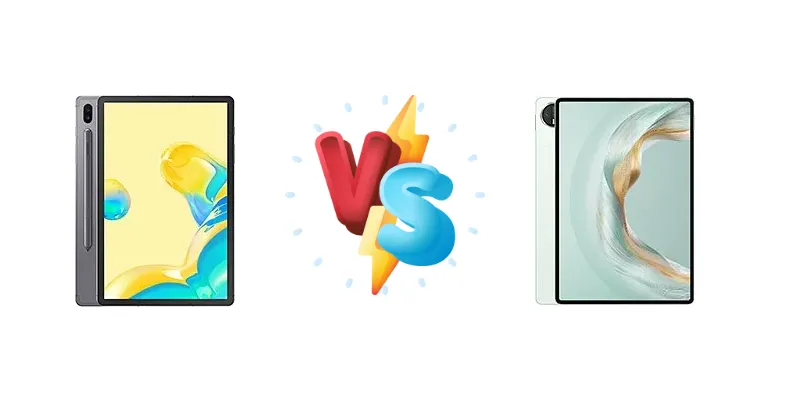
The large-screen Android tablet market is heating up. We pit the now-established Samsung Galaxy Tab S6 5G, a veteran known for its connectivity, against the newer Huawei MatePad Pro 12.2 (2025), which promises a significant leap in display technology and charging speed. This comparison focuses on which tablet delivers the best balance of performance, battery life, and usability for demanding users.
🏆 Quick Verdict
For the average user prioritizing long-term battery life and rapid charging, the Huawei MatePad Pro 12.2 (2025) is the clear winner. Its 11:24 active use battery score and 100W charging significantly outperform the Tab S6 5G. However, the Tab S6 5G remains a viable option for those heavily invested in the Samsung ecosystem and needing 5G connectivity.
| Network |
|---|
| 2G bands | GSM 850 / 900 / 1800 / 1900 | N/A |
| 3G bands | HSDPA 850 / 1700(AWS) / 1900 / 2100 | N/A |
| 4G bands | 1, 2, 3, 4, 5, 7, 8, 13, 17, 20, 38, 40, 41 | N/A |
| 5G bands | 78 SA/NSA | - |
| EDGE | - | No |
| GPRS | - | No |
| Speed | HSPA 42.2/5.76 Mbps, LTE (6CA) Cat20 2000/150 Mbps, 5G (2+ Gbps DL) | - |
| Technology | GSM / HSPA / LTE / 5G | No cellular connectivity |
| Launch |
|---|
| Announced | 2020, January 29 | 2025, May 15 |
| Status | Available. Released 2020, January 30 | Available. Released 2025, May 15 |
| Body |
|---|
| Build | Glass front, aluminum back, aluminum frame | - |
| Dimensions | 244.5 x 159.5 x 5.7 mm (9.63 x 6.28 x 0.22 in) | 271.3 x 182.5 x 5.5 mm (10.68 x 7.19 x 0.22 in) |
| SIM | Nano-SIM | No |
| Weight | 420 g (14.82 oz) | 508 g (1.12 lb) |
| | Stylus support (Bluetooth integration; magnetic) | - |
| Display |
|---|
| Resolution | 1600 x 2560 pixels, 16:10 ratio (~287 ppi density) | 2800 x 1840 pixels, 3:2 ratio (~275 ppi density) |
| Size | 10.5 inches, 321.9 cm2 (~82.5% screen-to-body ratio) | 12.2 inches, 440.7 cm2 (~89.0% screen-to-body ratio) |
| Type | Super AMOLED, HDR10+ | Double-layer OLED, 1B colors, 144Hz, 2000 nits (peak), HDR Vivid |
| Platform |
|---|
| CPU | Octa-core (1x2.96 GHz Kryo 485 & 3x2.42 GHz Kryo 485 & 4x1.8 GHz Kryo 485) | Octa-core (1x2.4 GHz & 3x2.00 GHz & 4x1.6GHz) |
| Chipset | Qualcomm SM8150 Snapdragon 855+ (7 nm) | Kirin T92A (7 nm) |
| GPU | Adreno 640 (700 MHz) | Maleoon 920 |
| OS | Android 10, One UI 2 | HarmonyOS 4.3 |
| Memory |
|---|
| Card slot | microSDXC (dedicated slot) | No |
| Internal | 128GB 6GB RAM | 256GB 12GB RAM, 512GB 12GB RAM, 1TB 16GB RAM |
| | UFS 3.0 | - |
| Main Camera |
|---|
| Dual | 13 MP, f/2.0, 26mm (wide), 1/3.4", 1.0µm, AF
5 MP, f/2.2, 12mm (ultrawide), 1.12µm | 50 MP, f/1.8, (wide), PDAF
8 MP, f/2.2, (ultrawide) |
| Features | HDR, panorama | LED flash, HDR, panorama |
| Video | 4K@30fps | 4K@30fps, 1080p@30fps |
| Selfie camera |
|---|
| Single | 8 MP, f/2.0, 26mm (wide), 1/4.0", 1.12µm | 8 MP, f/2.0 |
| Video | 1080p@30fps | 1080p@30fps |
| Sound |
|---|
| 3.5mm jack | No | - |
| 35mm jack | No | No |
| Loudspeaker | Yes, with stereo speakers (4 speakers) | Yes, with stereo speakers (4 speakers) |
| | Tuned by AKG | - |
| Comms |
|---|
| Bluetooth | 5.0, A2DP, LE | 5.2, A2DP, LE |
| NFC | No | No |
| Positioning | GPS, GLONASS, BDS, GALILEO | GPS, GLONASS, BDS, GALILEO, QZSS |
| Radio | No | No |
| USB | USB Type-C 3.1, magnetic connector | USB Type-C 3.1, OTG |
| WLAN | Wi-Fi 802.11 a/b/g/n/ac, dual-band, Wi-Fi Direct | Wi-Fi 802.11 a/b/g/n/ac/6/7, dual-band |
| Features |
|---|
| Sensors | Fingerprint (under display, optical), accelerometer, gyro, proximity, compass | Fingerprint (side-mounted), accelerometer, gyro, proximity (accessories only), compass |
| | Samsung DeX
ANT+ | - |
| Battery |
|---|
| Charging | 15W wired | 100W wired, 85% in 40 min, 100% in 55 min
7.5W reverse wired |
| Type | Li-Po 7040 mAh | Li-Po 10100 mAh |
| Misc |
|---|
| Colors | Mountain Gray | Black, Green |
| Models | SM-T866N | MRDI-W09 |
| Price | About 800 EUR | About 850 EUR |
Samsung Galaxy Tab S6 5G
- Integrated 5G connectivity for on-the-go access.
- Well-established Samsung ecosystem integration.
- S Pen support for note-taking and creative tasks.
- Older Snapdragon 855+ chipset may throttle under heavy load.
- Slow 15W charging.
- Lower peak display brightness.
Huawei MatePad Pro 12.2 (2025)
- Exceptional battery life (11:24h active use).
- Ultra-fast 100W charging.
- Bright and vibrant 1045 nit display.
- May lack seamless integration with Google services (depending on region).
- No native 5G connectivity.
Display Comparison
The Huawei MatePad Pro 12.2 (2025) boasts a significant advantage with its measured peak brightness of 1045 nits, offering superior visibility in bright outdoor conditions compared to the Tab S6 5G (brightness data unavailable, but typically around 400-500 nits for its panel type). While the Tab S6 5G’s display quality is still good, the MatePad Pro’s higher brightness and likely improved color accuracy (based on Huawei’s display advancements) make it the better choice for content creators and media consumers. The larger 12.2-inch screen of the MatePad Pro also provides more screen real estate for multitasking.
Camera Comparison
Camera performance isn’t a primary focus for tablets, but the MatePad Pro 12.2 likely holds an edge due to Huawei’s image processing expertise. Without specific sensor details for either device, it’s difficult to make a definitive statement. However, Huawei typically prioritizes camera quality even in its tablets, while Samsung often focuses more on features. The Tab S6 5G’s camera is adequate for video calls and quick snapshots, but the MatePad Pro is expected to deliver more detailed and vibrant images.
Performance
On paper, the Qualcomm Snapdragon 855+ in the Tab S6 5G appears strong, but the Kirin T92A in the MatePad Pro 12.2 benefits from a more recent 7nm process. While clock speeds aren’t directly comparable (Snapdragon 855+ peaks at 2.96 GHz vs Kirin T92A’s 2.4 GHz), the Kirin’s architecture and process node likely result in better sustained performance and thermal management. The Tab S6 5G’s older chipset may exhibit more throttling under prolonged heavy loads. The impact of RAM speed isn't specified, but both likely utilize LPDDR4X, minimizing the difference.
Battery Life
The Huawei MatePad Pro 12.2 (2025) dominates in battery performance and charging. Its 11:24 hour active use score is a substantial improvement over what the Tab S6 5G typically achieves. Furthermore, the MatePad Pro’s 100W wired charging is a game-changer, reaching 85% charge in just 40 minutes and 100% in 55 minutes. The Tab S6 5G’s 15W charging is comparatively slow, requiring significantly longer to fully recharge. The 7.5W reverse wired charging on the MatePad Pro is a useful addition for topping up accessories.
Buying Guide
Buy the Samsung Galaxy Tab S6 5G if you require reliable 5G connectivity for on-the-go productivity and are already integrated into the Samsung ecosystem. Buy the Huawei MatePad Pro 12.2 (2025) if you prioritize exceptional battery life, incredibly fast charging, and a brighter, more immersive display for media consumption and creative tasks.
Frequently Asked Questions
❓ Does the Kirin T92A chipset in the MatePad Pro 12.2 struggle with demanding games like Genshin Impact?
While the Snapdragon 855+ is a capable gaming chip, the Kirin T92A’s more modern architecture and thermal management should allow for sustained performance in demanding titles like Genshin Impact. Expect playable frame rates at medium to high settings, though it won’t match the performance of flagship-level Snapdragon 8 Gen series chips.
❓ Is the lack of 5G connectivity on the MatePad Pro 12.2 a significant drawback for users who travel frequently?
For users who rely heavily on constant mobile data access, the lack of 5G on the MatePad Pro 12.2 is a notable omission. However, the superior battery life and fast charging can mitigate this issue, allowing for longer usage periods between Wi-Fi connections. Consider your typical usage scenarios to determine if 5G is a necessity.
❓ How does the software experience differ between Samsung's One UI and Huawei's HarmonyOS on these tablets?
Samsung's One UI offers a feature-rich and customizable experience, deeply integrated with the Samsung ecosystem. Huawei's HarmonyOS, while evolving rapidly, may have limitations regarding Google Mobile Services availability depending on your region. HarmonyOS focuses on cross-device connectivity and a streamlined user interface.