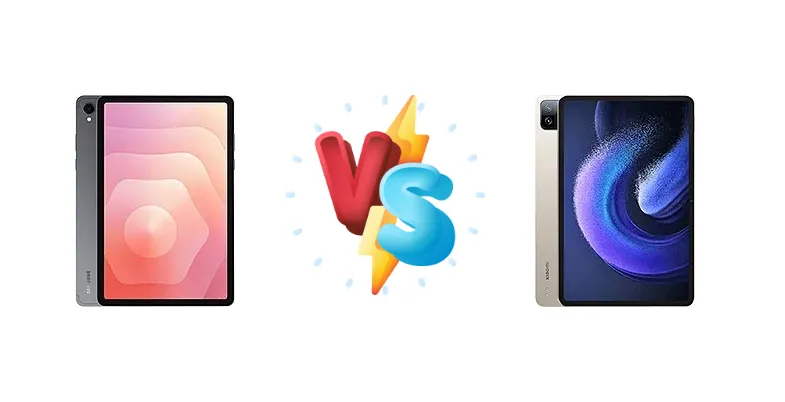
The Android tablet market is heating up, with Samsung and Xiaomi delivering compelling options. The Samsung Galaxy Tab S11, powered by the cutting-edge Mediatek Dimensity 9400+, aims for peak performance and endurance. Meanwhile, the Xiaomi Pad 6 Pro leverages the proven Qualcomm Snapdragon 8+ Gen 1, focusing on a balance of power and rapid charging. This comparison dissects these tablets to determine which best suits your needs.
🏆 Quick Verdict
For users prioritizing ultimate battery life and sustained performance under load, the Samsung Galaxy Tab S11 emerges as the winner. Its 81-hour endurance and advanced Dimensity 9400+ chipset offer a significant advantage. However, the Xiaomi Pad 6 Pro’s 67W charging is a compelling counterpoint for those who value speed.
| Network |
|---|
| 2G bands | GSM 850 / 900 / 1800 / 1900 | N/A |
| 3G bands | HSDPA 850 / 900 / 1700(AWS) / 1900 / 2100 | N/A |
| 4G bands | LTE | - |
| 5G bands | SA/NSA/Sub6 | - |
| EDGE | - | N/A |
| GPRS | - | N/A |
| Speed | HSPA, LTE, 5G - cellular model only | - |
| Technology | GSM / HSPA / LTE / 5G | No cellular connectivity |
| Launch |
|---|
| Announced | 2025, September 04 | 2023, April 18 |
| Status | Available. Released 2025, September 04 | Available. Released 2023, April 30 |
| Body |
|---|
| Build | Glass front, aluminum frame, aluminum back | Glass front (Gorilla Glass 3), aluminum frame, aluminum back |
| Dimensions | 253.8 x 165.3 x 5.5 mm (9.99 x 6.51 x 0.22 in) | 254 x 165.2 x 6.5 mm (10.0 x 6.50 x 0.26 in) |
| SIM | Nano-SIM + eSIM (cellular model only) | No |
| Weight | 469 g or 471 g (1.03 lb) | 490 g (1.08 lb) |
| | - | Stylus support (magnetic) |
| Display |
|---|
| Protection | Mohs level 5 | Corning Gorilla Glass 3 |
| Resolution | 1600 x 2560 pixels, 16:10 ratio (~274 ppi density) | 1800 x 2880 pixels, 16:10 ratio (~309 ppi density) |
| Size | 11.0 inches, 350.9 cm2 (~83.6% screen-to-body ratio) | 11.0 inches, 350.9 cm2 (~83.6% screen-to-body ratio) |
| Type | Dynamic AMOLED 2X, 120Hz, HDR10+, 1000 nits (typ), 1600 nits (peak) | IPS LCD, 1B colors, 144Hz, HDR10, Dolby Vision, 550 nits |
| Platform |
|---|
| CPU | Octa-core (1x3.63 GHz Cortex-X925 & 3x3.3 GHz Cortex-X4 & 4x2.4 GHz Cortex-A720) | Octa-core (1x3.19 GHz Cortex-X2 & 3x2.75 GHz Cortex-A710 & 4x1.80 GHz Cortex-A510) |
| Chipset | Mediatek Dimensity 9400+ (3 nm) | Qualcomm SM8475 Snapdragon 8+ Gen 1 (4 nm) |
| GPU | Immortalis-G925 | Adreno 730 |
| OS | Android 16, One UI 8 | Android 13, MIUI 14 |
| Memory |
|---|
| Card slot | microSDXC (dedicated slot) | No |
| Internal | 128GB 12GB RAM, 256GB 12GB RAM, 512GB 12GB RAM, 2TB 12GB RAM | 128GB 8GB RAM, 256GB 8GB RAM, 256GB 12GB RAM, 512GB 12GB RAM |
| | - | UFS 3.1 |
| Main Camera |
|---|
| Dual | - | 50 MP, f/1.8, (wide), 1/2.76", 0.64µm, PDAF
Auxiliary lens |
| Features | LED flash, HDR, panorama | Dual-LED flash, HDR, panorama |
| Single | 13 MP, f/2.0, 26mm (wide), 1/3.4", 1.0µm, AF | - |
| Video | 4K@30fps, 1080p@30fps | 4K@30/60fps, 1080p@30/60fps |
| Selfie camera |
|---|
| Features | HDR | - |
| Single | 12 MP, f/2.4, 120˚ (ultrawide) | 20 MP, f/2.2, (wide), 1/3.4", 0.8µm |
| Video | 4K@30fps, 1080p@30fps | 1080p@30/60fps |
| Sound |
|---|
| 3.5mm jack | - | No |
| 35mm jack | No | No |
| Loudspeaker | Yes, with stereo speakers (4 speakers) | Yes, with stereo speakers (4 speakers) |
| | - | 24-bit/192kHz audio |
| Comms |
|---|
| Bluetooth | 5.4, A2DP, LE | 5.3, A2DP, LE |
| NFC | No | No |
| Positioning | GPS, GLONASS, BDS, GALILEO - cellular model only | No |
| Radio | No | No |
| USB | USB Type-C 3.2, magnetic connector | USB Type-C 3.2, accessory connector |
| WLAN | Wi-Fi 802.11 a/b/g/n/ac/6e, tri-band, Wi-Fi Direct | Wi-Fi 802.11 a/b/g/n/a/6e, dual-band, Wi-Fi Direct |
| Features |
|---|
| Sensors | Fingerprint (under display, optical), accelerometer, gyro, proximity, compass | Accelerometer, gyro, proximity (accessories only) |
| Battery |
|---|
| Charging | 45W wired | 67W wired, PD3.0, QC4, 100% in 1 hour |
| Type | Li-Po 8400 mAh | Li-Po 8600 mAh |
| Misc |
|---|
| Colors | Moonstone Gray, Platinum Silver | Black, Blue, Gold |
| Models | SM-X730, SM-X736, SM-X736B | 23046RP50C |
| Price | $ 649.99 | About 330 EUR |
| SAR EU | 0.99 W/kg (body) | - |
| EU LABEL |
|---|
| Battery | 81:01h endurance, 1200 cycles | - |
| Energy | Class G | - |
| Free fall | Class E (0 falls) | - |
| Repairability | Class C | - |
Samsung Galaxy Tab S11
- Exceptional 81-hour battery life
- Cutting-edge Mediatek Dimensity 9400+ chipset
- Potentially superior display quality (Samsung expertise)
- Slower 45W charging compared to the competition
- Limited information on camera specifications
Xiaomi Pad 6 Pro
- Ultra-fast 67W charging with PD3.0 and QC4
- Proven Qualcomm Snapdragon 8+ Gen 1 performance
- Likely wider accessory ecosystem
- Shorter battery life compared to the Tab S11
- 4nm process less efficient than the Tab S11’s 3nm
Display Comparison
While display specs are missing, both tablets likely feature high-resolution LCD or AMOLED panels. The key difference will be in color calibration and peak brightness. Given Samsung’s display expertise, the Tab S11 likely boasts superior color accuracy. However, without specific nit ratings, it’s difficult to definitively declare a winner. The Tab S11’s potential for LTPO technology, common in Samsung’s flagship tablets, would offer adaptive refresh rates for improved efficiency.
Camera Comparison
Camera details are absent, but given the tablet form factor, image quality is less critical than on smartphones. Both tablets likely feature multi-camera setups, but the focus will be on video conferencing and casual photography. Without sensor size or aperture information, it’s impossible to assess image quality. However, Samsung’s image processing algorithms generally prioritize vibrant colors, while Xiaomi tends towards a more natural look.
Performance
The core battle lies in the chipsets. The Samsung Galaxy Tab S11’s Mediatek Dimensity 9400+ (3nm) represents a significant leap forward in efficiency and raw power compared to the Xiaomi Pad 6 Pro’s Qualcomm Snapdragon 8+ Gen 1 (4nm). The Dimensity 9400+'s Cortex-X925 core, clocked at 3.63 GHz, is expected to outperform the Snapdragon’s Cortex-X2 at 3.19 GHz. The newer architecture and smaller node size of the Dimensity 9400+ should translate to better thermal management and sustained performance during intensive tasks. The Tab S11’s CPU configuration (1x3.63 GHz, 3x3.3 GHz, 4x2.4 GHz) also suggests a more balanced approach to multi-core workloads.
Battery Life
The Samsung Galaxy Tab S11’s 81:01h endurance is a standout feature, indicating exceptional battery life. While the exact battery capacity is unknown, the Dimensity 9400+'s 3nm process contributes significantly to this longevity. The Xiaomi Pad 6 Pro compensates with its 67W wired charging, capable of a full charge in just one hour, utilizing PD3.0 and QC4 standards. This is a substantial advantage for users who need to quickly top up their battery. The Tab S11’s 45W charging is respectable, but noticeably slower.
Buying Guide
Buy the Samsung Galaxy Tab S11 if you need exceptional battery life for extended travel or work, and demand the latest processor architecture for demanding tasks like video editing or complex multitasking. Buy the Xiaomi Pad 6 Pro if you prioritize quick charging and a more readily available ecosystem of accessories, and your usage leans towards media consumption and casual gaming.
Frequently Asked Questions
❓ Does the Mediatek Dimensity 9400+ in the Galaxy Tab S11 suffer from thermal throttling during extended gaming sessions?
The Dimensity 9400+'s 3nm process and advanced thermal management features are designed to minimize throttling. While some heat generation is inevitable during prolonged gaming, the Tab S11 should maintain higher sustained performance levels compared to devices with less efficient chipsets.
❓ How does the 67W charging on the Xiaomi Pad 6 Pro compare to other tablets in terms of real-world charging speed?
67W charging is exceptionally fast for a tablet. It allows for a full charge in approximately one hour, significantly faster than most competitors that offer 25W or 45W charging. This is a major convenience for users who need to quickly replenish their battery.
❓ Is the difference in CPU architecture between the Dimensity 9400+ and Snapdragon 8+ Gen 1 noticeable in everyday tasks like browsing and video streaming?
For basic tasks like browsing and video streaming, the difference will be minimal. Both chipsets are more than capable of handling these workloads smoothly. The benefits of the Dimensity 9400+ become more apparent in demanding applications like video editing, 3D rendering, and graphically intensive games.