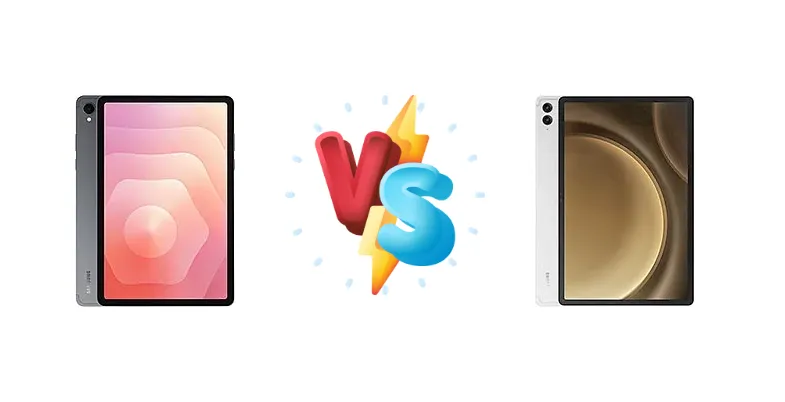
Samsung's tablet lineup offers choices for every user. The Galaxy Tab S11 represents a push for raw power with its Mediatek Dimensity 9400+ chipset, while the Galaxy Tab S9 FE+ aims for a balance of features and affordability with the Exynos 1380. This comparison dissects the key differences to help you determine which tablet best suits your needs.
🏆 Quick Verdict
For users prioritizing peak performance and longevity, the Samsung Galaxy Tab S11 is the clear winner. Its Dimensity 9400+ chipset delivers significantly more processing power, and the 1200 charge cycles promise a longer lifespan. However, the S9 FE+ offers a compelling value proposition for everyday tasks and casual gaming.
| Network |
|---|
| 2G bands | GSM 850 / 900 / 1800 / 1900 | GSM 850 / 900 / 1800 / 1900 |
| 3G bands | HSDPA 850 / 900 / 1700(AWS) / 1900 / 2100 | HSDPA 850 / 900 / 1700(AWS) / 1900 / 2100 |
| 4G bands | LTE | 1, 2, 3, 4, 5, 7, 8, 12, 13, 17, 20, 26, 28, 32, 38, 40, 41, 66 |
| 5G bands | SA/NSA/Sub6 | 1, 3, 5, 7, 8, 20, 28, 38, 40, 41, 66, 77, 78 SA/NSA/Sub6 |
| Speed | HSPA, LTE, 5G - cellular model only | HSPA, LTE, 5G - cellular model only |
| Technology | GSM / HSPA / LTE / 5G | GSM / HSPA / LTE / 5G |
| Launch |
|---|
| Announced | 2025, September 04 | 2023, October 04 |
| Status | Available. Released 2025, September 04 | Available. Released 2023, October 16 |
| Body |
|---|
| Build | Glass front, aluminum frame, aluminum back | Glass front, aluminum back, aluminum frame |
| Dimensions | 253.8 x 165.3 x 5.5 mm (9.99 x 6.51 x 0.22 in) | 285.4 x 185.4 x 6.5 mm (11.24 x 7.30 x 0.26 in) |
| SIM | Nano-SIM + eSIM (cellular model only) | Nano-SIM + eSIM (cellular model only) |
| Weight | 469 g or 471 g (1.03 lb) | 627 g or 628 g (1.38 lb) |
| Display |
|---|
| Protection | Mohs level 5 | - |
| Resolution | 1600 x 2560 pixels, 16:10 ratio (~274 ppi density) | 1600 x 2560 pixels, 16:10 ratio (~243 ppi density) |
| Size | 11.0 inches, 350.9 cm2 (~83.6% screen-to-body ratio) | 12.4 inches, 445.8 cm2 (~84.3% screen-to-body ratio) |
| Type | Dynamic AMOLED 2X, 120Hz, HDR10+, 1000 nits (typ), 1600 nits (peak) | IPS LCD, 90Hz |
| Platform |
|---|
| CPU | Octa-core (1x3.63 GHz Cortex-X925 & 3x3.3 GHz Cortex-X4 & 4x2.4 GHz Cortex-A720) | Octa-core (4x2.4 GHz Cortex-A78 & 4x2.0 GHz Cortex-A55) |
| Chipset | Mediatek Dimensity 9400+ (3 nm) | Exynos 1380 (5 nm) |
| GPU | Immortalis-G925 | Mali-G68 MP5 |
| OS | Android 16, One UI 8 | Android 13, up to 4 major Android upgrades, One UI 6 |
| Memory |
|---|
| Card slot | microSDXC (dedicated slot) | microSDXC (dedicated slot) |
| Internal | 128GB 12GB RAM, 256GB 12GB RAM, 512GB 12GB RAM, 2TB 12GB RAM | 128GB 6GB RAM, 128GB 8GB RAM, 256GB 8GB RAM, 256GB 12GB RAM |
| Main Camera |
|---|
| Dual | - | 8 MP, (wide)
8 MP, (ultrawide) |
| Features | LED flash, HDR, panorama | - |
| Single | 13 MP, f/2.0, 26mm (wide), 1/3.4", 1.0µm, AF | - |
| Video | 4K@30fps, 1080p@30fps | 4K@30fps, 1080p@30fps |
| Selfie camera |
|---|
| Features | HDR | - |
| Single | 12 MP, f/2.4, 120˚ (ultrawide) | 12 MP, (ultrawide) |
| Video | 4K@30fps, 1080p@30fps | Yes |
| Sound |
|---|
| 35mm jack | No | No |
| Loudspeaker | Yes, with stereo speakers (4 speakers) | Yes, with stereo speakers |
| Comms |
|---|
| Bluetooth | 5.4, A2DP, LE | 5.3, A2DP, LE |
| NFC | No | No |
| Positioning | GPS, GLONASS, BDS, GALILEO - cellular model only | GPS, GALILEO, GLONASS, BDS, QZSS - cellular model only |
| Radio | No | No |
| USB | USB Type-C 3.2, magnetic connector | USB Type-C 2.0, magnetic connector |
| WLAN | Wi-Fi 802.11 a/b/g/n/ac/6e, tri-band, Wi-Fi Direct | Wi-Fi 802.11 a/b/g/n/ac/6, dual-band, Wi-Fi Direct |
| Features |
|---|
| Sensors | Fingerprint (under display, optical), accelerometer, gyro, proximity, compass | Fingerprint (side-mounted), accelerometer, gyro, compass, proximity (accessories only) |
| Battery |
|---|
| Charging | 45W wired | 45W wired, QC2.0 |
| Type | Li-Po 8400 mAh | Li-Po 10090 mAh |
| Misc |
|---|
| Colors | Moonstone Gray, Platinum Silver | Mint, Silver, Gray, Lavender |
| Models | SM-X730, SM-X736, SM-X736B | SM-X610, SM-X616B |
| Price | $ 649.99 | About 770 EUR |
| SAR | - | 0.77 W/kg (body) |
| SAR EU | 0.99 W/kg (body) | 0.50 W/kg (body) |
| EU LABEL |
|---|
| Battery | 81:01h endurance, 1200 cycles | - |
| Energy | Class G | - |
| Free fall | Class E (0 falls) | - |
| Repairability | Class C | - |
Samsung Galaxy Tab S11
- Significantly faster processor (Dimensity 9400+)
- Longer battery lifespan (1200 charge cycles)
- Superior thermal efficiency (3nm process)
- Likely higher price point
- Potential for increased heat under extreme load (despite efficiency)
Samsung Galaxy Tab S9 FE+
- More affordable price
- QC2.0 support for potentially faster charging
- Good performance for everyday tasks
- Less powerful processor (Exynos 1380)
- Shorter battery lifespan
- May struggle with demanding games and applications
Display Comparison
While both tablets likely feature high-quality LCD panels (data unavailable), the core difference lies in the processing power driving them. Display quality is assumed to be similar, but the S11's chipset will handle graphically intensive tasks displayed on the screen with greater ease. The S9 FE+'s Exynos 1380 will be sufficient for most users, but may exhibit frame drops in demanding games.
Camera Comparison
Without specific camera specs, a direct comparison is limited. However, given the S11's positioning as a premium device, it likely features a more advanced camera system with a larger sensor and improved image processing. The S9 FE+ will likely offer a capable camera for casual photography, but may struggle in low-light conditions compared to the S11. The presence of QC2.0 on the S9 FE+ suggests faster charging for the camera's battery, but this is a minor benefit.
Performance
The Mediatek Dimensity 9400+ in the Tab S11, built on a 3nm process, represents a significant leap in performance over the Exynos 1380 (5nm) found in the S9 FE+. The Dimensity 9400+'s octa-core configuration – with a high-clocked Cortex-X925 – is designed for sustained peak performance, while the Exynos 1380 relies on older Cortex-A78 cores. This translates to faster app loading, smoother multitasking, and a more responsive experience, particularly for demanding applications. The 3nm node also implies superior thermal efficiency, potentially reducing throttling during extended use.
Battery Life
The Tab S11 boasts an impressive 81:01h endurance, suggesting optimized power management alongside its chipset. While the S9 FE+'s battery capacity is unknown, the 45W wired charging is shared between both devices. However, the S11's 1200 charge cycles indicate a significantly longer lifespan, meaning it will maintain its battery health for a longer period than the S9 FE+. This is a crucial factor for long-term ownership.
Buying Guide
Buy the Samsung Galaxy Tab S11 if you need uncompromising performance for demanding tasks like video editing, 3D rendering, or intensive gaming. Its advanced chipset and potential for sustained performance make it ideal for power users. Buy the Samsung Galaxy Tab S9 FE+ if you prioritize a balance of features, affordability, and all-day battery life for everyday productivity, media consumption, and light gaming.
Frequently Asked Questions
❓ Does the Exynos 1380 in the Tab S9 FE+ overheat during prolonged gaming sessions?
The Exynos 1380 is a capable chip, but its 5nm process is less efficient than the Dimensity 9400+'s 3nm process. While it won't likely overheat catastrophically, users may experience some thermal throttling during extended gaming, leading to reduced performance. The Tab S11's superior thermal management should mitigate this issue.
❓ How much of a real-world performance difference will I see between the Dimensity 9400+ and the Exynos 1380 in everyday tasks?
For basic tasks like web browsing, email, and video streaming, the difference will be minimal. However, when multitasking with numerous apps, editing large files, or playing graphically demanding games, the Dimensity 9400+ will provide a noticeably smoother and more responsive experience. The S11 is built for power users, while the S9 FE+ excels at everyday usability.
❓ Is the 45W charging on both tablets equally fast, considering the QC2.0 support on the S9 FE+?
While both support 45W charging, the QC2.0 on the S9 FE+ *could* allow for slightly faster charging speeds depending on the charger used. However, the difference is likely to be marginal. The S11's endurance and charge cycle count are more significant factors regarding long-term battery health.