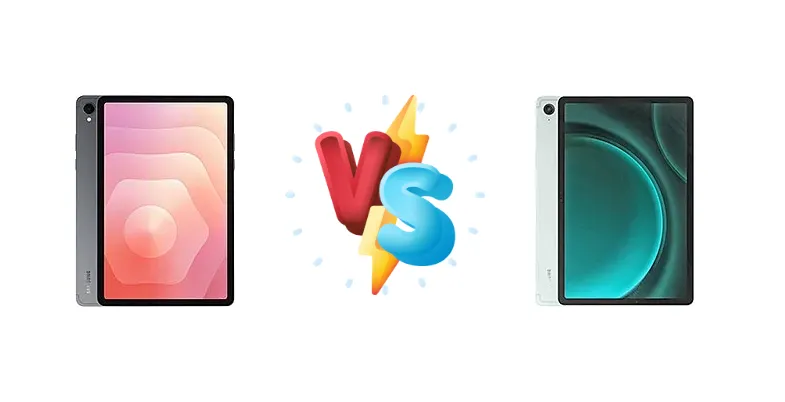
Samsung's Galaxy Tab lineup offers options for every user, but the Tab S11 and S9 FE represent distinct approaches. The S11 aims for near-flagship performance with the latest Mediatek Dimensity 9400+ chipset, while the S9 FE prioritizes affordability and efficiency with the Exynos 1380. This comparison dissects the key differences to help you choose the right tablet for your needs.
🏆 Quick Verdict
For users demanding the absolute best performance and longevity, the Samsung Galaxy Tab S11 is the clear winner. Its Dimensity 9400+ chipset and 1200 charge cycles provide a significant advantage. However, the S9 FE offers excellent value and a solid experience for everyday tasks, making it a compelling choice for budget-conscious buyers.
| Network |
|---|
| 2G bands | GSM 850 / 900 / 1800 / 1900 | GSM 850 / 900 / 1800 / 1900 |
| 3G bands | HSDPA 850 / 900 / 1700(AWS) / 1900 / 2100 | HSDPA 850 / 900 / 1700(AWS) / 1900 / 2100 |
| 4G bands | LTE | 1, 2, 3, 4, 5, 7, 8, 12, 13, 17, 20, 26, 28, 32, 38, 40, 41, 66 |
| 5G bands | SA/NSA/Sub6 | 1, 3, 5, 7, 8, 20, 28, 38, 40, 41, 66, 77, 78 SA/NSA/Sub6 |
| Speed | HSPA, LTE, 5G - cellular model only | HSPA, LTE, 5G - cellular model only |
| Technology | GSM / HSPA / LTE / 5G | GSM / HSPA / LTE / 5G |
| Launch |
|---|
| Announced | 2025, September 04 | 2023, October 04 |
| Status | Available. Released 2025, September 04 | Available. Released 2023, October 16 |
| Body |
|---|
| Build | Glass front, aluminum frame, aluminum back | Glass front, aluminum back, aluminum frame |
| Dimensions | 253.8 x 165.3 x 5.5 mm (9.99 x 6.51 x 0.22 in) | 254.3 x 165.8 x 6.5 mm (10.01 x 6.53 x 0.26 in) |
| SIM | Nano-SIM + eSIM (cellular model only) | Nano-SIM + eSIM (cellular model only) |
| Weight | 469 g or 471 g (1.03 lb) | 523 g or 524 g (1.15 lb) |
| Display |
|---|
| Protection | Mohs level 5 | - |
| Resolution | 1600 x 2560 pixels, 16:10 ratio (~274 ppi density) | 1440 x 2304 pixels, 16:10 ratio (~249 ppi density) |
| Size | 11.0 inches, 350.9 cm2 (~83.6% screen-to-body ratio) | 10.9 inches, 344.5 cm2 (~81.7% screen-to-body ratio) |
| Type | Dynamic AMOLED 2X, 120Hz, HDR10+, 1000 nits (typ), 1600 nits (peak) | IPS LCD, 90Hz |
| Platform |
|---|
| CPU | Octa-core (1x3.63 GHz Cortex-X925 & 3x3.3 GHz Cortex-X4 & 4x2.4 GHz Cortex-A720) | Octa-core (4x2.4 GHz Cortex-A78 & 4x2.0 GHz Cortex-A55) |
| Chipset | Mediatek Dimensity 9400+ (3 nm) | Exynos 1380 (5 nm) |
| GPU | Immortalis-G925 | Mali-G68 MP5 |
| OS | Android 16, One UI 8 | Android 13, up to 4 major Android upgrades, One UI 6 |
| Memory |
|---|
| Card slot | microSDXC (dedicated slot) | microSDXC (dedicated slot) |
| Internal | 128GB 12GB RAM, 256GB 12GB RAM, 512GB 12GB RAM, 2TB 12GB RAM | 128GB 6GB RAM, 128GB 8GB RAM, 256GB 8GB RAM |
| Main Camera |
|---|
| Features | LED flash, HDR, panorama | - |
| Single | 13 MP, f/2.0, 26mm (wide), 1/3.4", 1.0µm, AF | 8 MP, (wide) |
| Video | 4K@30fps, 1080p@30fps | 4K@30fps, 1080p@30fps |
| Selfie camera |
|---|
| Features | HDR | - |
| Single | 12 MP, f/2.4, 120˚ (ultrawide) | 12 MP, (ultrawide) |
| Video | 4K@30fps, 1080p@30fps | Yes |
| Sound |
|---|
| 35mm jack | No | No |
| Loudspeaker | Yes, with stereo speakers (4 speakers) | Yes, with stereo speakers |
| Comms |
|---|
| Bluetooth | 5.4, A2DP, LE | 5.3, A2DP, LE |
| NFC | No | No |
| Positioning | GPS, GLONASS, BDS, GALILEO - cellular model only | GPS, GALILEO, GLONASS, BDS, QZSS - cellular model only |
| Radio | No | No |
| USB | USB Type-C 3.2, magnetic connector | USB Type-C 2.0, magnetic connector |
| WLAN | Wi-Fi 802.11 a/b/g/n/ac/6e, tri-band, Wi-Fi Direct | Wi-Fi 802.11 a/b/g/n/ac/6, dual-band, Wi-Fi Direct |
| Features |
|---|
| Sensors | Fingerprint (under display, optical), accelerometer, gyro, proximity, compass | Fingerprint (side-mounted), accelerometer, gyro, compass, proximity (accessories only) |
| Battery |
|---|
| Charging | 45W wired | 45W wired, QC2.0 |
| Type | Li-Po 8400 mAh | Li-Po 8000 mAh |
| Misc |
|---|
| Colors | Moonstone Gray, Platinum Silver | Mint, Silver, Gray, Lavender |
| Models | SM-X730, SM-X736, SM-X736B | SM-X510, SM-X516B |
| Price | $ 649.99 | About 300 EUR |
| SAR | - | 1.55 W/kg (body) |
| SAR EU | 0.99 W/kg (body) | 0.59 W/kg (body) |
| EU LABEL |
|---|
| Battery | 81:01h endurance, 1200 cycles | - |
| Energy | Class G | - |
| Free fall | Class E (0 falls) | - |
| Repairability | Class C | - |
Samsung Galaxy Tab S11
- Superior performance with Dimensity 9400+ chipset
- Exceptional battery endurance (81:01h)
- Longer battery lifespan (1200 cycles)
- Likely higher price point
- Potentially larger and heavier form factor
Samsung Galaxy Tab S9 FE
- More affordable price
- QC2.0 fast charging support
- Potentially lighter and more portable
- Less powerful Exynos 1380 chipset
- Shorter battery lifespan compared to S11
Display Comparison
While display specs are missing, the Tab S11, positioned as a higher-tier device, likely features a superior panel. The Dimensity 9400+'s processing power suggests it can drive a higher resolution and refresh rate display. The S9 FE, being an 'FE' model, likely utilizes a quality LCD or AMOLED panel, but potentially with lower peak brightness and a standard 60Hz refresh rate. The S11's chipset could also support features like LTPO for variable refresh rate, improving battery efficiency.
Camera Comparison
Camera specifications are unavailable for both devices. However, given the S11’s positioning, it likely features a more advanced camera system with larger sensors and improved image processing. The S9 FE, as an 'FE' model, will likely prioritize cost-effectiveness, resulting in a more basic camera setup. Expect the S11 to perform better in low-light conditions and offer more detailed images.
Performance
The core difference lies in the chipsets. The Tab S11’s Mediatek Dimensity 9400+ (3nm) boasts a powerful octa-core configuration – 1x3.63 GHz Cortex-X925, 3x3.3 GHz Cortex-X4, and 4x2.4 GHz Cortex-A720 – designed for peak performance. This contrasts sharply with the S9 FE’s Exynos 1380 (5nm) with its 4x2.4 GHz Cortex-A78 and 4x2.0 GHz Cortex-A55 cores. The 3nm process of the Dimensity 9400+ offers significantly improved power efficiency and transistor density compared to the 5nm Exynos 1380, translating to sustained performance and reduced thermal throttling. The S11 will excel in CPU-intensive tasks and graphically demanding games.
Battery Life
The Tab S11 boasts an impressive 81:01h endurance and a 1200 cycle battery lifespan, indicating a larger capacity and superior battery health management. Both tablets support 45W wired charging, but the S9 FE adds QC2.0 support, potentially allowing for faster charging with compatible chargers. However, the S11’s longer endurance and cycle count suggest it will maintain its charging capacity for a longer period, making it a better long-term investment.
Buying Guide
Buy the Samsung Galaxy Tab S11 if you need uncompromising performance for demanding tasks like video editing, gaming, or running multiple applications simultaneously, and if long-term battery health is a priority. Buy the Samsung Galaxy Tab S9 FE if you prioritize affordability, all-day battery life for typical usage, and a lighter, more portable form factor without sacrificing core Samsung features.
Frequently Asked Questions
❓ Does the Exynos 1380 in the Tab S9 FE struggle with graphically intensive games like Genshin Impact?
While the Exynos 1380 is a capable chip, it will likely require reduced graphics settings and frame rate caps in demanding games like Genshin Impact to maintain a smooth experience. The Tab S11’s Dimensity 9400+ will handle these games with ease at higher settings.
❓ How does the 3nm process of the Dimensity 9400+ impact real-world battery life in the Tab S11?
The 3nm process allows for significantly more transistors in a smaller space, leading to improved power efficiency. This translates to longer battery life during typical usage and reduced heat generation, allowing the Tab S11 to maintain peak performance for extended periods without throttling.
❓ Is the 1200 charge cycle rating of the Tab S11 a significant advantage over the S9 FE?
Yes, a 1200 cycle rating means the Tab S11's battery is designed to retain a substantial portion of its original capacity after 1200 full charge-discharge cycles. This is a considerable benefit for long-term users, as it delays the need for a battery replacement compared to a tablet with a lower cycle count.