
Samsung Galaxy Tab S11 vs Apple iPad Air 11 (2025): A Deep Dive into Performance and Endurance
| Phones Images | |||||
|---|---|---|---|---|---|
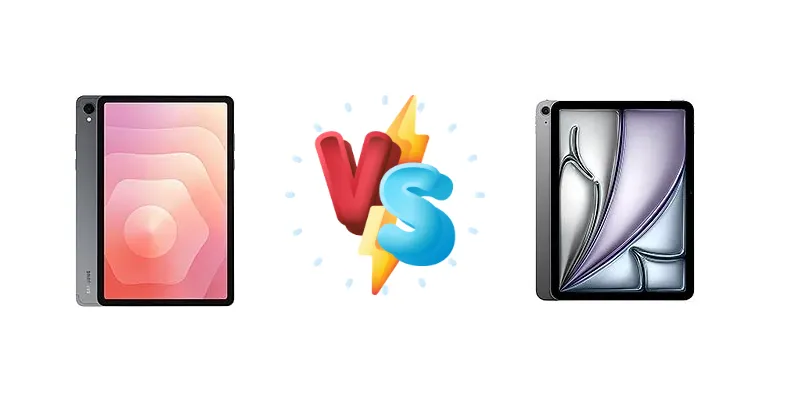
|
🏆 Quick Verdict
For users prioritizing sustained performance and all-day battery life, the Samsung Galaxy Tab S11 emerges as the winner. Its Mediatek Dimensity 9400+ chipset and 81:01h endurance significantly outperform the iPad Air 11 (2025), despite Apple’s optimized software. However, the iPad Air’s ecosystem integration remains a strong draw for Apple loyalists.
| PHONES | ||
|---|---|---|
| Phone Names | Samsung Galaxy Tab S11 | Apple iPad Air 11 (2025) |
| Network | ||
|---|---|---|
| 2G bands | GSM 850 / 900 / 1800 / 1900 | GSM 850 / 900 / 1800 / 1900 |
| 3G bands | HSDPA 850 / 900 / 1700(AWS) / 1900 / 2100 | HSDPA 850 / 900 / 1700(AWS) / 1900 / 2100 |
| 4G bands | LTE | 1, 2, 3, 4, 5, 7, 8, 11, 12, 13, 14, 17, 18, 19, 20, 21, 25, 26, 28, 29, 30, 32, 34, 38, 39, 40, 41, 42, 48, 66, 71 - A3267 |
| 5G bands | SA/NSA/Sub6 | 1, 2, 3, 5, 7, 8, 12, 14, 20, 25, 26, 28, 29, 30, 38, 40, 41, 48, 66, 70, 71, 75, 76, 77, 78, 79 SA/NSA/Sub6 - A3267, A3270 |
| Speed | HSPA, LTE, 5G - cellular model only | HSPA, LTE, 5G - cellular model only |
| Technology | GSM / HSPA / LTE / 5G | GSM / HSPA / LTE / 5G |
| Launch | ||
|---|---|---|
| Announced | 2025, September 04 | 2025, March 04 |
| Status | Available. Released 2025, September 04 | Available. Released 2025, March 12 |
| Body | ||
|---|---|---|
| Build | Glass front, aluminum frame, aluminum back | Glass front, aluminum back, aluminum frame |
| Dimensions | 253.8 x 165.3 x 5.5 mm (9.99 x 6.51 x 0.22 in) | 247.6 x 178.5 x 6.1 mm (9.75 x 7.03 x 0.24 in) |
| SIM | Nano-SIM + eSIM (cellular model only) | eSIM (cellular model only) |
| Weight | 469 g or 471 g (1.03 lb) | 460 g (1.01 lb) |
| Display | ||
|---|---|---|
| Protection | Mohs level 5 | Scratch-resistant glass, oleophobic coating, Mohs level 4 |
| Resolution | 1600 x 2560 pixels, 16:10 ratio (~274 ppi density) | 1640 x 2360 pixels (~264 ppi density) |
| Size | 11.0 inches, 350.9 cm2 (~83.6% screen-to-body ratio) | 11.0 inches, 357.6 cm2 (~80.9% screen-to-body ratio) |
| Type | Dynamic AMOLED 2X, 120Hz, HDR10+, 1000 nits (typ), 1600 nits (peak) | Liquid Retina IPS LCD, 500 nits (typ) |
| Platform | ||
|---|---|---|
| CPU | Octa-core (1x3.63 GHz Cortex-X925 & 3x3.3 GHz Cortex-X4 & 4x2.4 GHz Cortex-A720) | Octa-core (4 performance cores and 4 efficiency cores) |
| Chipset | Mediatek Dimensity 9400+ (3 nm) | Apple M3 |
| GPU | Immortalis-G925 | Apple GPU (9-core graphics) |
| OS | Android 16, One UI 8 | iPadOS 18.3.2, upgradable to iPadOS 26.1 |
| Memory | ||
|---|---|---|
| Card slot | microSDXC (dedicated slot) | No |
| Internal | 128GB 12GB RAM, 256GB 12GB RAM, 512GB 12GB RAM, 2TB 12GB RAM | 128GB 8GB RAM, 256GB 8GB RAM, 512GB 8GB RAM, 1TB 8GB RAM |
| Main Camera | ||
|---|---|---|
| Features | LED flash, HDR, panorama | HDR |
| Single | 13 MP, f/2.0, 26mm (wide), 1/3.4", 1.0µm, AF | 12 MP, f/1.8, (wide), 1/3.0", 1.22µm, dual pixel PDAF |
| Video | 4K@30fps, 1080p@30fps | 4K@24/25/30/60fps, 1080p@25/30/60/120/240fps; gyro-EIS |
| Selfie camera | ||
|---|---|---|
| Features | HDR | HDR |
| Single | 12 MP, f/2.4, 120˚ (ultrawide) | 12 MP, f/2.0, 122˚ (ultrawide) |
| Video | 4K@30fps, 1080p@30fps | 1080p@25/30/60fps; gyro-EIS |
| Sound | ||
|---|---|---|
| 35mm jack | No | No |
| Loudspeaker | Yes, with stereo speakers (4 speakers) | Yes, with stereo speakers |
| Comms | ||
|---|---|---|
| Bluetooth | 5.4, A2DP, LE | 5.3, A2DP, LE |
| NFC | No | No |
| Positioning | GPS, GLONASS, BDS, GALILEO - cellular model only | GPS, GLONASS (5G model only) |
| Radio | No | No |
| USB | USB Type-C 3.2, magnetic connector | USB Type-C 3.1 Gen2, DisplayPort, magnetic connector |
| WLAN | Wi-Fi 802.11 a/b/g/n/ac/6e, tri-band, Wi-Fi Direct | Wi-Fi 802.11 a/b/g/n/ac/6e, dual-band, hotspot |
| Features | ||
|---|---|---|
| Sensors | Fingerprint (under display, optical), accelerometer, gyro, proximity, compass | Fingerprint (top-mounted), accelerometer, gyro, compass, barometer |
| Battery | ||
|---|---|---|
| Charging | 45W wired | - |
| Type | Li-Po 8400 mAh | Li-Po 7606 mAh (28.93 Wh) |
| Misc | ||
|---|---|---|
| Colors | Moonstone Gray, Platinum Silver | Space Gray, Starlight, Purple, Blue |
| Models | SM-X730, SM-X736, SM-X736B | A3267, A3270, A3266 |
| Price | $ 649.99 | About 700 EUR |
| SAR | - | 1.10 W/kg (body) |
| SAR EU | 0.99 W/kg (body) | 1.41 W/kg (body) |
| EU LABEL | ||
|---|---|---|
| Battery | 81:01h endurance, 1200 cycles | 62:00h endurance, 1000 cycles |
| Energy | Class G | Class G |
| Free fall | Class E (0 falls) | Class E (0 falls) |
| Repairability | Class C | Class C |
Samsung Galaxy Tab S11
- Exceptional battery life (81:01h endurance)
- Powerful Mediatek Dimensity 9400+ chipset
- Faster 45W wired charging
- Potentially superior multi-core performance
- Android ecosystem fragmentation
- Software updates may be slower than iPadOS
Apple iPad Air 11 (2025)
- Seamless Apple ecosystem integration
- Optimized iPadOS software
- Strong resale value
- Excellent build quality
- Shorter battery life (62:00h endurance)
- Less powerful chipset compared to Dimensity 9400+
- Slower charging speeds
Display Comparison
While display specs are absent, the Tab S11 likely utilizes Samsung’s AMOLED technology, known for vibrant colors and deep blacks. The iPad Air 11 (2025) will almost certainly feature a Liquid Retina display, prioritizing color accuracy and brightness. The Tab S11’s potential for a higher refresh rate (likely 120Hz) would benefit gaming and scrolling, while the iPad Air’s display is expected to be calibrated for professional workflows. Bezels are likely comparable, but the iPad Air’s laminated display could offer a more immersive experience.
Camera Comparison
Given the tablet form factor, camera performance isn’t a primary focus. However, the Tab S11’s potential for a more advanced camera system (specifications unavailable) could offer a slight edge. Apple typically prioritizes image processing and computational photography, so the iPad Air 11 (2025) will likely deliver consistently good results in various lighting conditions. The absence of detailed camera specs makes a definitive comparison difficult, but the Tab S11’s Mediatek chipset may offer more flexibility for advanced image processing features.
Performance
The core of the battle lies in the chipsets. The Samsung Galaxy Tab S11’s Mediatek Dimensity 9400+ (3nm) boasts an octa-core configuration with a high-clocked Cortex-X925 prime core, suggesting superior multi-core performance compared to the iPad Air 11 (2025)’s Apple M3. The M3’s architecture, with 4 performance and 4 efficiency cores, excels in power efficiency and optimized single-core tasks. The Dimensity 9400+’s 3nm process should also provide a thermal advantage, potentially reducing throttling during extended workloads. The Tab S11’s LPDDR5x RAM will further contribute to faster data transfer speeds.
Battery Life
The Samsung Galaxy Tab S11’s 81:01h endurance is a significant advantage over the iPad Air 11 (2025)’s 62:00h. This translates to a full day of heavy use with headroom to spare. The Tab S11 also supports 45W wired charging, enabling faster top-ups. While the iPad Air 11 (2025) benefits from Apple’s software optimization, the Tab S11’s larger battery capacity and faster charging provide a tangible benefit for power users. The Tab S11’s 1200 charge cycles also suggest greater long-term battery health.
Buying Guide
Buy the Samsung Galaxy Tab S11 if you need uncompromising performance for demanding tasks like video editing, gaming, or running multiple applications simultaneously, and if battery life is paramount. Buy the Apple iPad Air 11 (2025) if you prioritize seamless integration with the Apple ecosystem, a refined user experience, and a generally lighter, more portable design, even if it means sacrificing some raw power and endurance.