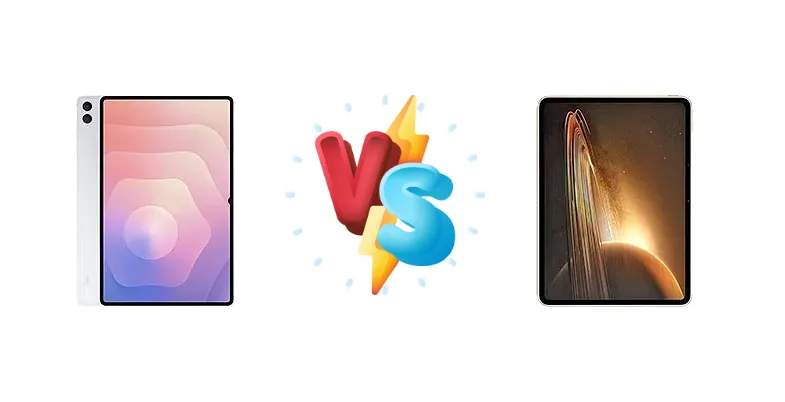
The high-end Android tablet space is heating up. The Samsung Galaxy Tab S11 Ultra, with its cutting-edge Mediatek Dimensity 9400+ chipset, faces off against the Oppo Pad 2, powered by the Dimensity 9000. This comparison dives deep into the core differences, focusing on performance, battery endurance, and charging capabilities to determine which tablet best suits your needs.
🏆 Quick Verdict
For demanding users prioritizing raw performance and extended battery life, the Samsung Galaxy Tab S11 Ultra is the clear winner. Its Dimensity 9400+ chipset and impressive 94:51h endurance outweigh the Oppo Pad 2’s faster charging, making it ideal for power users and creative professionals.
| Network |
|---|
| 2G bands | GSM 850 / 900 / 1800 / 1900 | N/A |
| 3G bands | HSDPA 850 / 900 / 1700(AWS) / 1900 / 2100 | N/A |
| 4G bands | LTE | N/A |
| 5G bands | SA/NSA/Sub6 | - |
| EDGE | - | No |
| GPRS | - | No |
| Speed | HSPA, LTE, 5G - cellular model only | - |
| Technology | GSM / HSPA / LTE / 5G | No cellular connectivity |
| Launch |
|---|
| Announced | 2025, September 04 | 2023, March 21 |
| Status | Available. Released 2025, September 04 | Available. Released 2023, March 24 |
| Body |
|---|
| Build | Glass front, aluminum frame, aluminum back | Glass front, aluminum frame |
| Dimensions | 326.3 x 208.5 x 5.1 mm (12.85 x 8.21 x 0.20 in) | 258 x 189.4 x 6.5 mm (10.16 x 7.46 x 0.26 in) |
| SIM | Nano-SIM + eSIM (cellular model only) | No |
| Weight | 692 g or 695 g (1.53 lb) | 552 g (1.22 lb) |
| | - | Stylus support, 2.0ms latency |
| Display |
|---|
| Protection | Mohs level 5 | - |
| Resolution | 1848 x 2960 pixels, 16:10 ratio (~239 ppi density) | 2000 x 2800 pixels (~296 ppi density) |
| Size | 14.6 inches, 617.8 cm2 (~90.8% screen-to-body ratio) | 11.61 inches, 411.3 cm2 (~84.2% screen-to-body ratio) |
| Type | Dynamic AMOLED 2X, 120Hz, HDR10+, 1000 nits (typ), 1600 nits (peak) | IPS LCD, 1B colors, Dolby Vision, 144Hz, 500 nits (typ) |
| Platform |
|---|
| CPU | Octa-core (1x3.63 GHz Cortex-X925 & 3x3.3 GHz Cortex-X4 & 4x2.4 GHz Cortex-A720) | Octa-core (1x3.05 GHz Cortex-X2 & 3x2.85 GHz Cortex-A710 & 4x1.80 GHz Cortex-A510) |
| Chipset | Mediatek Dimensity 9400+ (3 nm) | Mediatek Dimensity 9000 (4 nm) |
| GPU | Immortalis-G925 | Mali-G710 MC10 |
| OS | Android 16, One UI 8 | Android 13, ColorOS 13.1 |
| Memory |
|---|
| Card slot | microSDXC (dedicated slot) | No |
| Internal | 128GB 12GB RAM, 256GB 12GB RAM, 512GB 12GB RAM, 1TB 16GB RAM | 256GB 8GB RAM, 256GB 12GB RAM, 512GB 12GB RAM |
| | - | UFS 3.1 |
| Main Camera |
|---|
| Dual | 13 MP, f/2.0, 26mm (wide), 1/3.4", 1.0µm, AF
8 MP, f/2.2, (ultrawide) | - |
| Features | LED flash, HDR, panorama | Color spectrum sensor, LED flash |
| Single | - | 13 MP, f/2.2, (wide), AF |
| Video | 4K@30fps, 1080p@30fps | 4K@30fps, 1080p@30ps, gyro-EIS |
| Selfie camera |
|---|
| Features | HDR | - |
| Single | 12 MP, f/2.4, 120˚ (ultrawide) | 8 MP, f/2.3, 103˚ (ultrawide) |
| Video | 4K@30fps, 1080p@30fps | 1080p@30fps |
| Sound |
|---|
| 3.5mm jack | - | No |
| 35mm jack | No | No |
| Loudspeaker | Yes, with stereo speakers (4 speakers) | Yes, with stereo speakers (4 speakers) |
| Comms |
|---|
| Bluetooth | 5.4, A2DP, LE | 5.3, A2DP, LE, aptX HD |
| NFC | No | No |
| Positioning | GPS, GLONASS, BDS, GALILEO | GPS, GLONASS, GALILEO, BDS (B1I+B1c) |
| Radio | No | No |
| USB | USB Type-C 3.2, magnetic connector | USB Type-C 2.0, OTG, accessory connector |
| WLAN | Wi-Fi 802.11 a/b/g/n/ac/6e/7, tri-band, Wi-Fi Direct | Wi-Fi 802.11 a/b/g/n/ac/6, dual-band |
| Features |
|---|
| Sensors | Fingerprint (under display, optical), accelerometer, gyro, proximity, compass | Accelerometer, gyro, compass |
| Battery |
|---|
| Charging | 45W wired | 67W wired, PD, QC 2.0 |
| Type | Li-Po 11600 mAh | Li-Po 9510 mAh |
| Misc |
|---|
| Colors | Moonstone Gray, Platinum Silver | Gray, Gold |
| Models | SM-X930, SM-X936B, SM-X936N, SM-X930N | OPD2201, X22N2 |
| Price | $ 999.99 | About 410 EUR |
| SAR EU | 0.80 W/kg (body) | - |
| EU LABEL |
|---|
| Battery | 94:51h endurance, 1200 cycles | - |
| Energy | Class G | - |
| Free fall | Class E (0 falls) | - |
| Repairability | Class C | - |
Samsung Galaxy Tab S11 Ultra
- Superior processing power with Dimensity 9400+
- Exceptional battery life (94:51h endurance)
- Potentially higher quality display technology
- Slower charging speed (45W) compared to Oppo Pad 2
- Likely higher price point
Oppo Pad 2
- Faster 67W wired charging
- Potentially more affordable price
- PD and QC 2.0 charging compatibility
- Less powerful Dimensity 9000 chipset
- Shorter battery life compared to S11 Ultra
Display Comparison
While display specs are missing for the Oppo Pad 2, the Samsung Galaxy Tab S11 Ultra is expected to feature a high-resolution AMOLED panel. The key differentiator here will likely be peak brightness and color accuracy. The S11 Ultra’s chipset allows for more sophisticated display processing, potentially resulting in a more vibrant and accurate visual experience. The Oppo Pad 2’s display will likely be excellent, but the S11 Ultra has the potential to be superior.
Camera Comparison
Camera details are absent for both devices. However, given the tablet form factor, camera quality is less critical than on smartphones. We anticipate both tablets will offer capable cameras for casual photography and video calls. The S11 Ultra, being a flagship, may incorporate slightly larger sensors or more advanced image processing algorithms, but the difference is unlikely to be substantial for most users.
Performance
The Samsung Galaxy Tab S11 Ultra’s Mediatek Dimensity 9400+ (3nm) chipset represents a significant leap over the Oppo Pad 2’s Dimensity 9000 (4nm). The 3nm process node translates to improved power efficiency and higher transistor density, allowing for the Cortex-X925 core clocked at 3.63 GHz. This contrasts with the Oppo Pad 2’s Cortex-X2 at 3.05 GHz. The S11 Ultra’s CPU configuration – 1x X925, 3x X4, and 4x A720 – provides a more balanced and powerful architecture for sustained workloads. While both utilize LPDDR5x RAM, the S11 Ultra’s superior chipset will deliver noticeably faster application loading and smoother multitasking.
Battery Life
The Samsung Galaxy Tab S11 Ultra boasts a remarkable 94:51h endurance and supports 45W wired charging. The Oppo Pad 2 counters with a faster 67W wired charging solution. However, the S11 Ultra’s significantly longer endurance – including 13:25h of active use – mitigates the charging speed advantage. While the Oppo Pad 2 will charge faster from 0-100%, the S11 Ultra will likely last considerably longer between charges, making it more convenient for users on the go. The S11 Ultra also claims 1200 charge cycles, suggesting greater long-term battery health.
Buying Guide
Buy the Samsung Galaxy Tab S11 Ultra if you need uncompromising performance for demanding tasks like video editing, graphic design, or intensive gaming, and value long-lasting battery life. Buy the Oppo Pad 2 if you prioritize rapid charging speeds and a slightly more affordable price point, and your usage leans towards media consumption and lighter productivity tasks.
Frequently Asked Questions
❓ Will the Dimensity 9400+ in the Samsung Galaxy Tab S11 Ultra experience thermal throttling during extended gaming sessions?
The 3nm process node of the Dimensity 9400+ is designed to improve thermal efficiency. While some throttling is inevitable under sustained heavy load, it should be less pronounced than with the 4nm Dimensity 9000 in the Oppo Pad 2, allowing for longer periods of peak performance.
❓ How much faster is the 67W charging on the Oppo Pad 2 in real-world usage compared to the 45W charging on the Samsung Galaxy Tab S11 Ultra?
The Oppo Pad 2 will likely charge from 0-100% approximately 30-45 minutes faster than the S11 Ultra. However, the S11 Ultra’s significantly longer battery life means you’ll need to charge it less frequently, potentially negating the benefit of faster charging for many users.
❓ Is the difference in CPU architecture (Cortex-X925 vs Cortex-X2) noticeable in everyday tasks like browsing and video streaming?
For basic tasks like browsing and video streaming, the difference will be minimal. However, the Cortex-X925 in the S11 Ultra will provide a smoother experience when multitasking or running demanding applications, thanks to its higher clock speed and more efficient architecture.