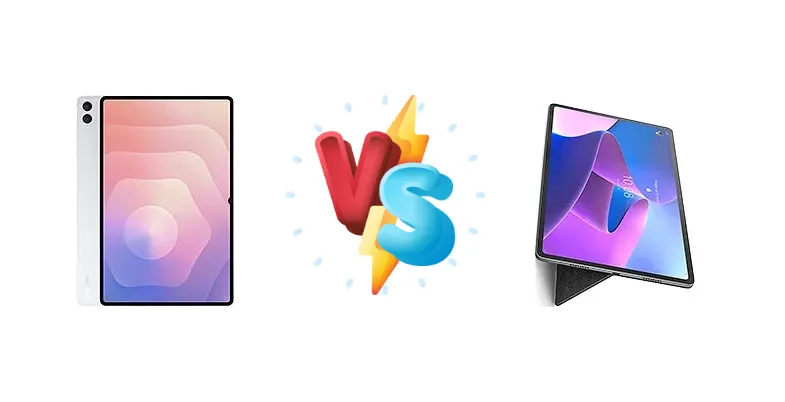
The high-end Android tablet space is heating up. The Samsung Galaxy Tab S11 Ultra, powered by the cutting-edge Mediatek Dimensity 9400+, aims to redefine performance. Meanwhile, the Lenovo Tab P12 Pro, with its Snapdragon 870 5G, offers a proven track record of solid performance and value. This comparison dissects these two tablets to determine which one best suits your needs.
🏆 Quick Verdict
For most users, the Samsung Galaxy Tab S11 Ultra is the superior choice. Its Mediatek Dimensity 9400+ chipset delivers a noticeable performance advantage, and its impressive 94:51h battery endurance ensures all-day usability. While the Lenovo Tab P12 Pro remains a strong contender, it falls slightly behind in raw processing power.
| Network |
|---|
| 2G bands | GSM 850 / 900 / 1800 / 1900 | GSM 850 / 900 / 1800 / 1900 |
| 3G bands | HSDPA 850 / 900 / 1700(AWS) / 1900 / 2100 | HSDPA 850 / 900 / 1900 / 2100 |
| 4G bands | LTE | 1, 2, 3, 4, 5, 7, 8, 19, 20, 26, 28, 34, 38, 39, 40, 41 |
| 5G bands | SA/NSA/Sub6 | 1, 3, 7, 8, 20, 28, 38, 41, 77, 78 SA/NSA/Sub6 |
| Speed | HSPA, LTE, 5G - cellular model only | HSPA, LTE, 5G - cellular model only |
| Technology | GSM / HSPA / LTE / 5G | GSM / HSPA / LTE / 5G |
| Launch |
|---|
| Announced | 2025, September 04 | 2021, September 08 |
| Status | Available. Released 2025, September 04 | Available. Released 2021, November 19 |
| Body |
|---|
| Build | Glass front, aluminum frame, aluminum back | - |
| Dimensions | 326.3 x 208.5 x 5.1 mm (12.85 x 8.21 x 0.20 in) | 285.6 x 184.5 x 5.6 mm (11.24 x 7.26 x 0.22 in) |
| SIM | Nano-SIM + eSIM (cellular model only) | Nano-SIM (cellular model only) |
| Weight | 692 g or 695 g (1.53 lb) | 565 g (1.25 lb) |
| | - | Stylus support |
| Display |
|---|
| Protection | Mohs level 5 | - |
| Resolution | 1848 x 2960 pixels, 16:10 ratio (~239 ppi density) | 1600 x 2560 pixels, 16:10 ratio (~240 ppi density) |
| Size | 14.6 inches, 617.8 cm2 (~90.8% screen-to-body ratio) | 12.6 inches, 460.3 cm2 (~87.4% screen-to-body ratio) |
| Type | Dynamic AMOLED 2X, 120Hz, HDR10+, 1000 nits (typ), 1600 nits (peak) | AMOLED, 120Hz, HDR10+, Dolby Vision, 600 nits (HBM) |
| Platform |
|---|
| CPU | Octa-core (1x3.63 GHz Cortex-X925 & 3x3.3 GHz Cortex-X4 & 4x2.4 GHz Cortex-A720) | Octa-core (1x3.2 GHz Kryo 585 & 3x2.42 GHz Kryo 585 & 4x1.80 GHz Kryo 585) |
| Chipset | Mediatek Dimensity 9400+ (3 nm) | Qualcomm SM8250-AC Snapdragon 870 5G (7 nm) |
| GPU | Immortalis-G925 | Adreno 650 |
| OS | Android 16, One UI 8 | Android 11 |
| Memory |
|---|
| Card slot | microSDXC (dedicated slot) | microSDXC (dedicated slot) |
| Internal | 128GB 12GB RAM, 256GB 12GB RAM, 512GB 12GB RAM, 1TB 16GB RAM | 128GB 6GB RAM, 256GB 8GB RAM |
| Main Camera |
|---|
| Dual | 13 MP, f/2.0, 26mm (wide), 1/3.4", 1.0µm, AF
8 MP, f/2.2, (ultrawide) | 13 MP, (wide), AF
5 MP, (ultrawide) |
| Features | LED flash, HDR, panorama | - |
| Video | 4K@30fps, 1080p@30fps | 4K@30fps, 1080p@30fps |
| Selfie camera |
|---|
| Features | HDR | - |
| Single | 12 MP, f/2.4, 120˚ (ultrawide) | 8 MP, (wide)
8 MP, IR TOF 3D, (biometrics sensor only) |
| Video | 4K@30fps, 1080p@30fps | 1080p@30fps |
| Sound |
|---|
| 3.5mm jack | - | No |
| 35mm jack | No | No |
| Loudspeaker | Yes, with stereo speakers (4 speakers) | Yes, with stereo speakers (4 speakers) |
| | - | JBL speakers |
| Comms |
|---|
| Bluetooth | 5.4, A2DP, LE | 5.2, A2DP, LE |
| NFC | No | Yes (wireless charging and data transfer only) |
| Positioning | GPS, GLONASS, BDS, GALILEO | GPS, GLONASS, BDS - cellular model only |
| Radio | No | Unspecified |
| USB | USB Type-C 3.2, magnetic connector | USB Type-C 3.1 |
| WLAN | Wi-Fi 802.11 a/b/g/n/ac/6e/7, tri-band, Wi-Fi Direct | Wi-Fi 802.11 a/b/g/n/ac/6, dual-band, Wi-Fi Direct |
| Features |
|---|
| Sensors | Fingerprint (under display, optical), accelerometer, gyro, proximity, compass | Fingerprint (side-mounted), accelerometer, gyro, proximity |
| Battery |
|---|
| Charging | 45W wired | 45W wired, QC4 |
| Type | Li-Po 11600 mAh | Li-Po 10200 mAh |
| Misc |
|---|
| Colors | Moonstone Gray, Platinum Silver | Storm Grey |
| Models | SM-X930, SM-X936B, SM-X936N, SM-X930N | TB-Q706Z, TB-Q706F |
| Price | $ 999.99 | About 520 EUR |
| SAR EU | 0.80 W/kg (body) | - |
| EU LABEL |
|---|
| Battery | 94:51h endurance, 1200 cycles | - |
| Energy | Class G | - |
| Free fall | Class E (0 falls) | - |
| Repairability | Class C | - |
Samsung Galaxy Tab S11 Ultra
- Superior performance with the Dimensity 9400+ chipset
- Exceptional battery life (94:51h endurance)
- Potentially better thermal management due to 3nm process
- Price likely to be higher than the Lenovo Tab P12 Pro
- Software updates may be less frequent than Lenovo
Lenovo Tab P12 Pro
- Proven Snapdragon 870 performance
- QC4 support for faster charging compatibility
- Potentially more affordable price point
- Less powerful chipset compared to the Dimensity 9400+
- Likely shorter battery life
Display Comparison
While both tablets likely feature high-quality displays (data not provided), the core difference lies beneath the surface. The Samsung Tab S11 Ultra benefits from the efficiency gains of the Dimensity 9400+’s 3nm process, potentially allowing for a brighter, more power-efficient display. The Lenovo Tab P12 Pro, utilizing the 7nm Snapdragon 870, will deliver excellent visuals, but may require more power to achieve similar brightness levels. The absence of display specs necessitates assuming both are high-resolution LCD or AMOLED panels, but the chipset impacts how efficiently those panels are driven.
Camera Comparison
Without specific camera specifications, a direct comparison is limited. However, given Samsung’s history with mobile photography, the Tab S11 Ultra likely incorporates more advanced image processing algorithms. The Lenovo Tab P12 Pro’s camera system is expected to be competent, but may not match the sophistication of Samsung’s offerings. The focus should be on the main sensor quality and image stabilization, as these are the most impactful factors in real-world photography.
Performance
The Mediatek Dimensity 9400+ in the Samsung Galaxy Tab S11 Ultra represents a significant leap forward. Its octa-core configuration, featuring a Cortex-X925 prime core clocked at 3.63 GHz, promises substantially faster processing speeds compared to the Lenovo Tab P12 Pro’s Snapdragon 870 (3.2 GHz Kryo 585). The Dimensity’s 3nm fabrication process also translates to improved thermal efficiency, reducing the likelihood of performance throttling during sustained workloads. While the Snapdragon 870 is a capable chip, the Dimensity 9400+ offers a clear advantage for demanding applications.
Battery Life
The Samsung Galaxy Tab S11 Ultra boasts an impressive 94:51h endurance rating, translating to 13:25h of active use. This is likely due to the efficiency of the 3nm Dimensity 9400+ chipset. The Lenovo Tab P12 Pro, while supporting 45W wired charging with QC4, doesn’t have endurance data available. Both tablets share the same 45W charging speed, but the S11 Ultra’s superior efficiency means it will likely reach full charge faster and maintain power for longer periods. The 1200 charge cycles rating for the S11 Ultra also suggests a longer lifespan.
Buying Guide
Buy the Samsung Galaxy Tab S11 Ultra if you prioritize peak performance for demanding tasks like video editing, gaming, or multitasking. Its newer chipset and longer battery life make it ideal for power users. Buy the Lenovo Tab P12 Pro if you value a balance of performance and affordability, and prefer a well-established platform with Qualcomm’s Snapdragon 870, offering a smooth experience for everyday tasks and media consumption.
Frequently Asked Questions
❓ Does the Mediatek Dimensity 9400+ in the Tab S11 Ultra overheat during prolonged gaming sessions?
The Dimensity 9400+'s 3nm fabrication process is designed for improved thermal efficiency. While any powerful chipset will generate heat, the 3nm node should significantly reduce throttling compared to the 7nm Snapdragon 870 in the Tab P12 Pro, allowing for more sustained performance during gaming.
❓ How does the 45W charging on both tablets compare in real-world usage?
Both tablets support 45W wired charging. However, the Samsung Galaxy Tab S11 Ultra’s more efficient chipset means it will likely reach a full charge faster and consume less energy overall, even with the same charging wattage. The Lenovo Tab P12 Pro’s QC4 support offers broader compatibility with various chargers.
❓ Is the performance difference between the Dimensity 9400+ and Snapdragon 870 noticeable for everyday tasks?
For basic tasks like browsing, email, and video streaming, the difference will be minimal. However, when performing demanding tasks like video editing, graphic design, or playing graphically intensive games, the Dimensity 9400+ will provide a noticeably smoother and faster experience.