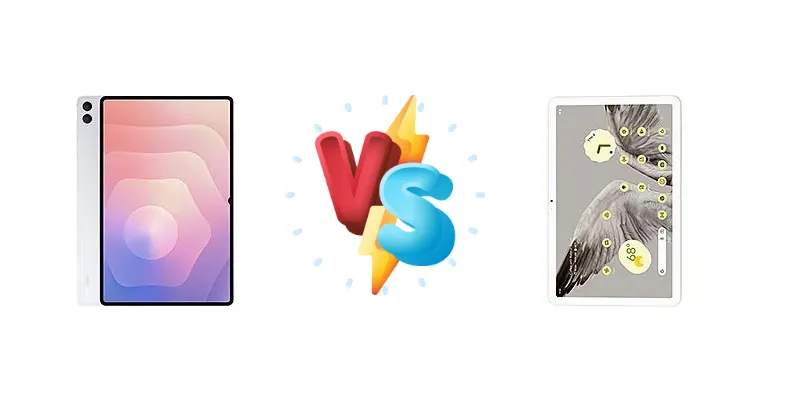
The Android tablet landscape is heating up. Samsung’s Galaxy Tab S11 Ultra aims for uncompromising performance and a premium experience, while Google’s Pixel Tablet focuses on seamless integration with the Google ecosystem and a unique charging/docking experience. This comparison dissects the core differences to determine which tablet best suits your needs.
🏆 Quick Verdict
For users prioritizing raw processing power and extended battery life, the Samsung Galaxy Tab S11 Ultra is the clear winner. Its Mediatek Dimensity 9400+ chipset and 94:51h endurance significantly outperform the Pixel Tablet. However, the Pixel Tablet offers a compelling value proposition for those deeply invested in the Google ecosystem.
| Network |
|---|
| 2G bands | GSM 850 / 900 / 1800 / 1900 | N/A |
| 3G bands | HSDPA 850 / 900 / 1700(AWS) / 1900 / 2100 | N/A |
| 4G bands | LTE | N/A |
| 5G bands | SA/NSA/Sub6 | - |
| EDGE | - | No |
| GPRS | - | No |
| Speed | HSPA, LTE, 5G - cellular model only | - |
| Technology | GSM / HSPA / LTE / 5G | No cellular connectivity |
| Launch |
|---|
| Announced | 2025, September 04 | 2023, May 10 |
| Status | Available. Released 2025, September 04 | Available. Released 2023, June 20 |
| Body |
|---|
| Build | Glass front, aluminum frame, aluminum back | Glass front, aluminum frame, aluminum back |
| Dimensions | 326.3 x 208.5 x 5.1 mm (12.85 x 8.21 x 0.20 in) | 258 x 169 x 8.1 mm (10.16 x 6.65 x 0.32 in) |
| SIM | Nano-SIM + eSIM (cellular model only) | No |
| Weight | 692 g or 695 g (1.53 lb) | 493 g (1.09 lb) |
| | - | Stylus support |
| Display |
|---|
| Protection | Mohs level 5 | - |
| Resolution | 1848 x 2960 pixels, 16:10 ratio (~239 ppi density) | 1600 x 2560 pixels, 16:10 ratio (~276 ppi density) |
| Size | 14.6 inches, 617.8 cm2 (~90.8% screen-to-body ratio) | 10.95 inches, 347.7 cm2 (~79.7% screen-to-body ratio) |
| Type | Dynamic AMOLED 2X, 120Hz, HDR10+, 1000 nits (typ), 1600 nits (peak) | IPS LCD |
| Platform |
|---|
| CPU | Octa-core (1x3.63 GHz Cortex-X925 & 3x3.3 GHz Cortex-X4 & 4x2.4 GHz Cortex-A720) | Octa-core (2x2.85 GHz Cortex-X1 & 2x2.35 GHz Cortex-A78 & 4x1.80 GHz Cortex-A55) |
| Chipset | Mediatek Dimensity 9400+ (3 nm) | Google Tensor G2 (5 nm) |
| GPU | Immortalis-G925 | Mali-G710 MP7 |
| OS | Android 16, One UI 8 | Android 13, upgradable to Android 15 |
| Memory |
|---|
| Card slot | microSDXC (dedicated slot) | No |
| Internal | 128GB 12GB RAM, 256GB 12GB RAM, 512GB 12GB RAM, 1TB 16GB RAM | 128GB 8GB RAM, 256GB 8GB RAM |
| | - | UFS 3.1 |
| Main Camera |
|---|
| Dual | 13 MP, f/2.0, 26mm (wide), 1/3.4", 1.0µm, AF
8 MP, f/2.2, (ultrawide) | - |
| Features | LED flash, HDR, panorama | HDR, panorama |
| Single | - | 8 MP, f/2.0, 24mm (wide), 1/4.0", 1.12µm |
| Video | 4K@30fps, 1080p@30fps | 1080p@30fps |
| Selfie camera |
|---|
| Features | HDR | HDR, panorama |
| Single | 12 MP, f/2.4, 120˚ (ultrawide) | 8 MP, f/2.0, 24mm (wide), 1/4.0", 1.12µm |
| Video | 4K@30fps, 1080p@30fps | 1080p@30fps |
| Sound |
|---|
| 3.5mm jack | - | No |
| 35mm jack | No | No |
| Loudspeaker | Yes, with stereo speakers (4 speakers) | Yes, with stereo speakers (4 speakers) |
| Comms |
|---|
| Bluetooth | 5.4, A2DP, LE | 5.2, A2DP, LE |
| NFC | No | No |
| Positioning | GPS, GLONASS, BDS, GALILEO | No |
| Radio | No | No |
| USB | USB Type-C 3.2, magnetic connector | USB Type-C 3.2 (Gen 1), magnetic connector |
| WLAN | Wi-Fi 802.11 a/b/g/n/ac/6e/7, tri-band, Wi-Fi Direct | Wi-Fi 802.11 a/b/g/n/ac/6, dual-band |
| Features |
|---|
| Sensors | Fingerprint (under display, optical), accelerometer, gyro, proximity, compass | Accelerometer, gyro, compass, proximity (accessories only) |
| | - | Ultra Wideband (UWB) support |
| Battery |
|---|
| Charging | 45W wired | 15W wired |
| Type | Li-Po 11600 mAh | Li-Po 7020 mAh (27 Wh) |
| Misc |
|---|
| Colors | Moonstone Gray, Platinum Silver | Porcelain, Hazel, Rose |
| Models | SM-X930, SM-X936B, SM-X936N, SM-X930N | GA06156-EU, GA06157-EU, GA06158-EU |
| Price | $ 999.99 | About 670 EUR |
| SAR EU | 0.80 W/kg (body) | - |
| EU LABEL |
|---|
| Battery | 94:51h endurance, 1200 cycles | - |
| Energy | Class G | - |
| Free fall | Class E (0 falls) | - |
| Repairability | Class C | - |
Samsung Galaxy Tab S11 Ultra
- Exceptional processing power with Dimensity 9400+
- Industry-leading battery life (94:51h endurance)
- Faster 45W wired charging
- Likely superior display quality (AMOLED, LTPO)
- Potentially higher price point
- Samsung’s One UI may not appeal to all users
Google Pixel Tablet
- Seamless integration with Google ecosystem
- Unique docking/charging speaker experience
- Competitive price point
- Excellent software support and updates
- Less powerful Tensor G2 chipset
- Slower 15W wired charging
- Inferior battery life compared to S11 Ultra
Display Comparison
While display specs are missing for the S11 Ultra, Samsung typically excels in this area, likely featuring an AMOLED panel with high peak brightness and color accuracy. The Pixel Tablet’s display is adequate for general use, but the S11 Ultra, based on Samsung’s history, will likely offer a superior visual experience, potentially with LTPO technology for variable refresh rates and improved power efficiency. Bezels are a key differentiator, and the S11 Ultra is expected to have slimmer bezels, maximizing screen real estate.
Camera Comparison
Camera details are limited, but the S11 Ultra is expected to have a more sophisticated camera system. The Pixel Tablet’s Tensor G2 excels in computational photography, but the S11 Ultra’s likely larger sensor and potentially more versatile lens setup will provide greater flexibility and image quality in various lighting conditions. The Pixel Tablet’s strength lies in its software processing, but the S11 Ultra should have a hardware advantage.
Performance
The performance gap is significant. The Samsung Galaxy Tab S11 Ultra’s Mediatek Dimensity 9400+ (3nm) chipset, with its octa-core configuration (1x3.63 GHz Cortex-X925, 3x3.3 GHz Cortex-X4, and 4x2.4 GHz Cortex-A720), represents a substantial leap in processing power compared to the Google Pixel Tablet’s Google Tensor G2 (5nm). The Dimensity 9400+’s newer architecture and smaller fabrication node translate to higher clock speeds and improved efficiency. The Tensor G2, while capable, is optimized for AI tasks and image processing rather than sustained peak performance. This difference will be most noticeable in demanding applications and graphically intensive games. The S11 Ultra will likely feature faster LPDDR5x RAM, further enhancing performance.
Battery Life
The Samsung Galaxy Tab S11 Ultra dominates in battery endurance with a reported 94:51h endurance and 13:25h of active use. This is largely due to the efficient 3nm Dimensity 9400+ chipset. The Pixel Tablet, with its 15W wired charging, will take considerably longer to charge compared to the S11 Ultra’s 45W wired charging. While the Pixel Tablet’s battery capacity is unknown, the S11 Ultra’s superior endurance and faster charging provide a significant advantage for users who rely on their tablet throughout the day.
Buying Guide
Buy the Samsung Galaxy Tab S11 Ultra if you need a powerhouse for demanding tasks like video editing, graphic design, or mobile gaming, and require exceptional battery life for all-day use. Buy the Google Pixel Tablet if you prioritize a seamless smart home experience, enjoy Google’s software features, and value a tablet that easily transitions between portable and docked modes for home use.
Frequently Asked Questions
❓ Does the Mediatek Dimensity 9400+ in the Galaxy Tab S11 Ultra generate excessive heat during prolonged gaming sessions?
The Dimensity 9400+’s 3nm fabrication process is designed for improved thermal efficiency. While demanding games will inevitably generate heat, the 9400+ is expected to manage temperatures more effectively than the 5nm Tensor G2, minimizing throttling and maintaining consistent performance over extended periods.
❓ How does the Google Pixel Tablet’s charging dock enhance the user experience beyond just charging?
The Pixel Tablet’s charging dock transforms the tablet into a smart display, offering hands-free Google Assistant access, smart home controls, and a convenient hub for media consumption. It effectively bridges the gap between a portable tablet and a stationary smart home device.
❓ Is the performance difference between the Dimensity 9400+ and Tensor G2 noticeable in everyday tasks like browsing and video streaming?
For basic tasks like web browsing, email, and video streaming, the performance difference may not be immediately apparent. However, the Dimensity 9400+’s superior processing power will result in snappier multitasking and faster app loading times, even during everyday use.