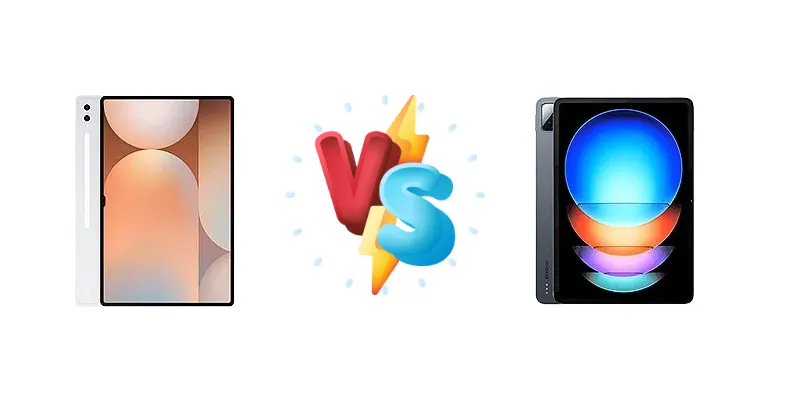
The high-end Android tablet space is heating up. Samsung’s Galaxy Tab S10 Ultra, powered by the new Mediatek Dimensity 9300+, aims to redefine performance. But Xiaomi’s Pad 6S Pro 12.4, equipped with the Snapdragon 8 Gen 2, presents a formidable challenge, particularly with its blazing-fast 120W charging. This comparison dissects these two titans to determine which tablet best suits demanding users.
🏆 Quick Verdict
For the average user prioritizing raw speed and long-term battery health, the Samsung Galaxy Tab S10 Ultra edges out the Xiaomi Pad 6S Pro 12.4. The Dimensity 9300+’s architecture and 2000 charge cycles offer a performance advantage and greater longevity, despite the Xiaomi’s faster charging.
| Network |
|---|
| 2G bands | GSM 850 / 900 / 1800 / 1900 | N/A |
| 3G bands | HSDPA 850 / 900 / 1700(AWS) / 1900 / 2100 | N/A |
| 4G bands | 1, 2, 3, 4, 5, 7, 8, 12, 13, 17, 20, 25, 26, 28, 32, 38, 39, 40, 41, 66 | - |
| 5G bands | 1, 2, 3, 5, 7, 8, 12, 20, 25, 26, 28, 38, 40, 41, 66, 77, 78 SA/NSA/Sub6 | - |
| EDGE | - | N/A |
| GPRS | - | N/A |
| Speed | HSPA, LTE, 5G - cellular model only | - |
| Technology | GSM / HSPA / LTE / 5G | No cellular connectivity |
| Launch |
|---|
| Announced | 2024, September 26 | 2024, February 22 |
| Status | Available. Released 2024, October 03 | Available. Released 2024, February 22 |
| Body |
|---|
| Build | Glass front, aluminum frame, aluminum back | Glass front (Gorilla Glass 5), aluminum frame, aluminum back |
| Dimensions | 326.4 x 208.6 x 5.4 mm (12.85 x 8.21 x 0.21 in) | 278.7 x 191.6 x 6.3 mm (10.97 x 7.54 x 0.25 in) |
| SIM | Nano-SIM + eSIM (cellular model only) | No |
| Weight | 718 g (Wi-Fi), 723 g (5G) (1.58 lb) | 590 g (1.30 lb) |
| Display |
|---|
| Protection | Mohs level 5 | Corning Gorilla Glass 5 |
| Resolution | 1848 x 2960 pixels, 16:10 ratio (~239 ppi density) | 2032 x 3048 pixels, 3:2 ratio (~295 ppi density) |
| Size | 14.6 inches, 617.8 cm2 (~90.7% screen-to-body ratio) | 12.4 inches, 457.8 cm2 (~85.7% screen-to-body ratio) |
| Type | Dynamic AMOLED 2X, 120Hz, HDR10+ | IPS LCD, 68B colors, 144Hz, HDR10, Dolby Vision, 900 nits (peak) |
| Platform |
|---|
| CPU | Octa-core (1x3.4 GHz Cortex-X4 & 3x2.8 GHz Cortex-X4 & 4x2.0 GHz Cortex-A720) | Octa-core (1x3.2 GHz Cortex-X3 & 2x2.8 GHz Cortex-A715 & 2x2.8 GHz Cortex-A710 & 3x2.0 GHz Cortex-A510) |
| Chipset | Mediatek Dimensity 9300+ (4 nm) | Qualcomm SM8550-AB Snapdragon 8 Gen 2 (4 nm) |
| GPU | Immortalis-G720 MC12 | Adreno 740 |
| OS | Android 14, One UI 6.1 | Android 14, up to 3 major Android upgrades, HyperOS |
| Memory |
|---|
| Card slot | microSDXC (dedicated slot) | No |
| Internal | 256GB 12GB RAM, 512GB 12GB RAM, 1TB 12GB RAM, 1TB 16GB RAM | 256GB 8GB RAM, 256GB 12GB RAM, 512GB 12GB RAM, 1TB 16GB RAM |
| Main Camera |
|---|
| Dual | 13 MP, f/2.0, 26mm (wide), 1/3.4", 1.0µm, AF
8 MP, f/2.2, (ultrawide) | 50 MP, f/1.8, (wide), 1/2.76", 0.64µm, PDAF
Auxiliary lens |
| Features | LED flash, HDR, panorama | LED flash, HDR, panorama |
| Video | 4K@30fps, 1080p@30fps | 4K@30/60fps, 1080p@30/60fps |
| Selfie camera |
|---|
| Dual | 12 MP, f/2.2, 26mm (wide)
12 MP, f/2.4, 120˚ (ultrawide) | - |
| Features | HDR | - |
| Single | - | 32 MP, f/2.2, (wide), 1/3.6", 0.61µm |
| Video | 4K@30fps, 1080p@30fps | 1080p@30fps |
| Sound |
|---|
| 35mm jack | No | No |
| Loudspeaker | Yes, with stereo speakers (4 speakers) | Yes, with stereo speakers (6 speakers) |
| Comms |
|---|
| Bluetooth | 5.3, A2DP, LE | 5.3, A2DP, LE, LHDC |
| NFC | No | Yes (file transfer only) |
| Positioning | GPS, GLONASS, BDS, GALILEO - cellular model only | No |
| Radio | No | No |
| USB | USB Type-C 3.2, magnetic connector | USB Type-C 3.2, accessory connector |
| WLAN | Wi-Fi 802.11 a/b/g/n/ac/6e/7, tri-band, Wi-Fi Direct | Wi-Fi 802.11 a/b/g/n/a/6/7, dual-band, Wi-Fi Direct |
| Features |
|---|
| Sensors | Fingerprint (under display, optical), accelerometer, gyro, proximity, compass | Fingerprint (side-mounted), accelerometer, gyro, proximity (accessories only), compass |
| Battery |
|---|
| Charging | 45W wired | 120W wired, PD3.0, QC4, 45% in 10 min, 100% in 35 min |
| Type | Li-Po 11200 mAh | 10000 mAh |
| Misc |
|---|
| Colors | Moonstone Gray, Platinum Silver | Black, Blue, Green |
| Models | SM-X920, SM-X926B, SM-X926N, SM-X920N | 24018RPACG |
| Price | $ 899.99 | About 700 EUR |
| SAR EU | 0.94 W/kg (body) | 0.99 W/kg (body) |
| EU LABEL |
|---|
| Battery | 85:18h endurance, 2000 cycles | - |
| Energy | Class G | - |
| Free fall | Class E (0 falls) | - |
| Repairability | Class C | - |
Samsung Galaxy Tab S10 Ultra
- Exceptional long-term battery health (2000 cycles)
- Potentially superior sustained performance with Dimensity 9300+
- Likely excellent software support from Samsung
- Slower charging speed (45W)
- Display specs not fully detailed
- Camera details are lacking
Xiaomi Pad 6S Pro 12.4
- Blazing-fast 120W charging (0-100% in 35 minutes)
- High-contrast, bright display (848 nits, 1378:1)
- Snapdragon 8 Gen 2 offers excellent performance
- Shorter battery lifespan (fewer charge cycles)
- Potentially more throttling under sustained load
- Xiaomi’s software experience can be divisive
Display Comparison
The Xiaomi Pad 6S Pro 12.4 boasts a superior display with a measured 848 nits of peak brightness and a 1378:1 contrast ratio, ensuring vivid visuals and deep blacks. While the Tab S10 Ultra’s display specs aren’t provided, Samsung typically employs AMOLED panels with excellent color accuracy. However, the Xiaomi’s higher contrast ratio will be noticeable in darker environments. The lack of LTPO information for the S10 Ultra means it may not dynamically adjust refresh rates as efficiently as some competitors, potentially impacting battery life during static content viewing.
Camera Comparison
Neither tablet is positioned as a photography powerhouse, but the Xiaomi Pad 6S Pro 12.4 likely holds an advantage. While specific camera specs for the Tab S10 Ultra are missing, Xiaomi’s focus on image quality in its flagship devices suggests a more refined camera system. The absence of details regarding OIS or sensor size on the S10 Ultra implies a more basic camera experience. Users should temper expectations for exceptional image quality from either device.
Performance
The core battle lies in the chipsets. The Samsung Galaxy Tab S10 Ultra’s Mediatek Dimensity 9300+ (4nm) features a unique core configuration – 1x3.4 GHz Cortex-X4, 3x2.8 GHz Cortex-X4, and 4x2.0 GHz Cortex-A720 – designed for sustained performance. The Xiaomi Pad 6S Pro 12.4 counters with the Qualcomm Snapdragon 8 Gen 2 (4nm), utilizing a more traditional 1x3.2 GHz Cortex-X3, 2x2.8 GHz Cortex-A715, 2x2.8 GHz Cortex-A710, and 3x2.0 GHz Cortex-A510 setup. While clock speeds aren’t everything, the Dimensity 9300+'s newer architecture and higher Cortex-X4 count suggest a potential edge in multi-threaded workloads. Both utilize a 4nm process, but Mediatek’s advancements in the 9300+ may yield better thermal efficiency, reducing throttling during extended gaming sessions.
Battery Life
The Samsung Galaxy Tab S10 Ultra claims an impressive 85:18h endurance and a remarkable 2000 charge cycles, indicating a focus on long-term battery health. The Xiaomi Pad 6S Pro 12.4, with an active use score of 11:14h, offers less endurance but compensates with its 120W wired charging, capable of reaching 45% in just 10 minutes and 100% in 35 minutes. This difference is significant for users who frequently need to top up their battery quickly. The S10 Ultra’s 45W charging is considerably slower, but the extended battery lifespan could offset this for users prioritizing longevity.
Buying Guide
Buy the Samsung Galaxy Tab S10 Ultra if you need uncompromising performance for demanding tasks like video editing, 3D rendering, or heavy multitasking, and value a longer-lasting battery with extended cycle life. Buy the Xiaomi Pad 6S Pro 12.4 if you prioritize incredibly fast charging – getting from 0 to 100% in just 35 minutes – and a vibrant, high-contrast display for media consumption, all at a potentially more competitive price point.
Frequently Asked Questions
❓ Does the Mediatek Dimensity 9300+ in the Galaxy Tab S10 Ultra suffer from thermal throttling during extended gaming sessions?
While the Dimensity 9300+ is a powerful chip, sustained performance is key. Mediatek has focused on thermal efficiency with this generation, and the 4nm process helps. However, without extensive testing, it's difficult to definitively say if throttling will occur. The architecture suggests it should handle heat better than previous generations, but demanding games will still push the system.
❓ How does the 120W charging on the Xiaomi Pad 6S Pro 12.4 impact battery health over the long term?
While 120W charging is incredibly fast, it can generate more heat, potentially accelerating battery degradation over time. Xiaomi likely employs sophisticated charging algorithms to mitigate this, but the Samsung Galaxy Tab S10 Ultra’s slower charging and 2000 charge cycle rating suggest a longer overall battery lifespan.
❓ Is the difference in CPU architecture between the Dimensity 9300+ and Snapdragon 8 Gen 2 noticeable in everyday tasks?
For typical tasks like browsing, video streaming, and social media, the difference will be minimal. Both chips are more than capable of handling these workloads. The architectural advantages of the Dimensity 9300+ will become more apparent in demanding applications like video editing, 3D rendering, and heavy multitasking.
❓ Does the Xiaomi Pad 6S Pro 12.4 support pen input, and if so, what is the latency like?
While the context data doesn't specify, Xiaomi typically offers pen support with its 'Pro' tablets. Latency will depend on the pen and software optimization. Expect a similar experience to other high-end tablets with active stylus support, but independent reviews will be needed to confirm specific latency figures.