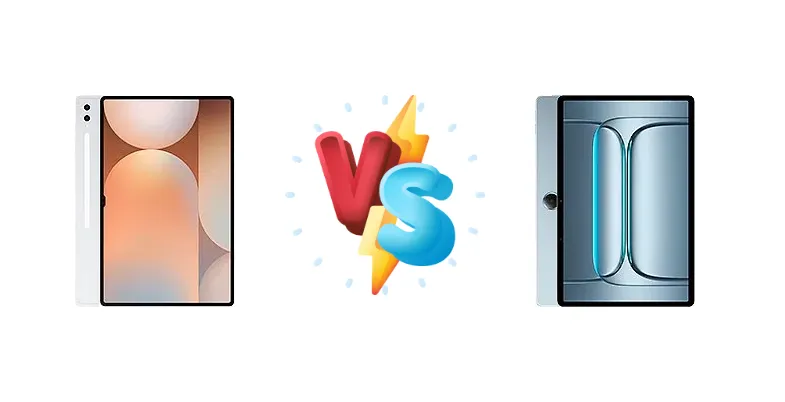
Samsung's Galaxy Tab S10 Ultra represents the pinnacle of Android tablet performance, boasting a cutting-edge chipset and premium features. The OnePlus Pad Lite, however, aims to deliver a capable tablet experience at a significantly lower price point. This comparison dissects the core differences between these two devices, focusing on how their hardware choices impact real-world usage.
🏆 Quick Verdict
For users prioritizing raw power, multitasking, and long-term durability, the Samsung Galaxy Tab S10 Ultra is the clear winner. Its Mediatek Dimensity 9300+ chipset and 85:18h endurance provide a superior experience. However, the OnePlus Pad Lite offers compelling value for casual users seeking a functional tablet for media consumption and light tasks.
| Network |
|---|
| 2G bands | GSM 850 / 900 / 1800 / 1900 | GSM 850 / 900 / 1800 / 1900 - cellular model only |
| 3G bands | HSDPA 850 / 900 / 1700(AWS) / 1900 / 2100 | HSDPA 850 / 900 / 2100 - cellular model only |
| 4G bands | 1, 2, 3, 4, 5, 7, 8, 12, 13, 17, 20, 25, 26, 28, 32, 38, 39, 40, 41, 66 | LTE - cellular model only |
| 5G bands | 1, 2, 3, 5, 7, 8, 12, 20, 25, 26, 28, 38, 40, 41, 66, 77, 78 SA/NSA/Sub6 | - |
| Speed | HSPA, LTE, 5G - cellular model only | HSPA, LTE - cellular model only |
| Technology | GSM / HSPA / LTE / 5G | GSM / HSPA / LTE |
| Launch |
|---|
| Announced | 2024, September 26 | 2025, July 08 |
| Status | Available. Released 2024, October 03 | Available. Released 2025, August 14 |
| Body |
|---|
| Build | Glass front, aluminum frame, aluminum back | - |
| Dimensions | 326.4 x 208.6 x 5.4 mm (12.85 x 8.21 x 0.21 in) | 254.9 x 166.5 x 7.4 mm (10.04 x 6.56 x 0.29 in) |
| SIM | Nano-SIM + eSIM (cellular model only) | Yes - cellular model only |
| Weight | 718 g (Wi-Fi), 723 g (5G) (1.58 lb) | 530 g (1.17 lb) |
| Display |
|---|
| Protection | Mohs level 5 | - |
| Resolution | 1848 x 2960 pixels, 16:10 ratio (~239 ppi density) | 1200 x 1920 pixels, 16:10 ratio (~207 ppi density) |
| Size | 14.6 inches, 617.8 cm2 (~90.7% screen-to-body ratio) | 11.0 inches, 347.5 cm2 (~81.9% screen-to-body ratio) |
| Type | Dynamic AMOLED 2X, 120Hz, HDR10+ | IPS LCD, 1B colors, 90Hz, 500 nits |
| Platform |
|---|
| CPU | Octa-core (1x3.4 GHz Cortex-X4 & 3x2.8 GHz Cortex-X4 & 4x2.0 GHz Cortex-A720) | Octa-core (2x2.2 GHz Cortex-A76 & 6x2.0 GHz Cortex-A55) |
| Chipset | Mediatek Dimensity 9300+ (4 nm) | Mediatek Helio G100 (6 nm) |
| GPU | Immortalis-G720 MC12 | Mali-G57 MC2 |
| OS | Android 14, One UI 6.1 | Android 15, OxygenOS 15 |
| Memory |
|---|
| Card slot | microSDXC (dedicated slot) | Unspecified |
| Internal | 256GB 12GB RAM, 512GB 12GB RAM, 1TB 12GB RAM, 1TB 16GB RAM | 128GB 6GB RAM, 128GB 8GB RAM |
| Main Camera |
|---|
| Dual | 13 MP, f/2.0, 26mm (wide), 1/3.4", 1.0µm, AF
8 MP, f/2.2, (ultrawide) | - |
| Features | LED flash, HDR, panorama | - |
| Single | - | 5 MP |
| Video | 4K@30fps, 1080p@30fps | 1080p@30fps |
| Selfie camera |
|---|
| Dual | 12 MP, f/2.2, 26mm (wide)
12 MP, f/2.4, 120˚ (ultrawide) | - |
| Features | HDR | - |
| Single | - | 5 MP |
| Video | 4K@30fps, 1080p@30fps | 1080p@30fps |
| Sound |
|---|
| 35mm jack | No | No |
| Loudspeaker | Yes, with stereo speakers (4 speakers) | Yes, with stereo speakers (4 speakers, Hi-Res audio) |
| Comms |
|---|
| Bluetooth | 5.3, A2DP, LE | 5.2, A2DP, LE, aptX HD |
| NFC | No | No |
| Positioning | GPS, GLONASS, BDS, GALILEO - cellular model only | GPS, (cellular model only) - unconfirmed |
| Radio | No | No |
| USB | USB Type-C 3.2, magnetic connector | USB Type-C 2.0 |
| WLAN | Wi-Fi 802.11 a/b/g/n/ac/6e/7, tri-band, Wi-Fi Direct | Wi-Fi 802.11 a/b/g/n/ac, dual-band |
| Features |
|---|
| Sensors | Fingerprint (under display, optical), accelerometer, gyro, proximity, compass | Unspecified |
| Battery |
|---|
| Charging | 45W wired | 33W wired |
| Type | Li-Po 11200 mAh | Li-Po 9340 mAh |
| Misc |
|---|
| Colors | Moonstone Gray, Platinum Silver | Aero Blue |
| Models | SM-X920, SM-X926B, SM-X926N, SM-X920N | OPD2480 |
| Price | $ 899.99 | About 200 EUR |
| SAR EU | 0.94 W/kg (body) | - |
| EU LABEL |
|---|
| Battery | 85:18h endurance, 2000 cycles | - |
| Energy | Class G | - |
| Free fall | Class E (0 falls) | - |
| Repairability | Class C | - |
Samsung Galaxy Tab S10 Ultra
- Exceptional performance with the Mediatek Dimensity 9300+ chipset
- Long battery life with 85:18h endurance and 2000 cycles
- Fast 45W wired charging
- Likely a higher price point
- Potentially larger and heavier form factor
OnePlus Pad Lite
- More affordable price
- Decent performance for everyday tasks
- Potentially more portable design
- Significantly less powerful than the Tab S10 Ultra
- Slower 33W charging
Display Comparison
While display specs are missing for the OnePlus Pad Lite, the Samsung Galaxy Tab S10 Ultra’s Mediatek Dimensity 9300+ chipset will drive a high-resolution, likely AMOLED panel. The Dimensity 9300+'s integrated graphics capabilities are crucial for rendering smooth visuals on such a display. The OnePlus Pad Lite, utilizing the Helio G100, will likely target a more cost-effective LCD panel, potentially impacting color accuracy and peak brightness. The 4nm process of the Dimensity 9300+ also contributes to more efficient display power consumption.
Camera Comparison
Camera details are absent for both devices, but given the market positioning, we can infer differences. The Tab S10 Ultra, as a flagship, will likely feature a more sophisticated camera system with larger sensors and optical image stabilization (OIS). The OnePlus Pad Lite will likely prioritize cost savings, resulting in a simpler camera setup. Without specific sensor information, it’s difficult to make a precise comparison, but the S10 Ultra is expected to deliver superior image quality, especially in low-light conditions.
Performance
The performance gap between these tablets is substantial. The Samsung Galaxy Tab S10 Ultra’s Mediatek Dimensity 9300+ (4nm) features a complex octa-core configuration – 1x3.4 GHz Cortex-X4, 3x2.8 GHz Cortex-X4, and 4x2.0 GHz Cortex-A720 – designed for peak performance and efficient multitasking. In contrast, the OnePlus Pad Lite’s Mediatek Helio G100 (6nm) with its 2x2.2 GHz Cortex-A76 and 6x2.0 GHz Cortex-A55 cores is geared towards mainstream usage. The 4nm fabrication process of the Dimensity 9300+ provides a significant advantage in thermal efficiency, reducing throttling during sustained workloads. This translates to consistently higher frame rates in games and faster rendering times for demanding applications.
Battery Life
The Samsung Galaxy Tab S10 Ultra boasts an impressive 85:18h endurance, suggesting a large battery capacity optimized by the efficient Dimensity 9300+ chipset. The 45W wired charging allows for relatively quick replenishment. The OnePlus Pad Lite, with its 33W charging, will likely take longer to fully charge. While the exact battery capacity of the Pad Lite is unknown, the Helio G100’s 6nm process is more efficient than older nodes, but still lags behind the 4nm Dimensity 9300+ in overall power efficiency. The S10 Ultra’s 2000 charge cycles also indicate a longer lifespan.
Buying Guide
Buy the Samsung Galaxy Tab S10 Ultra if you need a powerhouse for demanding applications like video editing, graphic design, or intensive gaming, and if longevity with 2000 battery cycles is a priority. Buy the OnePlus Pad Lite if you prefer a more affordable tablet for everyday tasks like browsing, streaming, and light productivity, and are willing to trade performance for a lower price.
Frequently Asked Questions
❓ Will the Mediatek Dimensity 9300+ in the Tab S10 Ultra overheat during extended gaming sessions?
The Dimensity 9300+'s 4nm fabrication process and advanced thermal management features are designed to minimize overheating. While some heat generation is inevitable during intensive tasks, the S10 Ultra should maintain stable performance for longer periods compared to devices with less efficient chipsets.
❓ Is the 33W charging on the OnePlus Pad Lite sufficient for quick top-ups throughout the day?
33W charging is adequate for overnight charging, but it will take considerably longer to fully charge the Pad Lite compared to the 45W charging on the Tab S10 Ultra. Quick top-ups will be slower, requiring more time connected to a power source.
❓ How will the difference in CPU architecture (Cortex-X4 vs Cortex-A76) impact multitasking performance?
The Cortex-X4 cores in the Dimensity 9300+ are designed for peak performance and are significantly more powerful than the Cortex-A76 cores in the Helio G100. This translates to smoother multitasking, faster app switching, and the ability to handle more demanding applications simultaneously on the Tab S10 Ultra.