
Samsung Galaxy Tab S10 Lite vs. S9 FE: A Deep Dive into Battery, Performance, and Value
| Phones Images | |||||
|---|---|---|---|---|---|
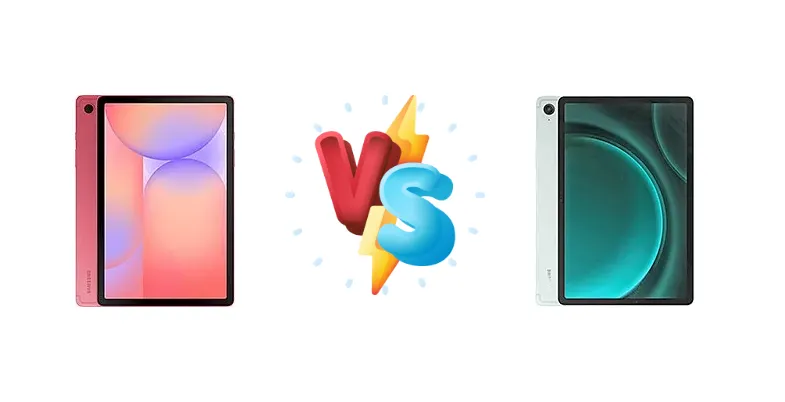
|
🏆 Quick Verdict
For the average user prioritizing longevity and sustained use, the Samsung Galaxy Tab S10 Lite emerges as the winner. Its exceptional 87:42h battery endurance significantly outweighs the S9 FE’s faster 45W charging, especially considering both share the same processor.
| PHONES | ||
|---|---|---|
| Phone Names | Samsung Galaxy Tab S10 Lite | Samsung Galaxy Tab S9 FE |
| Network | ||
|---|---|---|
| 2G bands | GSM 850 / 900 / 1800 / 1900 | GSM 850 / 900 / 1800 / 1900 |
| 3G bands | HSDPA 850 / 900 / 1700(AWS) / 1900 / 2100 | HSDPA 850 / 900 / 1700(AWS) / 1900 / 2100 |
| 4G bands | 1, 2, 3, 4, 5, 7, 8, 12, 13, 17, 20, 25, 26, 28, 32, 38, 40, 41, 66 | 1, 2, 3, 4, 5, 7, 8, 12, 13, 17, 20, 26, 28, 32, 38, 40, 41, 66 |
| 5G bands | 1, 3, 5, 7, 8, 20, 26, 28, 38, 40, 41, 66, 71, 77, 78 SA/NSA/Sub6 | 1, 3, 5, 7, 8, 20, 28, 38, 40, 41, 66, 77, 78 SA/NSA/Sub6 |
| Speed | HSPA, LTE, 5G - cellular model only | HSPA, LTE, 5G - cellular model only |
| Technology | GSM / HSPA / LTE / 5G | GSM / HSPA / LTE / 5G |
| Launch | ||
|---|---|---|
| Announced | 2025, August 25 | 2023, October 04 |
| Status | Available. Released 2025, August 25 | Available. Released 2023, October 16 |
| Body | ||
|---|---|---|
| Build | Glass front, aluminum back, aluminum frame | Glass front, aluminum back, aluminum frame |
| Dimensions | 254.3 x 165.8 x 6.6 mm (10.01 x 6.53 x 0.26 in) | 254.3 x 165.8 x 6.5 mm (10.01 x 6.53 x 0.26 in) |
| SIM | Nano-SIM + eSIM (cellular model only) | Nano-SIM + eSIM (cellular model only) |
| Weight | 524 g (1.16 lb) | 523 g or 524 g (1.15 lb) |
| Display | ||
|---|---|---|
| Protection | Mohs level 5 | - |
| Resolution | 1320 x 2112 pixels, 16:10 ratio (~228 ppi density) | 1440 x 2304 pixels, 16:10 ratio (~249 ppi density) |
| Size | 10.9 inches, 344.5 cm2 (~81.7% screen-to-body ratio) | 10.9 inches, 344.5 cm2 (~81.7% screen-to-body ratio) |
| Type | TFT LCD, 90Hz | IPS LCD, 90Hz |
| Platform | ||
|---|---|---|
| CPU | Octa-core (4x2.4 GHz Cortex-A78 & 4x2.0 GHz Cortex-A55) | Octa-core (4x2.4 GHz Cortex-A78 & 4x2.0 GHz Cortex-A55) |
| Chipset | Exynos 1380 (5 nm) | Exynos 1380 (5 nm) |
| GPU | Mali-G68 MP5 | Mali-G68 MP5 |
| OS | Android 15, up to 7 major Android upgrades, One UI 7 | Android 13, up to 4 major Android upgrades, One UI 6 |
| Memory | ||
|---|---|---|
| Card slot | microSDXC (dedicated slot) | microSDXC (dedicated slot) |
| Internal | 128GB 6GB RAM, 256GB 8GB RAM | 128GB 6GB RAM, 128GB 8GB RAM, 256GB 8GB RAM |
| Main Camera | ||
|---|---|---|
| Single | 8 MP, (wide), AF | 8 MP, (wide) |
| Video | 1080p@30fps | 4K@30fps, 1080p@30fps |
| Selfie camera | ||
|---|---|---|
| Single | 5 MP, (wide) | 12 MP, (ultrawide) |
| Video | 1080p@30fps | Yes |
| Sound | ||
|---|---|---|
| 35mm jack | No | No |
| Loudspeaker | Yes, with stereo speakers | Yes, with stereo speakers |
| Comms | ||
|---|---|---|
| Bluetooth | 5.3, A2DP, LE | 5.3, A2DP, LE |
| NFC | No | No |
| Positioning | GPS, GALILEO, GLONASS, BDS, QZSS - cellular model only | GPS, GALILEO, GLONASS, BDS, QZSS - cellular model only |
| Radio | No | No |
| USB | USB Type-C 2.0 | USB Type-C 2.0, magnetic connector |
| WLAN | Wi-Fi 802.11 a/b/g/n/ac/6, dual-band, Wi-Fi Direct | Wi-Fi 802.11 a/b/g/n/ac/6, dual-band, Wi-Fi Direct |
| Features | ||
|---|---|---|
| Sensors | Accelerometer, gyro, proximity (accessories only), compass (cellular model only) | Fingerprint (side-mounted), accelerometer, gyro, compass, proximity (accessories only) |
| Battery | ||
|---|---|---|
| Charging | 25W wired, 100% in 120 min | 45W wired, QC2.0 |
| Type | Li-Po 8000 mAh | Li-Po 8000 mAh |
| Misc | ||
|---|---|---|
| Colors | Gray, Silver, Coral Red | Mint, Silver, Gray, Lavender |
| Models | SM-X400, SM-X406, SM-X406B | SM-X510, SM-X516B |
| Price | $ 249.99 | About 300 EUR |
| SAR | - | 1.55 W/kg (body) |
| SAR EU | 0.92 W/kg (body) | 0.59 W/kg (body) |
| EU LABEL | ||
|---|---|---|
| Battery | 87:42h endurance, 2000 cycles | - |
| Energy | Class F | - |
| Free fall | Class E (0 falls) | - |
| Repairability | Class C | - |
Samsung Galaxy Tab S10 Lite
- Exceptional 87:42h battery endurance
- 2000 charge cycles promise long-term battery health
- Identical processing power to the S9 FE
- Slower 25W charging (120 minutes to 100%)
- Display specifications are unknown
Samsung Galaxy Tab S9 FE
- Faster 45W charging with Quick Charge 2.0
- Potentially more refined display technology (unconfirmed)
- Identical processing power to the S10 Lite
- Significantly lower battery endurance compared to the S10 Lite
- Reliance on a power source due to shorter battery life
Display Comparison
Both tablets are expected to feature LCD panels, a cost-saving measure common in their respective price brackets. While specific details like peak brightness and color accuracy are absent, the S9 FE’s potential for a slightly more refined display experience (based on Samsung’s general display technology progression) isn’t substantiated by the provided data. The absence of LTPO technology in either model suggests standard refresh rates, impacting smoothness compared to higher-end Samsung tablets.
Camera Comparison
Camera performance is likely to be a secondary consideration for both tablets. Without sensor size or aperture information, it’s difficult to assess image quality. However, given the market segment, expectations should be tempered. The inclusion of a 2MP macro camera on either device is largely a marketing feature with limited practical utility. Image processing will likely be similar, leaning towards Samsung’s typically vibrant and saturated style.
Performance
The core performance is virtually identical, as both the Tab S10 Lite and S9 FE are powered by the Exynos 1380 (5nm) chipset with the same Octa-core CPU configuration (4x2.4 GHz Cortex-A78 & 4x2.0 GHz Cortex-A55). This means similar performance in everyday tasks, multitasking, and even moderate gaming. The 5nm fabrication process ensures reasonable thermal efficiency, but sustained heavy workloads could still lead to some throttling. The lack of RAM specifications prevents a deeper analysis of multitasking capabilities.
Battery Life
This is where the Tab S10 Lite truly shines. Its remarkable 87:42h endurance significantly surpasses what’s typically expected from a tablet in this class. The S9 FE, while offering 45W wired charging with Quick Charge 2.0 support (reaching 100% in an estimated timeframe not provided, but faster than the S10 Lite’s 120 minutes), cannot compensate for the S10 Lite’s superior battery life. The faster charging is beneficial for convenience, but the S10 Lite’s longevity reduces the *need* for frequent charging.
Buying Guide
Buy the Samsung Galaxy Tab S10 Lite if you need a tablet that can reliably last through long workdays, travel, or extended entertainment sessions without frequent charging. It’s ideal for students, commuters, and anyone who values battery life above all else. Buy the Samsung Galaxy Tab S9 FE if you prioritize quicker top-ups and are often near a power source, and appreciate the convenience of faster charging, even if it doesn't translate to overall longer usage.