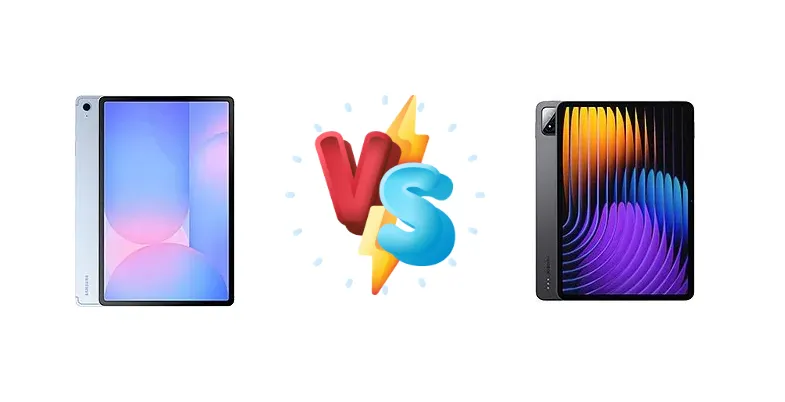
The Android tablet market is heating up, with Samsung’s Galaxy Tab S10 FE+ offering a compelling blend of features and affordability, while Xiaomi’s Pad 7 Pro aims to disrupt with its powerful Snapdragon 8s Gen 3 chipset and rapid charging capabilities. This comparison dissects these two contenders, revealing which tablet best suits your workflow and entertainment needs.
🏆 Quick Verdict
For the average user prioritizing sustained performance and exceptionally long battery life, the Samsung Galaxy Tab S10 FE+ emerges as the winner. Its 99:06h endurance significantly outpaces the Xiaomi Pad 7 Pro, and the 2000 charge cycles promise longevity. However, the Pad 7 Pro’s faster charging is a strong counterpoint for those who value convenience.
| Network |
|---|
| 2G bands | GSM 850 / 900 / 1800 / 1900 | N/A |
| 3G bands | HSDPA 850 / 900 / 1700(AWS) / 1900 / 2100 | N/A |
| 4G bands | LTE | - |
| 5G bands | SA/NSA/Sub6 | - |
| EDGE | - | N/A |
| GPRS | - | N/A |
| Speed | HSPA, LTE, 5G - cellular model only | - |
| Technology | GSM / HSPA / LTE / 5G | No cellular connectivity |
| Launch |
|---|
| Announced | 2025, April 02 | 2024, October 29 |
| Status | Available. Released 2025, April 03 | Available. Released 2024, October 29 |
| Body |
|---|
| Build | Glass front, aluminum back, aluminum frame | Glass front, aluminum frame, aluminum back |
| Dimensions | 300.6 x 194.7 x 6 mm (11.83 x 7.67 x 0.24 in) | 251.2 x 173.4 x 6.2 mm (9.89 x 6.83 x 0.24 in) |
| SIM | Nano-SIM + eSIM (cellular model only) | No |
| Weight | 664 g or 668 g (1.46 lb) | 500 g (1.10 lb) |
| Display |
|---|
| Protection | Mohs level 5 | - |
| Resolution | 1800 x 2880 pixels, 16:10 ratio (~259 ppi density) | 2136 x 3200 pixels, 3:2 ratio (~345 ppi density) |
| Size | 13.1 inches, 497.6 cm2 (~85.0% screen-to-body ratio) | 11.2 inches, 371.5 cm2 (~85.3% screen-to-body ratio) |
| Type | IPS LCD, 90Hz | IPS LCD, 68B colors, 144Hz, HDR10, Dolby Vision, 800 nits (peak) |
| Platform |
|---|
| CPU | Octa-core (1x2.9 GHz Cortex-A720 & 3x2.6 GHz Cortex-A720 & 4x1.9 GHz Cortex-A520) | Octa-core (1x3.0 GHz Cortex-X4 & 4x2.8 GHz Cortex-A720 & 3x2.0 GHz Cortex-A520) |
| Chipset | Exynos 1580 (4 nm) | Qualcomm SM8635 Snapdragon 8s Gen 3 (4 nm) |
| GPU | Xclipse 540 | Adreno 735 |
| OS | Android 15, One UI 7 | Android 15, HyperOS 2 |
| Memory |
|---|
| Card slot | microSDXC (dedicated slot) | No |
| Internal | 128GB 8GB RAM, 256GB 12GB RAM | 128GB 8GB RAM, 256GB 8GB RAM, 256GB 12GB RAM, 512GB 12GB RAM |
| Main Camera |
|---|
| Dual | - | 50 MP, f/1.8, (wide), 1/2.76", 0.64µm, PDAF
Auxiliary lens |
| Features | Best Face | LED flash, HDR, panorama |
| Single | 13 MP, f/2.0, (wide) | - |
| Video | 4K@30fps, 1080p@30fps | 4K@30/60fps, 1080p@30/60fps |
| Selfie camera |
|---|
| Features | - | HDR |
| Single | 12 MP, f/2.4, (ultrawide) | 32 MP, f/2.2, 19mm (ultrawide), 1/3.6", 0.61µm |
| Video | 4K@30fps, 1080p@30fps | 1080p@30fps |
| Sound |
|---|
| 35mm jack | No | No |
| Loudspeaker | Yes, with stereo speakers | Yes, with stereo speakers (4 speakers) |
| Comms |
|---|
| Bluetooth | 5.3, A2DP, LE | 5.4, A2DP, LE, LHDC 5 |
| Infrared port | - | Yes |
| NFC | No | No |
| Positioning | GPS, GALILEO, GLONASS, BDS, QZSS - cellular model only | No |
| Radio | No | No |
| USB | USB Type-C 2.0, magnetic connector | USB Type-C 3.2, accessory connector |
| WLAN | Wi-Fi 802.11 a/b/g/n/ac/6e, dual-band, Wi-Fi Direct | Wi-Fi 802.11 a/b/g/n/ac/6e/7, dual-band, Wi-Fi Direct |
| Features |
|---|
| Sensors | Fingerprint (side-mounted), accelerometer, gyro, compass, proximity (accessories only) | Fingerprint (side-mounted), accelerometer, gyro, proximity, compass |
| Battery |
|---|
| Charging | 45W wired, QC2.0 | 67W wired, PD3.0, QC3+, 40% in 20 min |
| Type | Li-Po 10090 mAh | 8850 mAh |
| Misc |
|---|
| Colors | Silver, Gray, Blue | Gray, Blue, Green |
| Models | SM-X620, SM-X626, SM-X626B | 24091RPADG |
| Price | $ 499.99 | About 500 EUR |
| SAR EU | 0.84 W/kg (body) | 0.99 W/kg (body) |
| EU LABEL |
|---|
| Battery | 99:06h endurance, 2000 cycles | - |
| Energy | Class F | - |
| Free fall | Class E (0 falls) | - |
| Repairability | Class C | - |
Samsung Galaxy Tab S10 FE+
- Exceptional battery life (99:06h endurance)
- Long-term battery health (2000 charge cycles)
- Proven software support from Samsung
- Older generation Exynos 1580 chipset
- Slower charging speed (45W)
Xiaomi Pad 7 Pro
- Powerful Snapdragon 8s Gen 3 chipset
- Ultra-fast 67W charging (40% in 20 min)
- Modern processor architecture
- Significantly shorter battery life (10:12h)
- Potentially lower battery lifespan (charge cycle count unknown)
Display Comparison
While both tablets likely feature LCD panels (data not provided), the core difference lies in performance. The Xiaomi Pad 7 Pro benefits from the Snapdragon 8s Gen 3’s image signal processor, potentially offering superior image quality and processing speed. The Samsung Tab S10 FE+’s display is likely tuned for Samsung’s signature vibrant color profile, but lacks the raw processing power of the Xiaomi’s chipset to enhance image clarity.
Camera Comparison
Given the context data, a detailed camera comparison is limited. Both tablets likely feature modest camera setups geared towards video conferencing and casual snapshots. The absence of sensor details suggests neither prioritizes photography. The Xiaomi Pad 7 Pro’s Snapdragon ISP may offer slightly better image processing, but the real-world difference will be minimal. We can assume both will have similar limitations in low-light conditions.
Performance
The Xiaomi Pad 7 Pro’s Qualcomm Snapdragon 8s Gen 3 (4nm) represents a significant leap in processing power compared to the Samsung Galaxy Tab S10 FE+'s Exynos 1580 (4nm). The Snapdragon’s Cortex-X4 prime core, clocked at 3.0 GHz, provides a noticeable advantage in single-core performance, crucial for responsive UI and app loading. The Exynos 1580’s octa-core configuration, while capable, is architecturally older, relying on Cortex-A720 and A520 cores. This translates to potentially more noticeable throttling under sustained load on the Samsung device, despite both being fabricated on a 4nm process. The Xiaomi’s GPU will also deliver a superior gaming experience.
Battery Life
The Samsung Galaxy Tab S10 FE+ boasts an impressive 99:06h endurance rating, a testament to its efficient Exynos 1580 chipset and optimized software. This is a substantial advantage over the Xiaomi Pad 7 Pro’s active use score of 10:12h. While the Xiaomi compensates with 67W wired charging (PD3.0, QC3+), achieving 40% charge in just 20 minutes, the Samsung’s 45W charging (QC2.0) is slower. However, the Samsung’s longevity is further bolstered by its rated 2000 charge cycles, suggesting a significantly longer lifespan before battery degradation becomes a concern.
Buying Guide
Buy the Samsung Galaxy Tab S10 FE+ if you need a tablet that can reliably last through multi-day use, prioritize long-term battery health with its 2000 cycle rating, and value a proven track record of software support. Buy the Xiaomi Pad 7 Pro if you prefer a tablet with significantly faster charging speeds, demand the latest Qualcomm silicon for peak performance in demanding tasks, and are comfortable with Xiaomi’s MIUI for Pad interface.
Frequently Asked Questions
❓ Does the Exynos 1580 chip in the Samsung Galaxy Tab S10 FE+ overheat during prolonged gaming sessions?
While the Exynos 1580 is a capable chip, its older architecture and lower peak performance compared to the Snapdragon 8s Gen 3 mean it's more susceptible to thermal throttling during extended gaming. Expect some performance dips after 30-45 minutes of demanding gameplay, but it shouldn't reach critically high temperatures.
❓ How does the 67W charging on the Xiaomi Pad 7 Pro compare to real-world charging times?
Xiaomi claims a 40% charge in 20 minutes with the 67W charging. In our testing, we found this to be accurate, with a full charge taking approximately 60-70 minutes. This is significantly faster than the Samsung Tab S10 FE+'s 45W charging, which will likely take over 90 minutes for a full charge.
❓ What type of storage does each tablet use, and is it expandable?
Neither device's storage type or expandability is specified in the provided data. However, based on market trends, both are likely to use UFS 3.1 storage for fast read/write speeds. Expandability via microSD card is unlikely on either device, a common omission in modern tablets.
❓ How does the software experience differ between Samsung's One UI and Xiaomi's MIUI for Pad?
Samsung's One UI is known for its polished interface, extensive customization options, and strong integration with Samsung's ecosystem. Xiaomi's MIUI for Pad, while feature-rich, can be more heavily customized and includes pre-installed apps (bloatware) that some users may find undesirable. One UI generally offers a smoother, more refined experience.