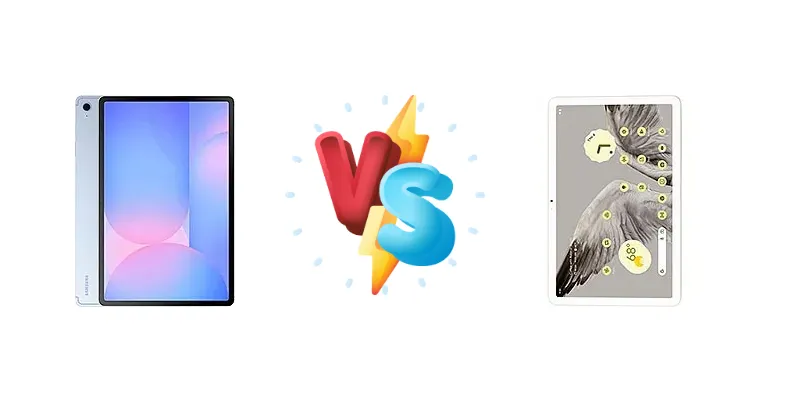
The Android tablet market is heating up, with Samsung and Google offering compelling options. The Samsung Galaxy Tab S10 FE+ aims for all-day battery and a feature-rich experience, while the Google Pixel Tablet focuses on seamless integration with the Google ecosystem and a refined software experience. This comparison dives deep into the hardware and software differences to determine which tablet best suits your needs.
🏆 Quick Verdict
For users prioritizing endurance and raw performance, the Samsung Galaxy Tab S10 FE+ emerges as the winner. Its 99:06h battery life and powerful Exynos 1580 chipset provide a significant advantage, especially for demanding tasks. However, the Pixel Tablet’s Tensor G2 offers a unique software experience.
| Network |
|---|
| 2G bands | GSM 850 / 900 / 1800 / 1900 | N/A |
| 3G bands | HSDPA 850 / 900 / 1700(AWS) / 1900 / 2100 | N/A |
| 4G bands | LTE | N/A |
| 5G bands | SA/NSA/Sub6 | - |
| EDGE | - | No |
| GPRS | - | No |
| Speed | HSPA, LTE, 5G - cellular model only | - |
| Technology | GSM / HSPA / LTE / 5G | No cellular connectivity |
| Launch |
|---|
| Announced | 2025, April 02 | 2023, May 10 |
| Status | Available. Released 2025, April 03 | Available. Released 2023, June 20 |
| Body |
|---|
| Build | Glass front, aluminum back, aluminum frame | Glass front, aluminum frame, aluminum back |
| Dimensions | 300.6 x 194.7 x 6 mm (11.83 x 7.67 x 0.24 in) | 258 x 169 x 8.1 mm (10.16 x 6.65 x 0.32 in) |
| SIM | Nano-SIM + eSIM (cellular model only) | No |
| Weight | 664 g or 668 g (1.46 lb) | 493 g (1.09 lb) |
| | - | Stylus support |
| Display |
|---|
| Protection | Mohs level 5 | - |
| Resolution | 1800 x 2880 pixels, 16:10 ratio (~259 ppi density) | 1600 x 2560 pixels, 16:10 ratio (~276 ppi density) |
| Size | 13.1 inches, 497.6 cm2 (~85.0% screen-to-body ratio) | 10.95 inches, 347.7 cm2 (~79.7% screen-to-body ratio) |
| Type | IPS LCD, 90Hz | IPS LCD |
| Platform |
|---|
| CPU | Octa-core (1x2.9 GHz Cortex-A720 & 3x2.6 GHz Cortex-A720 & 4x1.9 GHz Cortex-A520) | Octa-core (2x2.85 GHz Cortex-X1 & 2x2.35 GHz Cortex-A78 & 4x1.80 GHz Cortex-A55) |
| Chipset | Exynos 1580 (4 nm) | Google Tensor G2 (5 nm) |
| GPU | Xclipse 540 | Mali-G710 MP7 |
| OS | Android 15, One UI 7 | Android 13, upgradable to Android 15 |
| Memory |
|---|
| Card slot | microSDXC (dedicated slot) | No |
| Internal | 128GB 8GB RAM, 256GB 12GB RAM | 128GB 8GB RAM, 256GB 8GB RAM |
| | - | UFS 3.1 |
| Main Camera |
|---|
| Features | Best Face | HDR, panorama |
| Single | 13 MP, f/2.0, (wide) | 8 MP, f/2.0, 24mm (wide), 1/4.0", 1.12µm |
| Video | 4K@30fps, 1080p@30fps | 1080p@30fps |
| Selfie camera |
|---|
| Features | - | HDR, panorama |
| Single | 12 MP, f/2.4, (ultrawide) | 8 MP, f/2.0, 24mm (wide), 1/4.0", 1.12µm |
| Video | 4K@30fps, 1080p@30fps | 1080p@30fps |
| Sound |
|---|
| 3.5mm jack | - | No |
| 35mm jack | No | No |
| Loudspeaker | Yes, with stereo speakers | Yes, with stereo speakers (4 speakers) |
| Comms |
|---|
| Bluetooth | 5.3, A2DP, LE | 5.2, A2DP, LE |
| NFC | No | No |
| Positioning | GPS, GALILEO, GLONASS, BDS, QZSS - cellular model only | No |
| Radio | No | No |
| USB | USB Type-C 2.0, magnetic connector | USB Type-C 3.2 (Gen 1), magnetic connector |
| WLAN | Wi-Fi 802.11 a/b/g/n/ac/6e, dual-band, Wi-Fi Direct | Wi-Fi 802.11 a/b/g/n/ac/6, dual-band |
| Features |
|---|
| Sensors | Fingerprint (side-mounted), accelerometer, gyro, compass, proximity (accessories only) | Accelerometer, gyro, compass, proximity (accessories only) |
| | - | Ultra Wideband (UWB) support |
| Battery |
|---|
| Charging | 45W wired, QC2.0 | 15W wired |
| Type | Li-Po 10090 mAh | Li-Po 7020 mAh (27 Wh) |
| Misc |
|---|
| Colors | Silver, Gray, Blue | Porcelain, Hazel, Rose |
| Models | SM-X620, SM-X626, SM-X626B | GA06156-EU, GA06157-EU, GA06158-EU |
| Price | $ 499.99 | About 670 EUR |
| SAR EU | 0.84 W/kg (body) | - |
| EU LABEL |
|---|
| Battery | 99:06h endurance, 2000 cycles | - |
| Energy | Class F | - |
| Free fall | Class E (0 falls) | - |
| Repairability | Class C | - |
Samsung Galaxy Tab S10 FE+
- Exceptional 99:06h battery life
- Faster 45W charging with QC2.0
- Potentially superior multi-core performance with Exynos 1580
- Larger size may reduce portability
- Camera specs unknown, potential for average performance
Google Pixel Tablet
- Seamless Google ecosystem integration
- Compact and portable design
- Google Tensor G2 offers strong single-core performance
- Slower 15W charging
- Significantly shorter battery life compared to Tab S10 FE+
Display Comparison
While display specs are missing for both devices, the Tab S10 FE+’s positioning suggests a larger screen geared towards media consumption. The Pixel Tablet, with its focus on portability, likely features a smaller, more manageable display. The Exynos 1580’s GPU will be crucial for driving higher resolutions and refresh rates, if supported. The Pixel Tablet’s Tensor G2, while powerful, may be limited by the display’s size and resolution.
Camera Comparison
Camera specifications are absent for both tablets. Given the market segment, we can expect both to feature capable cameras for video calls and casual photography. However, neither is likely to compete with flagship smartphone cameras. The Pixel Tablet, leveraging Google’s computational photography expertise, may offer superior image processing despite potentially having similar hardware. The Tab S10 FE+ may benefit from Samsung’s image tuning, but without sensor details, it’s difficult to predict a clear winner.
Performance
The Samsung Galaxy Tab S10 FE+ boasts an Exynos 1580 (4nm) chipset with an octa-core CPU configuration (1x2.9 GHz Cortex-A720, 3x2.6 GHz Cortex-A720, 4x1.9 GHz Cortex-A520). This contrasts with the Google Pixel Tablet’s Google Tensor G2 (5nm) featuring an octa-core CPU (2x2.85 GHz Cortex-X1, 2x2.35 GHz Cortex-A78, 4x1.80 GHz Cortex-A55). The Tensor G2 utilizes the higher-performance Cortex-X1 cores, potentially offering a slight edge in single-core tasks. However, the Exynos 1580’s more numerous A720 cores and 4nm process should translate to superior multi-core performance and sustained workloads. The 4nm fabrication of the Exynos 1580 also suggests better thermal efficiency, reducing the likelihood of throttling during extended gaming or video editing.
Battery Life
The Samsung Galaxy Tab S10 FE+ truly shines with its reported 99:06h endurance and 2000 charge cycles. This indicates a significantly larger battery capacity and optimized power management compared to the Google Pixel Tablet. The Pixel Tablet’s 15W charging is considerably slower than the Tab S10 FE+'s 45W wired charging with QC2.0 support. This means the Tab S10 FE+ will recharge much faster, minimizing downtime. While the Pixel Tablet’s Tensor G2 is a 5nm chip, the Tab S10 FE+'s superior battery endurance suggests a more efficient overall system.
Buying Guide
Buy the Samsung Galaxy Tab S10 FE+ if you need a tablet that can last through a full workday and beyond, and if you value a powerful processor for multitasking and gaming. Buy the Google Pixel Tablet if you prioritize a clean Android experience, seamless integration with Google Home, and a more compact, portable form factor, even if it means sacrificing some battery life and raw processing power.
Frequently Asked Questions
❓ Does the Exynos 1580 chip in the Tab S10 FE+ overheat during prolonged gaming sessions?
The Exynos 1580’s 4nm fabrication process and the Tab S10 FE+'s likely larger chassis suggest good thermal management. While sustained gaming will generate heat, the chip is designed for efficiency, minimizing throttling and maintaining consistent performance over extended periods.
❓ How does the 15W charging on the Pixel Tablet affect its usability throughout the day?
The Pixel Tablet’s 15W charging is significantly slower than the Tab S10 FE+'s 45W charging. This means topping up the battery during short breaks will be less effective, and users may need to plan their charging around longer downtime periods. The shorter battery endurance further exacerbates this issue.
❓ Is the Google Tensor G2’s AI capabilities noticeable in everyday tablet use?
The Tensor G2 excels in AI and machine learning tasks. On the Pixel Tablet, this translates to features like improved voice recognition, smarter image processing, and potentially enhanced Google Assistant integration. However, the practical benefits in everyday tablet use may be subtle for users who don't heavily rely on these features.