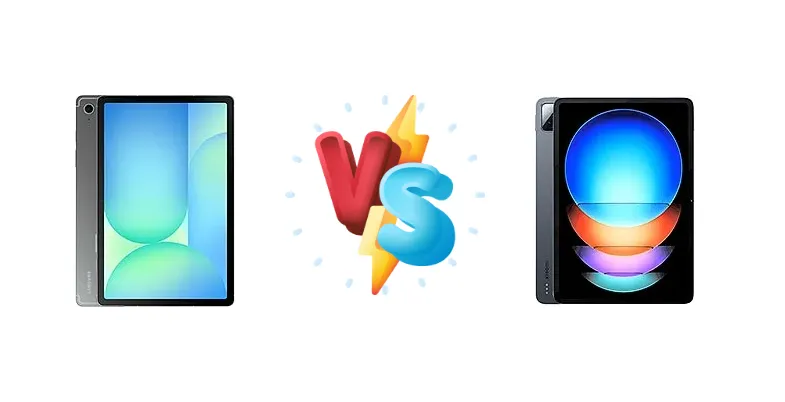
The Android tablet market is heating up, with Samsung’s Galaxy Tab S10 FE offering a familiar experience and impressive battery life, while Xiaomi’s Pad 6S Pro 12.4 arrives with flagship-level processing power and rapid charging. This comparison dissects these two contenders, revealing which tablet best balances performance, longevity, and value.
🏆 Quick Verdict
For users prioritizing raw performance and quick charging, the Xiaomi Pad 6S Pro 12.4 is the clear winner, thanks to its Snapdragon 8 Gen 2 chipset and 120W charging. However, the Samsung Galaxy Tab S10 FE provides exceptional battery endurance and a more established ecosystem, making it ideal for users who value longevity and Samsung’s software features.
| Network |
|---|
| 2G bands | GSM 850 / 900 / 1800 / 1900 | N/A |
| 3G bands | HSDPA 850 / 900 / 1700(AWS) / 1900 / 2100 | N/A |
| 4G bands | LTE | - |
| 5G bands | SA/NSA/Sub6 | - |
| EDGE | - | N/A |
| GPRS | - | N/A |
| Speed | HSPA, LTE, 5G - cellular model only | - |
| Technology | GSM / HSPA / LTE / 5G | No cellular connectivity |
| Launch |
|---|
| Announced | 2025, April 02 | 2024, February 22 |
| Status | Available. Released 2025, April 03 | Available. Released 2024, February 22 |
| Body |
|---|
| Build | Glass front, aluminum back, aluminum frame | Glass front (Gorilla Glass 5), aluminum frame, aluminum back |
| Dimensions | 254.3 x 165.8 x 6 mm (10.01 x 6.53 x 0.24 in) | 278.7 x 191.6 x 6.3 mm (10.97 x 7.54 x 0.25 in) |
| SIM | Nano-SIM + eSIM (cellular model only) | No |
| Weight | 497 g or 500 g (1.10 lb) | 590 g (1.30 lb) |
| Display |
|---|
| Protection | Mohs level 5 | Corning Gorilla Glass 5 |
| Resolution | 1440 x 2304 pixels, 16:10 ratio (~249 ppi density) | 2032 x 3048 pixels, 3:2 ratio (~295 ppi density) |
| Size | 10.9 inches, 344.5 cm2 (~81.7% screen-to-body ratio) | 12.4 inches, 457.8 cm2 (~85.7% screen-to-body ratio) |
| Type | IPS LCD, 90Hz | IPS LCD, 68B colors, 144Hz, HDR10, Dolby Vision, 900 nits (peak) |
| Platform |
|---|
| CPU | Octa-core (1x2.9 GHz Cortex-A720 & 3x2.6 GHz Cortex-A720 & 4x1.9 GHz Cortex-A520) | Octa-core (1x3.2 GHz Cortex-X3 & 2x2.8 GHz Cortex-A715 & 2x2.8 GHz Cortex-A710 & 3x2.0 GHz Cortex-A510) |
| Chipset | Exynos 1580 (4 nm) | Qualcomm SM8550-AB Snapdragon 8 Gen 2 (4 nm) |
| GPU | Xclipse 540 | Adreno 740 |
| OS | Android 15, One UI 7 | Android 14, up to 3 major Android upgrades, HyperOS |
| Memory |
|---|
| Card slot | microSDXC (dedicated slot) | No |
| Internal | 128GB 8GB RAM, 256GB 12GB RAM | 256GB 8GB RAM, 256GB 12GB RAM, 512GB 12GB RAM, 1TB 16GB RAM |
| Main Camera |
|---|
| Dual | - | 50 MP, f/1.8, (wide), 1/2.76", 0.64µm, PDAF
Auxiliary lens |
| Features | Best Face | LED flash, HDR, panorama |
| Single | 13 MP, f/2.0, (wide) | - |
| Video | 4K@30fps, 1080p@30fps | 4K@30/60fps, 1080p@30/60fps |
| Selfie camera |
|---|
| Single | 12 MP, f/2.4, (ultrawide) | 32 MP, f/2.2, (wide), 1/3.6", 0.61µm |
| Video | 4K@30fps, 1080p@30fps | 1080p@30fps |
| Sound |
|---|
| 35mm jack | No | No |
| Loudspeaker | Yes, with stereo speakers | Yes, with stereo speakers (6 speakers) |
| Comms |
|---|
| Bluetooth | 5.3, A2DP, LE | 5.3, A2DP, LE, LHDC |
| NFC | No | Yes (file transfer only) |
| Positioning | GPS, GALILEO, GLONASS, BDS, QZSS - cellular model only | No |
| Radio | No | No |
| USB | USB Type-C 2.0, magnetic connector | USB Type-C 3.2, accessory connector |
| WLAN | Wi-Fi 802.11 a/b/g/n/ac/6e, dual-band, Wi-Fi Direct | Wi-Fi 802.11 a/b/g/n/a/6/7, dual-band, Wi-Fi Direct |
| Features |
|---|
| Sensors | Fingerprint (side-mounted), accelerometer, gyro, compass, proximity (accessories only) | Fingerprint (side-mounted), accelerometer, gyro, proximity (accessories only), compass |
| Battery |
|---|
| Charging | 45W wired, QC2.0 | 120W wired, PD3.0, QC4, 45% in 10 min, 100% in 35 min |
| Type | Li-Po 8000 mAh | 10000 mAh |
| Misc |
|---|
| Colors | Silver, Gray, Blue | Black, Blue, Green |
| Models | SM-X520, SM-X526, SM-X526B | 24018RPACG |
| Price | $ 359.99 | About 700 EUR |
| SAR EU | 0.92 W/kg (body) | 0.99 W/kg (body) |
| EU LABEL |
|---|
| Battery | 96:32h endurance, 2000 cycles | - |
| Energy | Class F | - |
| Free fall | Class E (0 falls) | - |
| Repairability | Class C | - |
Samsung Galaxy Tab S10 FE
- Exceptional battery endurance (96:32h)
- Long battery lifespan (2000 charge cycles)
- Established Samsung ecosystem
- Less powerful processor compared to Snapdragon 8 Gen 2
- Slower charging speeds (45W)
Xiaomi Pad 6S Pro 12.4
- Flagship-level performance with Snapdragon 8 Gen 2
- Ultra-fast 120W charging (0-100% in 35 min)
- Brighter and higher contrast display
- Shorter battery endurance (11:14h active use)
- Potentially more thermal throttling under sustained load
Display Comparison
The Xiaomi Pad 6S Pro 12.4 boasts a significantly brighter display, reaching a measured 848 nits, compared to an unspecified brightness for the Tab S10 FE. This higher peak brightness translates to better visibility outdoors. Furthermore, the 1378:1 contrast ratio on the Xiaomi suggests deeper blacks and a more vibrant image. While the Tab S10 FE’s display quality isn’t detailed in the provided data, Samsung typically employs high-quality panels; however, the Xiaomi’s specifications indicate a clear advantage in visual fidelity. The larger screen size of the Xiaomi (12.4 inches vs. unspecified for the S10 FE) also contributes to a more immersive viewing experience.
Camera Comparison
The provided data doesn’t offer detailed camera specifications for either tablet. Given the tablet form factor, camera quality is typically less of a priority. However, assuming both tablets feature similar sensor configurations (likely a primary and ultrawide lens), the image processing capabilities of the Snapdragon 8 Gen 2 in the Xiaomi Pad 6S Pro could provide a slight edge in image quality, particularly in low-light conditions. Without further details, it’s difficult to make a definitive assessment.
Performance
The core difference lies in the chipsets. The Xiaomi Pad 6S Pro 12.4’s Snapdragon 8 Gen 2 (4nm) is a substantial upgrade over the Samsung Galaxy Tab S10 FE’s Exynos 1580 (4nm). The Snapdragon 8 Gen 2 features a Cortex-X3 prime core clocked at 3.2 GHz, alongside high-performance Cortex-A715 and A710 cores, offering significantly faster processing speeds for demanding applications. The Exynos 1580, while still capable, relies on older Cortex-A720 and A520 cores. This translates to smoother multitasking, faster game loading times, and improved performance in resource-intensive tasks on the Xiaomi. The 4nm fabrication process on both chips offers good efficiency, but the architectural advantages of the Snapdragon 8 Gen 2 will likely result in less thermal throttling during sustained workloads.
Battery Life
The Samsung Galaxy Tab S10 FE claims an impressive 96:32h endurance, suggesting exceptional battery life. While the Xiaomi Pad 6S Pro 12.4 only provides an active use score of 11:14h, its 120W wired charging is a game-changer. The Xiaomi can reach 45% charge in just 10 minutes and 100% in 35 minutes, minimizing downtime. The Tab S10 FE’s 45W charging with QC2.0 is considerably slower. The Samsung prioritizes longevity, while the Xiaomi prioritizes convenience and rapid replenishment of power. The Tab S10 FE also boasts 2000 charge cycles, suggesting a longer lifespan for the battery itself.
Buying Guide
Buy the Samsung Galaxy Tab S10 FE if you need a tablet that can last through multi-day trips and value a mature software experience with long-term support. Buy the Xiaomi Pad 6S Pro 12.4 if you prioritize demanding tasks like gaming and video editing, and want the convenience of incredibly fast charging and a more powerful processor.
Frequently Asked Questions
❓ Does the Exynos 1580 chip in the Galaxy Tab S10 FE overheat during prolonged gaming sessions?
While the Exynos 1580 is a capable chip, it's less thermally efficient than the Snapdragon 8 Gen 2. Expect some throttling during extended gaming, potentially leading to frame rate drops. The Xiaomi Pad 6S Pro 12.4, with its superior cooling and more efficient chipset, will maintain higher sustained performance.
❓ How does the 120W charging on the Xiaomi Pad 6S Pro 12.4 impact long-term battery health?
While 120W charging is incredibly fast, Xiaomi incorporates intelligent charging algorithms to minimize heat generation and prevent overcharging, mitigating potential long-term battery degradation. However, consistently using extremely fast charging *can* contribute to faster battery wear over several years compared to slower charging methods.
❓ Is the difference in battery endurance between the two tablets noticeable in everyday use?
Yes, the 96:32h endurance of the Samsung Galaxy Tab S10 FE translates to significantly longer usage between charges. Users who frequently travel or rely on their tablet for extended periods without access to power will greatly benefit from the Samsung's superior battery life. The Xiaomi will require more frequent charging, despite its fast charging capabilities.