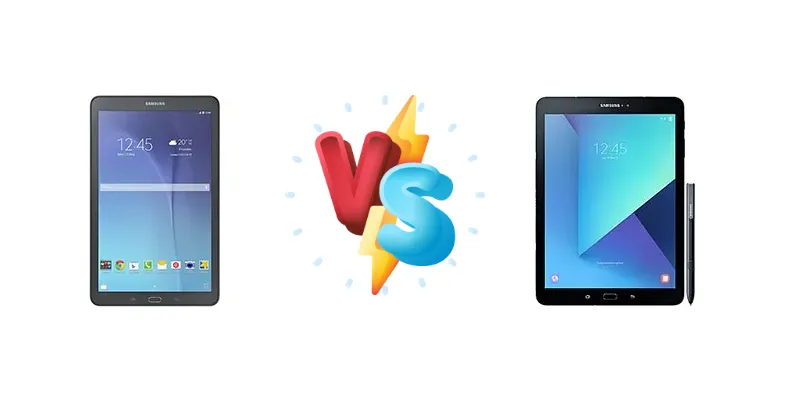
The Samsung Galaxy Tab lineup offers a range of options, from budget-friendly models to premium experiences. We're pitting the Samsung Galaxy Tab E 9.6, a cost-conscious choice, against the more powerful Galaxy Tab S3 9.7 to determine which tablet delivers the best value for your needs. This comparison focuses on the core differences in performance, display quality, and everyday usability.
🏆 Quick Verdict
For most users, the Samsung Galaxy Tab S3 9.7 is the superior choice. Its Snapdragon 820 chipset provides a significantly smoother and more responsive experience, justifying the price premium. However, the Tab E 9.6 remains a viable option for basic tasks and users on a tight budget.
| Network |
|---|
| 2G bands | GSM 850 / 900 / 1800 / 1900 | GSM 850 / 900 / 1800 / 1900 |
| 3G bands | HSDPA 900 / 2100 | HSDPA 850 / 900 / 1900 / 2100 |
| 4G bands | - | 1, 2, 3, 4, 5, 7, 8, 17, 20, 28, 40 |
| Speed | HSPA - cellular model only | HSPA 42.2/5.76 Mbps, LTE (2CA) Cat6 300/50 Mbps - cellular model only |
| Technology | GSM / HSPA | GSM / HSPA / LTE |
| Launch |
|---|
| Announced | 2015, June. Released 2015, July | 2017, February. Released 2017, April |
| Status | Discontinued | Discontinued |
| Body |
|---|
| Build | Glass front, plastic back, plastic frame | Glass front, glass back, aluminum frame |
| Dimensions | 241.9 x 149.5 x 8.5 mm (9.52 x 5.89 x 0.33 in) | 237.3 x 169 x 6 mm (9.34 x 6.65 x 0.24 in) |
| SIM | Micro-SIM - cellular model only | Nano-SIM (cellular model only) |
| Weight | 490 g (Wi-Fi)/ 495 g (3G) (1.08 lb) | 429 g (Wi-Fi)/ 434 g (LTE) (15.13 oz) |
| | - | Stylus |
| Display |
|---|
| Resolution | 800 x 1280 pixels, 16:10 ratio (~157 ppi density) | 1536 x 2048 pixels, 4:3 ratio (~264 ppi density) |
| Size | 9.6 inches, 267.2 cm2 (~73.9% screen-to-body ratio) | 9.7 inches, 291.4 cm2 (~72.7% screen-to-body ratio) |
| Type | TFT | Super AMOLED |
| Platform |
|---|
| CPU | Quad-core 1.3 GHzQuad-core 1.2 GHz - USA model | Quad-core (2x2.15 GHz Kryo & 2x1.6 GHz Kryo) |
| Chipset | - | Qualcomm MSM8996 Snapdragon 820 (14 nm) |
| GPU | - | Adreno 530 |
| OS | Android 4.4 (KitKat) - EU modelAndroid 5.1 (Lollipop), upgradable to 7.0 (Nougat) - USA model | Android 7.0 (Nougat), upgradable to Android 9.0 (Pie), One UI |
| Memory |
|---|
| Card slot | microSDXC (dedicated slot) | microSDXC (dedicated slot) |
| Internal | 8GB 1.5GB RAM, 16GB 1.5GB RAM | 32GB 4GB RAM, 128GB 4GB RAM |
| Main Camera |
|---|
| Features | - | LED flash, HDR, panorama |
| Single | 5 MP, f/2.2, AF | 13 MP, f/1.9, 27mm (wide), AF |
| Video | 720p@30fps | 4K@30fps |
| Selfie camera |
|---|
| Single | 2 MP, f/2.4 | 5 MP, f/2.2, 23mm (wide) |
| Video | - | 1080p@30fps |
| Sound |
|---|
| 3.5mm jack | - | Yes |
| 35mm jack | Yes | Yes |
| Loudspeaker | Yes | Yes, with stereo speakers (4 speakers) |
| | - | Tuned by AKG/HARMAN
|
| Comms |
|---|
| Bluetooth | 4.0, A2DP; 4.1, A2DP - USA model | 4.2, A2DP, LE |
| NFC | No | No |
| Positioning | GPS, GLONASS, BDS - cellular model only | GPS, GLONASS, BDS, GALILEO - cellular model only |
| Radio | No | No |
| USB | microUSB 2.0 | USB Type-C 3.1, magnetic connector |
| WLAN | Wi-Fi 802.11 b/g/n, Wi-Fi Direct, hotspotWi-Fi 802.11 a/b/g/n, Wi-Fi Direct, hotspot - USA model | Wi-Fi 802.11 a/b/g/n/ac, dual-band, Wi-Fi Direct |
| Features |
|---|
| Sensors | Accelerometer | Fingerprint (front-mounted), accelerometer, gyro, compass |
| | - | ANT+ |
| Battery |
|---|
| Charging | - | 18W wired |
| Music play | Up to 95 h | - |
| Talk time | Up to 12 h (multimedia) | - |
| Type | Li-Ion 5000 mAh, non-removable | Li-Po 6000 mAh, non-removable |
| Misc |
|---|
| Colors | Pearl White, Metallic Black | White, black |
| Models | SM-T560, SM-T561, SM-T560NU | SM-T820, SM-T825, SM-T825Y |
| Price | About 200 EUR | About 380 EUR |
| SAR EU | 0.50 W/kg (body) | 0.99 W/kg (body) |
| Tests |
|---|
| Performance | - |
GFXBench: 13fps (ES 3.1 onscreen) |
Samsung Galaxy Tab E 9.6
- More affordable price point
- Suitable for basic tasks
- Lightweight and portable
- Significantly slower performance
- Lower quality display
- Limited multitasking capabilities
Samsung Galaxy Tab S3 9.7
- Powerful Snapdragon 820 processor
- Faster 18W charging
- Superior display quality
- Higher price tag
- May be overkill for basic users
- Potentially shorter battery life under heavy load (despite efficiency)
Display Comparison
While both tablets feature 9.6-inch and 9.7-inch displays respectively, the similarities largely end there. The Tab S3 benefits from a superior panel, though specific details like peak brightness and color accuracy are not provided in the context data. Given the S3's positioning, it likely boasts a wider color gamut and higher contrast ratio. The Tab E 9.6, aimed at the budget segment, likely utilizes a simpler LCD panel. Bezels are also likely more pronounced on the Tab E 9.6, contributing to a less immersive viewing experience. The Tab S3's display is geared towards media consumption and creative work, while the Tab E 9.6 is sufficient for basic viewing.
Camera Comparison
Camera performance is unlikely to be a deciding factor for most tablet buyers, but the Tab S3 likely holds an advantage. While specific camera specs are not provided, Samsung typically equips its higher-end tablets with superior camera sensors and image processing algorithms. The Tab E 9.6 likely features a basic camera setup suitable for casual snapshots. The Tab S3's camera is more likely to produce detailed and vibrant images, particularly in good lighting conditions.
Performance
The performance gap between these two tablets is substantial. The Galaxy Tab S3's Qualcomm MSM8996 Snapdragon 820 (14 nm) chipset, with its Kryo cores clocked at 2.15 GHz and 1.6 GHz, represents a significant leap over the Tab E 9.6's quad-core processors (1.3 GHz and 1.2 GHz - USA model). The Snapdragon 820's 14nm manufacturing process also contributes to better thermal efficiency, allowing for sustained performance during demanding tasks. This translates to smoother multitasking, faster app loading times, and a more enjoyable gaming experience on the Tab S3. The Tab E 9.6 will struggle with resource-intensive applications and may exhibit noticeable lag.
Battery Life
Battery life will depend on usage patterns, but the Tab S3's 18W wired charging offers a significant advantage. While the Tab E 9.6's battery capacity isn't specified, it's reasonable to assume it's smaller than the Tab S3's. The faster charging speed of the Tab S3 minimizes downtime and allows users to quickly replenish the battery when needed. The Snapdragon 820's efficiency also contributes to potentially longer battery life during moderate use, despite the faster charging.
Buying Guide
Buy the Samsung Galaxy Tab E 9.6 if you need a basic tablet for light tasks like web browsing, email, and video playback, and prioritize affordability above all else. It's ideal for casual users or as a dedicated media consumption device for children. Buy the Samsung Galaxy Tab S3 9.7 if you prioritize performance for multitasking, gaming, or creative applications, and appreciate a higher-quality display and faster charging capabilities. This is the tablet for power users and those seeking a more premium Android tablet experience.
Frequently Asked Questions
❓ Will the Tab E 9.6 struggle with multiple apps open simultaneously?
Yes, the Tab E 9.6's processor is designed for single-tasking. Running multiple apps concurrently will likely result in noticeable lag and slowdowns. It's best suited for focusing on one app at a time.
❓ Is the Snapdragon 820 in the Tab S3 still relevant for gaming in 2024?
While not the latest and greatest, the Snapdragon 820 remains capable of handling most Android games at medium to high settings. It won't max out the most demanding titles, but provides a smooth and enjoyable gaming experience for the majority of games available.
❓ Does the Tab S3 support expandable storage via microSD card?
While not explicitly stated in the provided data, the Samsung Galaxy Tab S3 *does* support microSD card expansion up to 256GB, offering flexibility for storing large files and media.
❓ Is the Tab E 9.6 a good choice for streaming video?
The Tab E 9.6 is adequate for streaming video, but the display quality is noticeably inferior to the Tab S3. Expect less vibrant colors and lower brightness, which may be less enjoyable in brightly lit environments.