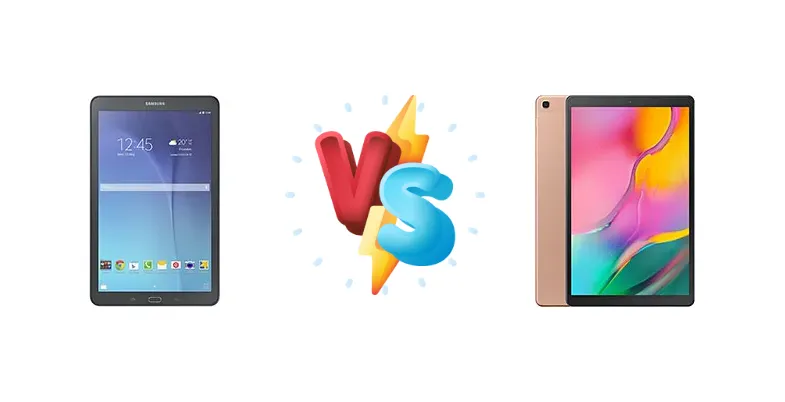
Samsung's tablet lineup offers options at every price point. The Galaxy Tab E 9.6 and the Galaxy Tab A 10.1 (2019) both aim for the budget-conscious consumer, but they take distinctly different approaches to achieving affordability. The Tab E prioritizes extreme cost-effectiveness, while the Tab A 10.1 (2019) attempts to balance price with a more modern chipset and larger display.
🏆 Quick Verdict
For most users, the Samsung Galaxy Tab A 10.1 (2019) is the better choice. Its Exynos 7904 chipset delivers significantly improved performance over the Tab E 9.6’s quad-core processor, making it more suitable for multitasking, streaming, and light gaming. While the Tab E is cheaper, the performance trade-off is substantial.
| Network |
|---|
| 2G bands | GSM 850 / 900 / 1800 / 1900 | GSM 850 / 900 / 1800 / 1900 |
| 3G bands | HSDPA 900 / 2100 | HSDPA 850 / 900 / 1700(AWS) / 1900 / 2100 |
| 4G bands | - | 1, 2, 3, 4, 5, 7, 8, 12, 17, 20, 28, 38, 40, 66 |
| Speed | HSPA - cellular model only | HSPA, LTE - cellular model only |
| Technology | GSM / HSPA | GSM / HSPA / LTE |
| Launch |
|---|
| Announced | 2015, June. Released 2015, July | 2019, February 15. Released 2019, April |
| Status | Discontinued | Discontinued |
| Body |
|---|
| Build | Glass front, plastic back, plastic frame | Glass front, aluminum back, aluminum frame |
| Dimensions | 241.9 x 149.5 x 8.5 mm (9.52 x 5.89 x 0.33 in) | 245.2 x 149.4 x 7.5 mm (9.65 x 5.88 x 0.30 in) |
| SIM | Micro-SIM - cellular model only | Nano-SIM (cellular model only) |
| Weight | 490 g (Wi-Fi)/ 495 g (3G) (1.08 lb) | 469 g (1.03 lb) |
| Display |
|---|
| Resolution | 800 x 1280 pixels, 16:10 ratio (~157 ppi density) | 1200 x 1920 pixels, 16:10 ratio (~224 ppi density) |
| Size | 9.6 inches, 267.2 cm2 (~73.9% screen-to-body ratio) | 10.1 inches, 295.8 cm2 (~80.7% screen-to-body ratio) |
| Type | TFT | TFT LCD |
| Platform |
|---|
| CPU | Quad-core 1.3 GHzQuad-core 1.2 GHz - USA model | Octa-core (2x1.8 GHz Cortex-A73 & 6x1.6 GHz Cortex-A53) |
| Chipset | - | Exynos 7904 (14 nm) |
| GPU | - | Mali-G71 MP2 |
| OS | Android 4.4 (KitKat) - EU modelAndroid 5.1 (Lollipop), upgradable to 7.0 (Nougat) - USA model | Android 9.0 (Pie), upgradable to Android 11, One UI 3.0 |
| Memory |
|---|
| Card slot | microSDXC (dedicated slot) | microSDXC (dedicated slot) |
| Internal | 8GB 1.5GB RAM, 16GB 1.5GB RAM | 16GB 2GB RAM, 32GB 2GB RAM, 32GB 3GB RAM, 64GB 3GB RAM, 128GB 3GB RAM |
| | - | eMMC 5.1 |
| Main Camera |
|---|
| Features | - | Panorama |
| Single | 5 MP, f/2.2, AF | 8 MP, f/2.0, AF |
| Video | 720p@30fps | 1080p@30fps |
| Selfie camera |
|---|
| Single | 2 MP, f/2.4 | 5 MP, f/2.2 |
| Video | - | 1080p@30fps |
| Sound |
|---|
| 3.5mm jack | - | Yes |
| 35mm jack | Yes | Yes |
| Loudspeaker | Yes | Yes, with stereo speakers |
| Comms |
|---|
| Bluetooth | 4.0, A2DP; 4.1, A2DP - USA model | 5.0, A2DP, LE |
| NFC | No | No |
| Positioning | GPS, GLONASS, BDS - cellular model only | GPS, GLONASS, GALILEO, BDS - cellular model only |
| Radio | No | No |
| USB | microUSB 2.0 | USB Type-C 2.0 |
| WLAN | Wi-Fi 802.11 b/g/n, Wi-Fi Direct, hotspotWi-Fi 802.11 a/b/g/n, Wi-Fi Direct, hotspot - USA model | Wi-Fi 802.11 a/b/g/n/ac, dual-band, Wi-Fi Direct |
| Features |
|---|
| Sensors | Accelerometer | Accelerometer, gyro, compass |
| | - | ANT+ |
| Battery |
|---|
| Music play | Up to 95 h | - |
| Talk time | Up to 12 h (multimedia) | - |
| Type | Li-Ion 5000 mAh, non-removable | Li-Po 6150 mAh, non-removable |
| Misc |
|---|
| Colors | Pearl White, Metallic Black | Black, Gold, Silver |
| Models | SM-T560, SM-T561, SM-T560NU | SM-T515, SM-T510 |
| Price | About 200 EUR | About 220 EUR |
| SAR | - | 0.92 W/kg (body) |
| SAR EU | 0.50 W/kg (body) | 1.36 W/kg (body) |
Samsung Galaxy Tab E 9.6
- Lower price point makes it very accessible.
- Compact size is easier to hold and carry.
- Sufficient for basic tasks like reading and web browsing.
- Significantly slower performance compared to the Tab A 10.1 (2019).
- Smaller display may feel cramped for some users.
- Likely limited software updates.
Samsung Galaxy Tab A 10.1 (2019)
- Much faster performance thanks to the Exynos 7904 chipset.
- Larger display provides a more immersive viewing experience.
- Better suited for multitasking and light gaming.
- Higher price compared to the Tab E 9.6.
- Larger size may be less convenient for some users.
- Still a budget tablet, so don't expect flagship-level features.
Display Comparison
The Galaxy Tab A 10.1 (2019) boasts a larger 10.1-inch display compared to the Tab E 9.6’s 9.6-inch screen, offering a more immersive viewing experience. While both likely utilize TFT LCD panels (based on their market positioning), the Tab A’s larger size and potentially higher resolution contribute to a sharper image. We lack specific brightness data, but the Tab A’s newer design suggests a potentially brighter panel. Bezels are expected to be larger on the Tab E 9.6, reflecting its older design and cost-cutting measures.
Camera Comparison
Neither tablet is expected to excel in photography. Both likely feature basic camera setups, and detailed specifications are scarce. The Tab A 10.1 (2019) may have a slightly more capable main sensor, but image quality will likely be limited by the overall hardware and software. Any 2MP macro or depth sensors on either device should be considered largely marketing features with minimal practical benefit.
Performance
The performance gap is the most significant differentiator. The Galaxy Tab E 9.6 is equipped with a quad-core processor clocked at 1.3 GHz (or 1.2 GHz in the USA model), a relatively basic configuration. In contrast, the Tab A 10.1 (2019) features the Exynos 7904, an octa-core chipset built on a 14nm process. This Exynos chip utilizes a big.LITTLE architecture with two Cortex-A73 cores for performance and six Cortex-A53 cores for efficiency. This translates to a substantially faster and smoother user experience, particularly when multitasking or running demanding applications. The Tab A’s chipset also benefits from a more modern GPU, improving graphics performance.
Battery Life
Battery life will depend heavily on usage patterns. While the Tab E 9.6 may have a slightly smaller battery capacity due to its smaller size, the Tab A 10.1 (2019)’s more efficient Exynos 7904 chipset could offset this difference. The Tab A’s chipset allows it to throttle performance to conserve power when needed, extending battery life during less demanding tasks. Charging speeds are likely similar on both devices, with neither supporting fast charging technologies.
Buying Guide
Buy the Samsung Galaxy Tab E 9.6 if you need a basic tablet primarily for static tasks like reading ebooks, browsing the web with few tabs open, or simple video playback, and your budget is extremely limited. Buy the Samsung Galaxy Tab A 10.1 (2019) if you prefer a more responsive experience for multitasking, streaming higher-resolution content, or enjoying casual gaming, and are willing to spend a bit more for a noticeable performance boost.
Frequently Asked Questions
❓ Does the Exynos 7904 in the Tab A 10.1 (2019) get hot during extended gaming sessions?
The Exynos 7904 is a relatively efficient chipset. While it will generate heat during prolonged gaming, its 14nm process and thermal design should prevent significant throttling. Expect some performance reduction after extended play, but it shouldn't become uncomfortably hot or shut down.
❓ Is the Galaxy Tab E 9.6 suitable for video conferencing?
The Galaxy Tab E 9.6 can handle basic video conferencing, but its smaller screen and limited processing power may result in a less-than-ideal experience. The smaller display can make it difficult to see details, and the processor may struggle with multiple video streams or background apps.
❓ How much storage does each tablet offer, and is it expandable?
Storage configurations vary by region, but both tablets typically offer 32GB or 64GB of internal storage. Crucially, both the Tab E 9.6 and the Tab A 10.1 (2019) support microSD card expansion, allowing you to add up to 512GB of additional storage for photos, videos, and other files.
❓ What version of Android do these tablets run?
The Galaxy Tab A 10.1 (2019) launched with Android 9 Pie and has received updates to Android 10. The Galaxy Tab E 9.6 launched with Android 8 Oreo and likely has limited or no further software updates. This means the Tab A 10.1 (2019) will benefit from newer features and security patches.