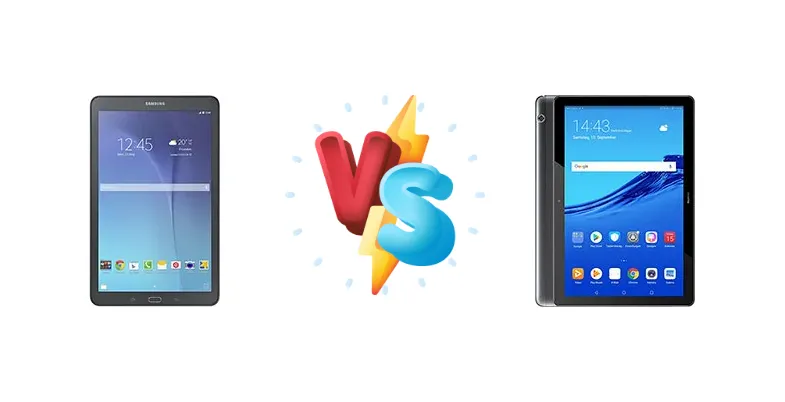
The Samsung Galaxy Tab E 9.6 and Huawei MediaPad T5 represent the lower end of the Android tablet market, targeting users who need basic functionality without a flagship price tag. This comparison dives deep into their specifications to determine which device offers the best value for casual users, students, or anyone seeking a secondary display for media consumption.
🏆 Quick Verdict
For most users, the Huawei MediaPad T5 emerges as the better choice. Its Kirin 659 chipset, with its octa-core configuration, provides a noticeable performance advantage over the Galaxy Tab E 9.6’s quad-core processor, making it more capable for multitasking and demanding apps. While both are budget options, the T5 delivers more processing power for the price.
| Network |
|---|
| 2G bands | GSM 850 / 900 / 1800 / 1900 | GSM 850 / 900 / 1800 / 1900 |
| 3G bands | HSDPA 900 / 2100 | HSDPA 850 / 900 / 1900 / 2100 |
| 4G bands | - | 1, 3, 5, 7, 8, 20 |
| Speed | HSPA - cellular model only | HSPA 42.2/5.76 Mbps, LTE (2CA) Cat6 300/50 Mbps - cellular model only |
| Technology | GSM / HSPA | GSM / HSPA / LTE |
| Launch |
|---|
| Announced | 2015, June. Released 2015, July | 2018, August. Released 2018, September |
| Status | Discontinued | Discontinued |
| Body |
|---|
| Build | Glass front, plastic back, plastic frame | Glass front, aluminum back, aluminum frame |
| Dimensions | 241.9 x 149.5 x 8.5 mm (9.52 x 5.89 x 0.33 in) | 243 x 164 x 7.8 mm (9.57 x 6.46 x 0.31 in) |
| SIM | Micro-SIM - cellular model only | Nano-SIM (cellular model only) |
| Weight | 490 g (Wi-Fi)/ 495 g (3G) (1.08 lb) | 460 g (1.01 lb) |
| Display |
|---|
| Resolution | 800 x 1280 pixels, 16:10 ratio (~157 ppi density) | 1920 x 1200 pixels, 16:10 ratio (~224 ppi density) |
| Size | 9.6 inches, 267.2 cm2 (~73.9% screen-to-body ratio) | 10.1 inches, 295.8 cm2 (~74.2% screen-to-body ratio) |
| Type | TFT | IPS LCD |
| Platform |
|---|
| CPU | Quad-core 1.3 GHzQuad-core 1.2 GHz - USA model | Octa-core (4x2.36 GHz Cortex-A53 & 4x1.7 GHz Cortex-A53) |
| Chipset | - | Kirin 659 (16 nm) |
| GPU | - | Mali-T830 MP2 |
| OS | Android 4.4 (KitKat) - EU modelAndroid 5.1 (Lollipop), upgradable to 7.0 (Nougat) - USA model | Android 8.0 (Oreo), EMUI 8 |
| Memory |
|---|
| Card slot | microSDXC (dedicated slot) | microSDXC (dedicated slot) |
| Internal | 8GB 1.5GB RAM, 16GB 1.5GB RAM | 16GB 2GB RAM, 32GB 2GB RAM, 32GB 3GB RAM, 64GB 4GB RAM |
| | - | eMMC 5.1 |
| Main Camera |
|---|
| Single | 5 MP, f/2.2, AF | 5 MP, f/2.4, AF |
| Video | 720p@30fps | 1080p@30fps |
| Selfie camera |
|---|
| Single | 2 MP, f/2.4 | 2 MP, f/2.4 |
| Sound |
|---|
| 3.5mm jack | - | Yes |
| 35mm jack | Yes | Yes |
| Loudspeaker | Yes | Yes, with stereo speakers |
| Comms |
|---|
| Bluetooth | 4.0, A2DP; 4.1, A2DP - USA model | 4.2, A2DP, LE |
| NFC | No | No |
| Positioning | GPS, GLONASS, BDS - cellular model only | GPS (LTE model), GLONASS, BDS - cellular model only |
| Radio | No | No |
| USB | microUSB 2.0 | microUSB 2.0 |
| WLAN | Wi-Fi 802.11 b/g/n, Wi-Fi Direct, hotspotWi-Fi 802.11 a/b/g/n, Wi-Fi Direct, hotspot - USA model | Wi-Fi 802.11 a/b/g/n/ac, dual-band, Wi-Fi Direct |
| Features |
|---|
| Sensors | Accelerometer | Accelerometer |
| Battery |
|---|
| Music play | Up to 95 h | - |
| Talk time | Up to 12 h (multimedia) | - |
| Type | Li-Ion 5000 mAh, non-removable | Li-Po 5100 mAh, non-removable |
| Misc |
|---|
| Colors | Pearl White, Metallic Black | Black, Champagne Gold |
| Models | SM-T560, SM-T561, SM-T560NU | AGS2-W09, AGS2-W19, AGS2-L09 |
| Price | About 200 EUR | About 170 EUR |
| SAR EU | 0.50 W/kg (body) | - |
Samsung Galaxy Tab E 9.6
- Recognizable Samsung Brand
- Simple Android Interface
- Potentially Lower Price (depending on region)
- Underpowered Quad-Core Processor
- Limited Display Specifications
- Missing Battery Capacity Information
Huawei MediaPad T5
- Octa-Core Kirin 659 Processor
- More Responsive Multitasking
- 16nm Process for Improved Efficiency
- Huawei EMUI Software (preference-based)
- Limited Camera Capabilities
- Display Specs are not high-end
Display Comparison
Neither tablet boasts a particularly impressive display. The Galaxy Tab E 9.6’s display specifications are limited, lacking details on brightness or color accuracy. The MediaPad T5 also doesn’t specify high brightness levels, suggesting both are best suited for indoor use. The absence of detailed display specs on the Tab E 9.6 suggests a focus on cost reduction, likely resulting in a less vibrant and accurate viewing experience compared to the T5, which at least benefits from Huawei’s display calibration expertise.
Camera Comparison
Camera performance is unlikely to be a deciding factor for either tablet. Both devices are equipped with basic camera setups geared towards occasional snapshots. Detailed camera specs are scarce for both, but given their market segment, image quality will likely be adequate for video calls and casual photos in good lighting conditions. The absence of advanced features like optical image stabilization (OIS) or high-resolution sensors suggests neither tablet is intended for serious photography.
Performance
The core difference lies in the processors. The Samsung Galaxy Tab E 9.6 utilizes a quad-core processor clocked at either 1.3 GHz or 1.2 GHz depending on the region. This is significantly less powerful than the Huawei MediaPad T5’s Kirin 659. The Kirin 659 is an octa-core chip featuring four Cortex-A53 cores at 2.36 GHz and another four at 1.7 GHz. This architecture allows for better handling of multiple tasks simultaneously. The T5’s chipset, built on a 16nm process, also offers improved power efficiency compared to the likely larger node process used in the Tab E 9.6, potentially leading to longer battery life under load. Users who plan to run multiple apps or play casual games will find the MediaPad T5 a far more responsive experience.
Battery Life
Battery capacity details are missing for the Galaxy Tab E 9.6, making a direct comparison difficult. The MediaPad T5’s battery life will depend heavily on usage patterns, but the Kirin 659’s 16nm process contributes to reasonable power efficiency. Charging speeds are also unspecified for both devices, suggesting neither offers particularly fast charging capabilities. Users should expect to charge both tablets overnight for a full day of moderate use.
Buying Guide
Buy the Samsung Galaxy Tab E 9.6 if you prioritize brand recognition and a simple, straightforward Android experience, and your usage is limited to very basic tasks like web browsing and light reading. Buy the Huawei MediaPad T5 if you prefer a more responsive tablet experience for multitasking, streaming video, and running a wider range of applications, and you’re comfortable with Huawei’s EMUI software.
Frequently Asked Questions
❓ Is the Huawei MediaPad T5’s EMUI software difficult to use for someone new to Huawei?
EMUI is a customized version of Android, and while it differs from stock Android, it’s generally user-friendly. It includes features like gesture navigation and customizable themes. However, it does come with pre-installed Huawei apps, which some users may consider bloatware.
❓ Can the Huawei MediaPad T5 handle basic gaming like Candy Crush or Angry Birds?
Yes, the Kirin 659 chipset is more than capable of handling casual games like Candy Crush or Angry Birds. While it won’t run demanding 3D games at high settings, it provides a smooth experience for less intensive titles.
❓ Does the Samsung Galaxy Tab E 9.6 receive regular software updates?
Software update support for the Galaxy Tab E 9.6 is limited. As a budget device, it’s unlikely to receive frequent updates or major Android version upgrades. Users should expect a relatively static software experience.
❓ Is the MediaPad T5 suitable for video streaming services like Netflix or YouTube?
Yes, the MediaPad T5 is well-suited for video streaming. The Kirin 659 chipset can handle decoding video content efficiently, and the display, while not exceptional, is adequate for enjoying movies and TV shows.