
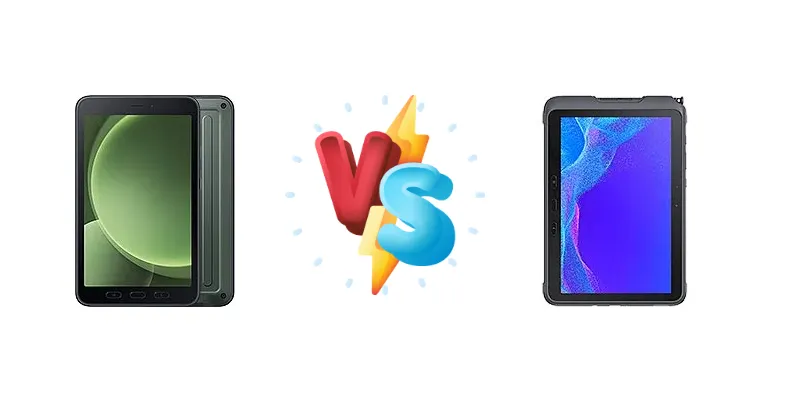
Samsung Galaxy Tab Active5 vs. Active4 Pro: Which Rugged Tablet Reigns Supreme?
| Phones Images | |||||
|---|---|---|---|---|---|
|
🏆 Quick Verdict
For most users, the Samsung Galaxy Tab Active5 offers a compelling upgrade. Its newer Exynos 1380 chipset, built on a 5nm process, delivers improved efficiency and performance compared to the Active4 Pro’s 6nm Snapdragon 778G. While the Active4 Pro offers wired charging, the Active5’s overall package provides a better balance of power and longevity.
| PHONES | ||
|---|---|---|
| Phone Names | Samsung Galaxy Tab Active5 | Samsung Galaxy Tab Active4 Pro |
| Network | ||
|---|---|---|
| 2G bands | GSM 850 / 900 / 1800 / 1900 | GSM 850 / 900 / 1800 / 1900 |
| 3G bands | HSDPA 850 / 900 / 1700(AWS) / 1900 / 2100 | HSDPA 850 / 900 / 1700(AWS) / 1900 / 2100 |
| 4G bands | 1, 2, 3, 4, 5, 7, 8, 12, 13, 17, 20, 26, 28, 32, 38, 40, 41, 66, 68 | 1, 2, 3, 4, 5, 7, 8, 12, 13, 17, 20, 25, 26, 28, 32, 38, 40, 41, 66 |
| 5G bands | 1, 3, 5, 7, 8, 20, 26, 28, 38, 40, 41, 66, 71, 77, 78 SA/NSA/Sub6 | 1, 3, 5, 7, 8, 20, 28, 38, 40, 41, 66, 77, 78 SA/NSA/Sub6 |
| Speed | HSPA, LTE, 5G - cellular model only | HSPA, LTE, 5G - cellular model only |
| Technology | GSM / HSPA / LTE / 5G | GSM / HSPA / LTE / 5G |
| Launch | ||
|---|---|---|
| Announced | 2024, January 10 | 2022, August 31 |
| Status | Available. Released 2024, January 23 | Available. Released 2022, September 13 |
| Body | ||
|---|---|---|
| Dimensions | 213.8 x 126.8 x 10.1 mm (8.42 x 4.99 x 0.40 in) | 242.9 x 170.2 x 10.2 mm (9.56 x 6.70 x 0.40 in) |
| SIM | · Nano-SIM + eSIM· Nano-SIM + Nano-SIM (cellular model only) | · Nano-SIM· Nano-SIM + Nano-SIM - cellular model only |
| Weight | 433 g (15.27 oz) | 674 g (1.49 lb) |
| - | Stylus IP68 dust/water resistant (up to 1.5m for 30 min) Drop-to-concrete resistance from up to 1 meter MIL-STD-810H compliant | |
| Display | ||
|---|---|---|
| Protection | Corning Gorilla Glass 5 | Corning Gorilla Glass 5 |
| Resolution | 1920 x 1200 pixels, 16:10 ratio (~283 ppi density) | 1920 x 1200 pixels, 16:10 ratio (~224 ppi density) |
| Size | 8.0 inches, 185.6 cm2 (~68.5% screen-to-body ratio) | 10.1 inches, 295.8 cm2 (~71.5% screen-to-body ratio) |
| Type | TFT LCD, 120Hz | TFT LCD |
| Platform | ||
|---|---|---|
| CPU | Octa-core (4x2.4 GHz Cortex-A78 & 4x2.0 GHz Cortex-A55) | Octa-core (1x2.4 GHz Cortex-A78 & 3x2.2 GHz Cortex-A78 & 4x1.8 GHz Cortex-A55) |
| Chipset | Exynos 1380 (5 nm) | Qualcomm SM7325 Snapdragon 778G 5G (6 nm) |
| GPU | Mali-G68 MP5 | Adreno 642L |
| OS | Android 14, One UI 6 | Android 12, upgradable to Android 13 |
| Memory | ||
|---|---|---|
| Card slot | microSDXC | microSDXC (uses shared SIM slot) |
| Internal | 128GB 6GB RAM, 128GB 8GB RAM, 256GB 8GB RAM | 64GB 4GB RAM, 128GB 6GB RAM |
| Main Camera | ||
|---|---|---|
| Features | LED flash, HDR, panorama | LED flash, HDR, panorama |
| Single | 13 MP, f/1.9, AF | 13 MP, f/1.9, AF |
| Video | 4K@30fps, 1080p@30fps | 4K@30fps, 1080p@30fps |
| Selfie camera | ||
|---|---|---|
| Single | 5 MP, f/2.2 | 8 MP, f/2.0 |
| Video | 1080p@30fps | 1080p@30fps |
| Sound | ||
|---|---|---|
| 3.5mm jack | - | Yes |
| 35mm jack | Yes | Yes |
| Loudspeaker | Yes | Yes |
| Comms | ||
|---|---|---|
| Bluetooth | 5.3, A2DP, LE | 5.2, A2DP, LE |
| NFC | Yes | Yes |
| Positioning | GPS, GLONASS, BDS, GALILEO, QZSS - cellular model only | GPS, GLONASS, BDS, GALILEO, QZSS - cellular model only |
| Radio | No | No |
| USB | USB Type-C 2.0, charging/accessories connector pins | USB Type-C 3.2, charging/accessories connector pins |
| WLAN | Wi-Fi 802.11 a/b/g/n/ac/6, dual-band, Wi-Fi Direct | Wi-Fi 802.11 a/b/g/n/ac/6, dual-band, Wi-Fi Direct |
| Features | ||
|---|---|---|
| Sensors | Fingerprint (front-mounted), accelerometer, proximity, gyro, compass, proximity (accessories only) | Fingerprint (front-mounted), accelerometer, gyro, proximity, compass |
| - | Samsung DeX | |
| Battery | ||
|---|---|---|
| Charging | - | Wired |
| Type | Li-Po 5050 mAh, removable | Li-Po 7600 mAh, removable |
| Misc | ||
|---|---|---|
| Colors | Green, Tactical Edition | Black |
| Models | SM-X306B | SM-T636B |
| Price | $ 629.99 | About 830 EUR |
| SAR EU | 0.53 W/kg (head) 0.90 W/kg (body) | 1.12 W/kg (body) |
Samsung Galaxy Tab Active5
- More efficient 5nm Exynos 1380 chipset
- Potentially better sustained performance
- Modern processor architecture
- Relies on slower wireless charging
- Detailed display specs are unknown
Samsung Galaxy Tab Active4 Pro
- Wired charging for faster replenishment
- Proven Snapdragon 778G performance
- Established rugged design
- Less efficient 6nm chipset
- Older processor architecture
Display Comparison
Both tablets likely feature similar LCD panels optimized for outdoor visibility, but detailed display specs (resolution, brightness) are not provided. The Active series prioritizes durability over display fidelity. The absence of LTPO technology in either suggests a standard 60Hz refresh rate. Bezels are expected to be substantial on both models, contributing to their rugged design and ease of grip with gloved hands.
Camera Comparison
Neither tablet is positioned as a photography powerhouse. Camera details are sparse, but the Active series typically features functional cameras for documentation and scanning. The Active4 Pro’s camera system is likely similar to the Active5, with a focus on practicality over image quality. Any differences in sensor size or image processing would be minimal and unlikely to be a deciding factor for most users.
Performance
The core difference lies in the chipsets. The Tab Active5’s Exynos 1380 (5nm) features an octa-core configuration with 4x2.4 GHz Cortex-A78 and 4x2.0 GHz Cortex-A55 cores. The Active4 Pro utilizes the Qualcomm Snapdragon 778G 5G (6nm) with 1x2.4 GHz Cortex-A78, 3x2.2 GHz Cortex-A78, and 4x1.8 GHz Cortex-A55 cores. While both have a lead Cortex-A78 core, the Exynos 1380’s newer architecture and smaller 5nm node should translate to better power efficiency and sustained performance under load. The Active4 Pro’s Snapdragon 778G is a proven performer, but the Active5 has a theoretical edge in multi-core tasks and graphics processing.
Battery Life
Battery capacity details are missing for both devices. However, the Active series is known for prioritizing all-day battery life. The Exynos 1380’s 5nm process in the Active5 should contribute to improved battery efficiency compared to the 6nm Snapdragon 778G in the Active4 Pro. The Active4 Pro’s inclusion of wired charging is a significant advantage for users needing rapid replenishment, while the Active5 relies on wireless charging, which is slower.
Buying Guide
Buy the Samsung Galaxy Tab Active5 if you prioritize sustained performance for tasks like data logging, remote diagnostics, or mobile point-of-sale systems, and value the benefits of a more modern chipset. Buy the Samsung Galaxy Tab Active4 Pro if you specifically require wired charging for mission-critical applications where downtime is unacceptable, and are comfortable with a slightly older, but still capable, processor.