
Samsung Galaxy Tab Active5 vs. Lenovo Tab P11 Gen 2: A Deep Dive Comparison
| Phones Images | |||||
|---|---|---|---|---|---|
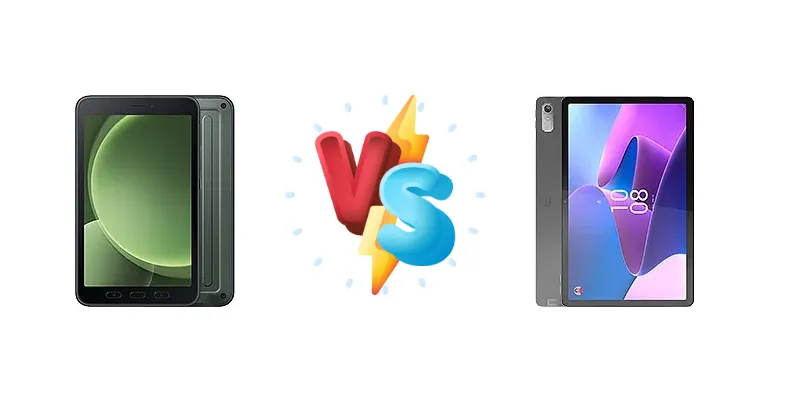
|
🏆 Quick Verdict
For users needing a truly rugged tablet for demanding environments, the Samsung Galaxy Tab Active5 is the clear winner. However, for everyday use, streaming, and light productivity, the Lenovo Tab P11 Gen 2 offers a more balanced experience at a potentially lower cost, leveraging its more efficient chipset.
| PHONES | ||
|---|---|---|
| Phone Names | Samsung Galaxy Tab Active5 | Lenovo Tab P11 Gen 2 |
| Network | ||
|---|---|---|
| 2G bands | GSM 850 / 900 / 1800 / 1900 | GSM 850 / 900 / 1800 / 1900 |
| 3G bands | HSDPA 850 / 900 / 1700(AWS) / 1900 / 2100 | HSDPA 800 / 850 / 900 / 1700(AWS) / 1900 / 2100 |
| 4G bands | 1, 2, 3, 4, 5, 7, 8, 12, 13, 17, 20, 26, 28, 32, 38, 40, 41, 66, 68 | 1, 2, 3, 4, 5, 7, 8, 12, 13, 18, 19, 20, 25, 26, 28, 38, 40, 41, 66 |
| 5G bands | 1, 3, 5, 7, 8, 20, 26, 28, 38, 40, 41, 66, 71, 77, 78 SA/NSA/Sub6 | - |
| Speed | HSPA, LTE, 5G - cellular model only | HSPA, LTE - cellular model only |
| Technology | GSM / HSPA / LTE / 5G | GSM / HSPA / LTE |
| Launch | ||
|---|---|---|
| Announced | 2024, January 10 | 2022, September 01 |
| Status | Available. Released 2024, January 23 | Available. Released 2023, January |
| Body | ||
|---|---|---|
| Dimensions | 213.8 x 126.8 x 10.1 mm (8.42 x 4.99 x 0.40 in) | 269.1 x 169.4 x 7.4 mm (10.59 x 6.67 x 0.29 in) |
| SIM | · Nano-SIM + eSIM· Nano-SIM + Nano-SIM (cellular model only) | Nano-SIM (cellular model only) |
| Weight | 433 g (15.27 oz) | 520 g (1.15 lb) |
| - | Stylus support | |
| Display | ||
|---|---|---|
| Protection | Corning Gorilla Glass 5 | - |
| Resolution | 1920 x 1200 pixels, 16:10 ratio (~283 ppi density) | 1200 x 2000 pixels, 5:3 ratio (~203 ppi density) |
| Size | 8.0 inches, 185.6 cm2 (~68.5% screen-to-body ratio) | 11.5 inches, 376.4 cm2 (~82.6% screen-to-body ratio) |
| Type | TFT LCD, 120Hz | IPS LCD, 120Hz, 400 nits (typ) |
| Platform | ||
|---|---|---|
| CPU | Octa-core (4x2.4 GHz Cortex-A78 & 4x2.0 GHz Cortex-A55) | Octa-core (2x2.2 GHz Cortex-A76 & 6x2.0 GHz Cortex-A55) |
| Chipset | Exynos 1380 (5 nm) | Mediatek Helio G99 (6 nm) |
| GPU | Mali-G68 MP5 | Mali-G57 MC2 |
| OS | Android 14, One UI 6 | Android 12L |
| Memory | ||
|---|---|---|
| Card slot | microSDXC | microSDXC (dedicated slot) |
| Internal | 128GB 6GB RAM, 128GB 8GB RAM, 256GB 8GB RAM | 64GB 4GB RAM, 128GB 4GB RAM, 128GB 6GB RAM |
| Main Camera | ||
|---|---|---|
| Features | LED flash, HDR, panorama | LED flash |
| Single | 13 MP, f/1.9, AF | 13 MP, f/2.4, (wide), AF |
| Video | 4K@30fps, 1080p@30fps | 1080p@30fps |
| Selfie camera | ||
|---|---|---|
| Single | 5 MP, f/2.2 | 8 MP, f/2.0 |
| Video | 1080p@30fps | 1080p@30fps |
| Sound | ||
|---|---|---|
| 3.5mm jack | - | Yes |
| 35mm jack | Yes | Yes |
| Loudspeaker | Yes | Yes, with stereo speakers (4 speakers) |
| Comms | ||
|---|---|---|
| Bluetooth | 5.3, A2DP, LE | 5.2, A2DP, LE |
| NFC | Yes | No |
| Positioning | GPS, GLONASS, BDS, GALILEO, QZSS - cellular model only | GPS, GLONASS, BDS - cellular model only |
| Radio | No | No |
| USB | USB Type-C 2.0, charging/accessories connector pins | USB Type-C 2.0, OTG, magnetic connector |
| WLAN | Wi-Fi 802.11 a/b/g/n/ac/6, dual-band, Wi-Fi Direct | Wi-Fi 802.11 a/b/g/n/ac/6e, dual-band, Wi-Fi Direct |
| Features | ||
|---|---|---|
| Sensors | Fingerprint (front-mounted), accelerometer, proximity, gyro, compass, proximity (accessories only) | Accelerometer, gyro, proximity |
| Battery | ||
|---|---|---|
| Type | Li-Po 5050 mAh, removable | Li-Po 7700 mAh |
| Misc | ||
|---|---|---|
| Colors | Green, Tactical Edition | Storm Grey, Sage |
| Models | SM-X306B | TB350FU |
| Price | $ 629.99 | About 350 EUR |
| SAR EU | 0.53 W/kg (head) 0.90 W/kg (body) | - |
Samsung Galaxy Tab Active5
- Exceptional Ruggedness: IP68 water and dust resistance, shock-absorbing design.
- Programmable Key: Customizable button for quick access to frequently used apps.
- Glove Mode: Enhanced touchscreen sensitivity for use with gloves.
- Potentially Lower Battery Life: Exynos 1380 is less power efficient.
- Smaller Display: Less immersive for media consumption.
Lenovo Tab P11 Gen 2
- Power Efficient Chipset: MediaTek Helio G99 offers excellent battery life.
- Larger Display: Ideal for streaming videos and multitasking.
- More Affordable: Typically priced lower than the Active5.
- Lacks Ruggedization: Not designed for harsh environments.
- Camera Quality: Likely inferior to the Active5 in low-light conditions.
Display Comparison
While specific display specs (resolution, panel type) are missing, the Active5’s focus on ruggedness likely means a more utilitarian display prioritizing visibility in bright sunlight and durability. The Lenovo Tab P11 Gen 2, positioned as a media tablet, likely features a more vibrant and color-accurate panel. The P11 Gen 2’s larger screen size (typically 11 inches vs the Active5’s 8 inches) will provide a more immersive viewing experience. Bezels on the Active5 are likely thicker to contribute to its shock-absorbing design.
Camera Comparison
Camera performance is unlikely to be a primary concern for either tablet. However, the Active5’s camera is likely optimized for quick documentation in field settings, while the P11 Gen 2’s camera may prioritize image quality for social media and casual photography. Without specific sensor details, it’s difficult to make a definitive judgment. The inclusion of a 2MP macro camera on the P11 Gen 2 is largely a marketing feature with limited practical benefit. The Active5 may prioritize a more robust camera module for durability.
Performance
The Samsung Galaxy Tab Active5 utilizes the Exynos 1380 (5nm), featuring a Cortex-A78 based CPU. This architecture prioritizes performance, offering strong single-core speeds (2.4 GHz) for responsive application launches. Conversely, the Lenovo Tab P11 Gen 2 employs the MediaTek Helio G99 (6nm). While the G99’s Cortex-A76 cores clock slightly higher (2.2 GHz), the 6nm process node offers superior power efficiency. This translates to potentially longer battery life during sustained use. The Active5’s 5nm chip *should* offer better thermal headroom, but the G99’s efficiency could mitigate throttling in less demanding tasks. The Active5’s RAM configuration (likely LPDDR4x) may be slower than the P11 Gen 2’s (potentially LPDDR5), impacting multitasking performance.
Battery Life
Battery life will be a key differentiator. The MediaTek Helio G99’s 6nm process gives the Lenovo Tab P11 Gen 2 a significant advantage in power efficiency. While the Active5 may have a slightly larger battery capacity, the Exynos 1380’s higher performance demands will likely result in shorter runtimes. The P11 Gen 2’s charging wattage (typically 20W) is likely comparable to the Active5, resulting in similar 0-100% charge times, but the P11 Gen 2 will likely last longer on a single charge.
Buying Guide
Buy the Samsung Galaxy Tab Active5 if you require a tablet capable of withstanding drops, dust, and water exposure, and need features like glove mode and programmable keys for field work. Buy the Lenovo Tab P11 Gen 2 if you prioritize a larger display for media consumption, smoother multitasking for everyday tasks, and a more streamlined user experience without the ruggedized price premium.