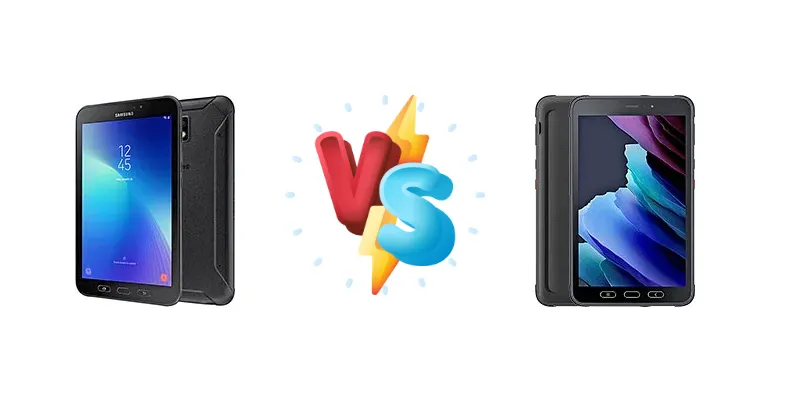
The Samsung Galaxy Tab Active series caters to professionals needing durable tablets for demanding environments. The Active2, while still available, is now overshadowed by the Active3. This comparison dissects the key differences – primarily the chipset upgrade – to determine if the Active3 justifies the cost for new buyers or if the Active2 remains a viable, budget-friendly option.
🏆 Quick Verdict
For users prioritizing performance and future-proofing, the Galaxy Tab Active3 is the clear winner. The Exynos 9810 delivers a substantial performance leap over the Active2’s Exynos 7870, enabling smoother multitasking and more demanding applications. However, the Active2 remains a compelling choice for basic tasks at a lower price point.
| Network |
|---|
| 2G bands | GSM 900 / 1800 / 1900 | GSM 900 / 1800 / 1900 |
| 3G bands | HSDPA 850 / 900 / 1900 / 2100 | HSDPA 850 / 900 / 1700(AWS) / 1900 / 2100 |
| 4G bands | 1, 3, 5, 7, 8, 20 | 1, 2, 3, 4, 5, 7, 8, 12, 13, 17, 20, 28, 38, 40, 41, 66 |
| Speed | HSPA 42.2/5.76 Mbps, LTE (2CA) Cat6 300/50 Mbps | HSPA, LTE |
| Technology | GSM / HSPA / LTE | GSM / HSPA / LTE |
| Launch |
|---|
| Announced | 2017, October. Released 2017, November | 2020, September 28. Released 2020, September 28 |
| Status | Discontinued | Discontinued |
| Body |
|---|
| Dimensions | 127.6 x 214.7 x 9.9 mm (5.02 x 8.45 x 0.39 in) | 213.8 x 126.8 x 9.9 mm (8.42 x 4.99 x 0.39 in) |
| SIM | Nano-SIM | Nano-SIM |
| Weight | 415 g (Wi-Fi) / 419 g (LTE) (14.64 oz) | 426 g (Wi-Fi) / 429 g (LTE) (15.03 oz) |
| | - | Stylus
IP68 dust/water resistant (up to 1.5m for 30 mins)
MIL-STD-810H compliant |
| Display |
|---|
| Resolution | 800 x 1280 pixels, 16:10 ratio (~189 ppi density) | 1200 x 1920 pixels, 16:10 ratio (~283 ppi density) |
| Size | 8.0 inches, 185.6 cm2 (~67.7% screen-to-body ratio) | 8.0 inches, 185.6 cm2 (~68.5% screen-to-body ratio) |
| Type | LCD | PLS LCD |
| Platform |
|---|
| CPU | Octa-core 1.6 GHz Cortex-A53 | Octa-core (4x2.7 GHz Mongoose M3 & 4x1.7 GHz Cortex-A55) |
| Chipset | Exynos 7870 Octa (14 nm) | Exynos 9810 (10 nm) |
| GPU | Mali-T830 MP1 | Mali-G72 MP18 |
| OS | Android 7.1.1 (Nougat) | Android 10, upgradable to Android 12, One UI 4.1 |
| Memory |
|---|
| Card slot | microSDXC (dedicated slot) | microSDXC (dedicated slot) |
| Internal | 16GB 2GB RAM, 16GB 3GB RAM | 64GB 4GB RAM, 128GB 4GB RAM |
| Main Camera |
|---|
| Features | LED flash, HDR, panorama | LED flash, HDR, panorama |
| Single | 8 MP, AF | 13 MP, f/1.9, (wide), AF |
| Video | 1080p@30fps | 4K@30fps, 1080p@30fps |
| Selfie camera |
|---|
| Single | 5 MP | 5 MP, f/2.2 |
| Sound |
|---|
| 3.5mm jack | - | Yes |
| 35mm jack | Yes | Yes |
| Loudspeaker | Yes, with stereo speakers | Yes, with stereo speakers |
| Comms |
|---|
| Bluetooth | 4.2, A2DP, LE | 5.0, A2DP, LE |
| NFC | Yes | Yes (EMV Level 1 certification) |
| Positioning | GPS, GLONASS | GPS, GLONASS, GALILEO, BDS |
| Radio | No | No |
| USB | USB Type-C 2.0 | USB Type-C 3.1, magnetic connector |
| WLAN | Wi-Fi 802.11 a/b/g/n/ac, dual-band, Wi-Fi Direct | Wi-Fi 802.11 a/b/g/n/ac/6, dual-band, Wi-Fi Direct |
| Features |
|---|
| Sensors | Fingerprint (front-mounted), accelerometer, gyro, proximity, compass | Fingerprint (front-mounted), accelerometer, gyro, proximity, compass |
| | - | Samsung DeX (desktop experience support) |
| Battery |
|---|
| Charging | - | 15W wired |
| Type | Li-Ion 4450 mAh, removable | Li-Ion 5050 mAh, removable |
| Misc |
|---|
| Colors | Black | Black |
| Models | SM-T395 | SM-T575 |
| Price | About 390 EUR | About 600 EUR |
| SAR | - | 1.09 W/kg (head) 1.39 W/kg (body) |
Samsung Galaxy Tab Active2
- Lower price point makes it accessible for budget-conscious users.
- Ruggedized design provides excellent durability.
- Suitable for basic tasks and applications.
- Significantly slower performance compared to the Active3.
- Older chipset may struggle with demanding applications.
- Likely slower charging speeds.
Samsung Galaxy Tab Active3
- Substantially faster performance thanks to the Exynos 9810.
- 15W fast charging reduces downtime.
- More future-proofed for demanding applications.
- Higher price compared to the Active2.
- Rugged design adds bulk and weight.
- Camera performance is still modest.
Display Comparison
Both tablets share a focus on durability over display extravagance, and specific display specs are not provided. However, given the Active series’ target audience, we can infer both utilize LCD panels optimized for outdoor visibility. The Active3 likely benefits from the more advanced image processing capabilities of the Exynos 9810, potentially resulting in slightly improved color accuracy and contrast. Bezels are expected to be substantial on both models to enhance grip and protect the screen.
Camera Comparison
Detailed camera specifications are limited. Both tablets likely feature modest camera setups geared towards basic documentation. The Active3, benefiting from the more powerful ISP (Image Signal Processor) within the Exynos 9810, will likely produce slightly better image quality, particularly in challenging lighting conditions. However, neither tablet is expected to compete with flagship smartphone cameras; their primary function is utility, not photography.
Performance
The core difference lies in the chipset. The Active3’s Exynos 9810, built on a 10nm process, represents a significant architectural leap over the Active2’s 14nm Exynos 7870. The 9810’s octa-core configuration, featuring 4x2.7 GHz Mongoose M3 cores and 4x1.7 GHz Cortex-A55 cores, provides substantially higher peak performance and improved efficiency compared to the Active2’s 1.6 GHz Cortex-A53 cores. This translates to faster app loading times, smoother multitasking, and the ability to handle more demanding applications like CAD software or complex spreadsheets. The Active3’s CPU architecture is also more modern, offering better instruction set support and overall responsiveness.
Battery Life
Battery capacity isn’t specified for either device. However, the Active3’s 15W wired charging is a notable upgrade. While the Active2’s charging speed is unknown, it’s likely slower. The 10nm process of the Exynos 9810 also contributes to improved power efficiency, potentially offsetting any difference in battery capacity. Users requiring extended operation in the field will benefit from the Active3’s faster charging and potentially longer runtimes.
Buying Guide
Buy the Samsung Galaxy Tab Active2 if you need a highly affordable, rugged tablet for basic field data entry, simple communication, and light application use where sustained performance isn't critical. Buy the Samsung Galaxy Tab Active3 if you require significantly faster processing speeds for complex applications, improved multitasking capabilities, and a tablet that will remain relevant for longer due to its more powerful hardware.
Frequently Asked Questions
❓ Does the Exynos 9810 in the Active3 generate excessive heat during prolonged use?
The Exynos 9810, built on a 10nm process, is more power-efficient than the Active2’s Exynos 7870. While it will generate heat under heavy load, the Active3’s thermal design should manage it effectively, preventing significant throttling during typical field work applications. However, sustained gaming or video encoding may lead to some performance reduction.
❓ Is the performance increase from the Active2 to the Active3 noticeable for everyday tasks like email and web browsing?
Yes, the performance difference is noticeable even in everyday tasks. The Active3’s faster CPU and improved memory management result in snappier app launches, smoother scrolling, and a more responsive user experience. While the Active2 is adequate for basic tasks, the Active3 provides a more fluid and enjoyable experience.
❓ What type of user would benefit most from the Active3's upgraded processor?
Professionals who rely on their tablets for data-intensive tasks like running CAD software, accessing remote desktops, processing large spreadsheets, or utilizing specialized field service applications will see the greatest benefit from the Active3’s Exynos 9810. The increased processing power and efficiency will significantly improve their workflow.