
Samsung Galaxy Tab A9 vs. Xiaomi Redmi Pad SE 8.7: A Detailed Comparison
| Phones Images | |||||
|---|---|---|---|---|---|
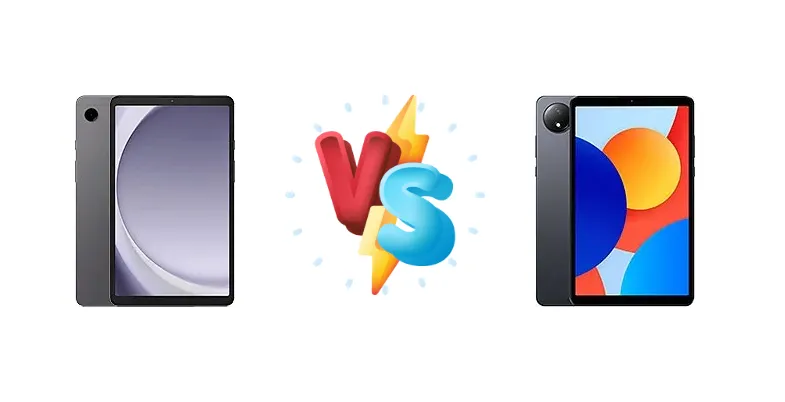
|
🏆 Quick Verdict
For most users, the Samsung Galaxy Tab A9 emerges as the better choice. Its newer Mediatek Helio G99 chipset, built on a 6nm process, provides a noticeable performance advantage over the Redmi Pad SE 8.7’s Helio G85, translating to smoother multitasking and gaming. While the Redmi Pad SE offers slightly faster charging (in international markets), the A9’s overall efficiency and processing power make it the more compelling option.
| PHONES | ||
|---|---|---|
| Phone Names | Samsung Galaxy Tab A9 | Xiaomi Redmi Pad SE 8.7 |
| Network | ||
|---|---|---|
| 2G bands | GSM 850 / 900 / 1800 / 1900 | GSM 850 / 900 / 1800 / 1900 |
| 3G bands | HSDPA 850 / 900 / 1700(AWS) / 1900 / 2100 | HSDPA 800 / 850 / 900 / 1700(AWS) / 1900 / 2100 |
| 4G bands | 1, 2, 3, 4, 5, 7, 8, 12, 17, 20, 28, 38, 40, 41, 66 | 1, 2, 3, 4, 5, 7, 8, 13, 18, 19, 20, 26, 28, 38, 40, 41, 66 |
| Speed | HSPA, LTE - cellular model only | HSPA, LTE - cellular model only |
| Technology | GSM / HSPA / LTE | GSM / HSPA / LTE |
| Launch | ||
|---|---|---|
| Announced | 2023, October 05 | 2024, July 29 |
| Status | Available. Released 2023, October 05 | Available. Released 2024, August 08 |
| Body | ||
|---|---|---|
| Build | - | Glass front (Gorilla Glass 3) |
| Dimensions | 211 x 124.7 x 8 mm (8.31 x 4.91 x 0.31 in) | 211.6 x 125.5 x 8.8 mm (8.33 x 4.94 x 0.35 in) |
| SIM | Nano-SIM (cellular model only) | Nano-SIM + Nano-SIM (cellular model only) |
| Weight | 332 g or 333 g (11.71 oz) | 370 / 373 / 375 g (13.05 oz) |
| Display | ||
|---|---|---|
| Protection | - | Corning Gorilla Glass 3 |
| Resolution | 800 x 1340 pixels, 5:3 ratio (~179 ppi density) | 800 x 1340 pixels, 5:3 ratio (~179 ppi density) |
| Size | 8.7 inches, 214.9 cm2 (~81.7% screen-to-body ratio) | 8.7 inches, 214.9 cm2 (~80.9% screen-to-body ratio) |
| Type | TFT LCD | IPS LCD, 1B colors, 90Hz, 600 nits (HBM) |
| Platform | ||
|---|---|---|
| CPU | Octa-core (2x2.2 GHz Cortex-A76 & 6x2.0 GHz Cortex-A55) | Octa-core (2x2.0 GHz Cortex-A75 & 6x1.8 GHz Cortex-A55) |
| Chipset | Mediatek Helio G99 (6 nm) | Mediatek Helio G85 (12 nm) |
| GPU | Mali-G57 MC2 | Mali-G52 MC2 |
| OS | Android 13, upgradable to Android 15, One UI 7 | Android 14, HyperOS |
| Memory | ||
|---|---|---|
| Card slot | microSDXC (dedicated slot) | microSDXC (dedicated slot) |
| Internal | 64GB 4GB RAM, 128GB 4GB RAM, 128GB 8GB RAM | 64GB 4GB RAM, 128GB 4GB RAM, 128GB 6GB RAM |
| Main Camera | ||
|---|---|---|
| Features | - | LED flash |
| Single | 8 MP, AF | 8 MP, f/2.0, (wide), 1/4.0", 1.12µm |
| Video | 1080p@30fps | 1080p@30fps |
| Selfie camera | ||
|---|---|---|
| Single | 2 MP | 5 MP, f/2.2, (wide), 1/5.0", 1.12µm |
| Video | Yes | 1080p@30fps |
| Sound | ||
|---|---|---|
| 35mm jack | Yes | Yes |
| Loudspeaker | Yes, with stereo speakers | Yes, with stereo speakers |
| Comms | ||
|---|---|---|
| Bluetooth | 5.3, A2DP, LE | 5.3, A2DP, LE |
| Infrared port | - | Yes |
| NFC | No | No |
| Positioning | GPS, GLONASS, BDS, GALILEO, QZSS - cellular model only | GPS, GALILEO, GLONASS, BDS - cellular model only |
| Radio | No | FM radio |
| USB | USB Type-C 2.0 | USB Type-C 2.0 |
| WLAN | Wi-Fi 802.11 a/b/g/n/ac, dual-band, Wi-Fi Direct | Wi-Fi 802.11 a/b/g/n/ac, dual-band |
| Features | ||
|---|---|---|
| Sensors | Accelerometer, proximity, compass | Accelerometer, proximity (accessories only), compass |
| Battery | ||
|---|---|---|
| Charging | 15W wired | 18W wired (Int'l) 10W wired (India) |
| Type | Li-Po 5100 mAh | 6650 mAh |
| Misc | ||
|---|---|---|
| Colors | Graphite, Silver, Navy | Aurora Green (Forest Green), Sky Blue (Ocean Blue), Graphite Gray (Urban Grey) |
| Models | SM-X110, SM-X115 | 220233L2G |
| Price | About 180 EUR | About 120 EUR |
| SAR | 0.48 W/kg (head) 0.89 W/kg (body) | 0.90 W/kg (head) 0.65 W/kg (body) |
| SAR EU | 0.51 W/kg (body) | 0.40 W/kg (head) 0.99 W/kg (body) |
Samsung Galaxy Tab A9
- More powerful and efficient Mediatek Helio G99 chipset
- Likely better sustained performance due to 6nm process
- Potentially longer battery life due to chipset efficiency
- Slower charging speed (15W)
- Larger size may be less portable
Xiaomi Redmi Pad SE 8.7
- More compact and portable 8.7-inch display
- Faster charging speed (18W - International markets)
- Potentially lower price point
- Less powerful Mediatek Helio G85 chipset
- Less efficient 12nm process
- Potentially shorter battery life under load
Display Comparison
Both tablets feature LCD panels, but detailed display specs are missing. However, the Redmi Pad SE’s 8.7-inch size offers a more compact and portable experience, while the Tab A9’s larger screen (size unspecified) is better suited for multitasking and media viewing. The difference in chipset manufacturing process suggests the Tab A9 may have a more efficient display driver, potentially impacting battery life. Bezels are likely similar given the price point, and color accuracy is expected to be standard for this segment.
Camera Comparison
Camera performance is unlikely to be a deciding factor for either tablet. Both are expected to feature basic camera setups, likely with a primary sensor and a depth or macro lens. Given the focus on budget pricing, image quality will be adequate for casual snapshots but not competitive with smartphones. The Redmi Pad SE 8.7’s camera specs are not available, but the Tab A9 is expected to have a similar configuration to other A-series tablets. We anticipate minimal differences in image processing capabilities.
Performance
The core difference lies in the chipsets. The Samsung Galaxy Tab A9’s Mediatek Helio G99 (6nm) boasts newer Cortex-A76 cores clocked at 2.2 GHz, compared to the Redmi Pad SE 8.7’s Helio G85 (12nm) with 2.0 GHz Cortex-A75 cores. The 6nm process of the G99 is significantly more efficient, leading to better thermal management and sustained performance. While both are octa-core CPUs, the architectural improvements in the G99, combined with the smaller node, give the Tab A9 a clear edge in CPU-intensive tasks. The G99 also features a more capable GPU, offering a better gaming experience. RAM configurations are not specified, but faster LPDDR5x RAM would further enhance the Tab A9’s performance.
Battery Life
Battery capacity is not specified for either device. However, the Redmi Pad SE 8.7 supports 18W wired charging (international markets) or 10W (India), while the Tab A9 is limited to 15W. While 18W is faster on paper, the Tab A9’s more efficient Helio G99 chipset could offset the charging speed difference with longer battery life. Real-world 0-100% charging times will depend on the battery capacity and charging adapter used, but the Redmi Pad SE has the potential for quicker top-ups in regions with 18W support.
Buying Guide
Buy the Samsung Galaxy Tab A9 if you prioritize consistent performance for everyday tasks, light gaming, and future-proofing. Its more efficient chipset will also contribute to longer battery life under sustained load. Buy the Xiaomi Redmi Pad SE 8.7 if you are primarily focused on media consumption and portability, and live in a region where the 18W charging is available, as the slightly faster charging could be beneficial. The Redmi Pad SE is also a good option if you find it significantly cheaper than the Tab A9.