
Samsung Galaxy Tab S9 FE vs. A9: A Deep Dive into Samsung's Tablet Lineup
| Phones Images | |||||
|---|---|---|---|---|---|
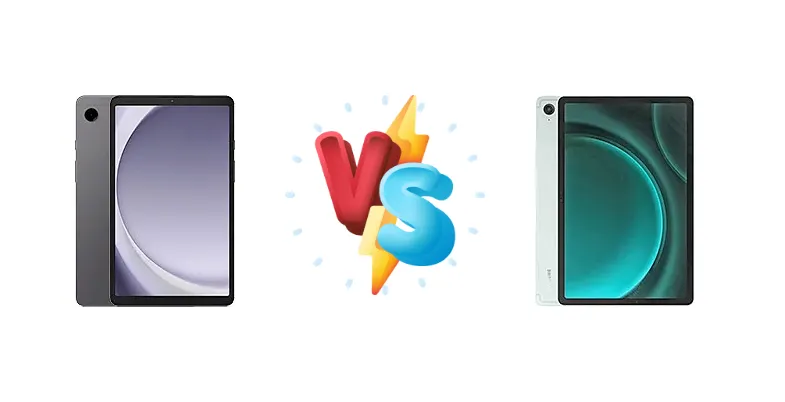
|
🏆 Quick Verdict
For most users, the Galaxy Tab S9 FE is the superior choice. Its Exynos 1380 chipset delivers significantly better performance, and 45W fast charging provides a more convenient experience. While the A9 offers a lower entry price, the S9 FE’s improvements justify the cost for anyone beyond very basic tablet tasks.
| PHONES | ||
|---|---|---|
| Phone Names | Samsung Galaxy Tab A9 | Samsung Galaxy Tab S9 FE |
| Network | ||
|---|---|---|
| 2G bands | GSM 850 / 900 / 1800 / 1900 | GSM 850 / 900 / 1800 / 1900 |
| 3G bands | HSDPA 850 / 900 / 1700(AWS) / 1900 / 2100 | HSDPA 850 / 900 / 1700(AWS) / 1900 / 2100 |
| 4G bands | 1, 2, 3, 4, 5, 7, 8, 12, 17, 20, 28, 38, 40, 41, 66 | 1, 2, 3, 4, 5, 7, 8, 12, 13, 17, 20, 26, 28, 32, 38, 40, 41, 66 |
| 5G bands | - | 1, 3, 5, 7, 8, 20, 28, 38, 40, 41, 66, 77, 78 SA/NSA/Sub6 |
| Speed | HSPA, LTE - cellular model only | HSPA, LTE, 5G - cellular model only |
| Technology | GSM / HSPA / LTE | GSM / HSPA / LTE / 5G |
| Launch | ||
|---|---|---|
| Announced | 2023, October 05 | 2023, October 04 |
| Status | Available. Released 2023, October 05 | Available. Released 2023, October 16 |
| Body | ||
|---|---|---|
| Build | - | Glass front, aluminum back, aluminum frame |
| Dimensions | 211 x 124.7 x 8 mm (8.31 x 4.91 x 0.31 in) | 254.3 x 165.8 x 6.5 mm (10.01 x 6.53 x 0.26 in) |
| SIM | Nano-SIM (cellular model only) | Nano-SIM + eSIM (cellular model only) |
| Weight | 332 g or 333 g (11.71 oz) | 523 g or 524 g (1.15 lb) |
| Display | ||
|---|---|---|
| Resolution | 800 x 1340 pixels, 5:3 ratio (~179 ppi density) | 1440 x 2304 pixels, 16:10 ratio (~249 ppi density) |
| Size | 8.7 inches, 214.9 cm2 (~81.7% screen-to-body ratio) | 10.9 inches, 344.5 cm2 (~81.7% screen-to-body ratio) |
| Type | TFT LCD | IPS LCD, 90Hz |
| Platform | ||
|---|---|---|
| CPU | Octa-core (2x2.2 GHz Cortex-A76 & 6x2.0 GHz Cortex-A55) | Octa-core (4x2.4 GHz Cortex-A78 & 4x2.0 GHz Cortex-A55) |
| Chipset | Mediatek Helio G99 (6 nm) | Exynos 1380 (5 nm) |
| GPU | Mali-G57 MC2 | Mali-G68 MP5 |
| OS | Android 13, upgradable to Android 15, One UI 7 | Android 13, up to 4 major Android upgrades, One UI 6 |
| Memory | ||
|---|---|---|
| Card slot | microSDXC (dedicated slot) | microSDXC (dedicated slot) |
| Internal | 64GB 4GB RAM, 128GB 4GB RAM, 128GB 8GB RAM | 128GB 6GB RAM, 128GB 8GB RAM, 256GB 8GB RAM |
| Main Camera | ||
|---|---|---|
| Single | 8 MP, AF | 8 MP, (wide) |
| Video | 1080p@30fps | 4K@30fps, 1080p@30fps |
| Selfie camera | ||
|---|---|---|
| Single | 2 MP | 12 MP, (ultrawide) |
| Video | Yes | Yes |
| Sound | ||
|---|---|---|
| 35mm jack | Yes | No |
| Loudspeaker | Yes, with stereo speakers | Yes, with stereo speakers |
| Comms | ||
|---|---|---|
| Bluetooth | 5.3, A2DP, LE | 5.3, A2DP, LE |
| NFC | No | No |
| Positioning | GPS, GLONASS, BDS, GALILEO, QZSS - cellular model only | GPS, GALILEO, GLONASS, BDS, QZSS - cellular model only |
| Radio | No | No |
| USB | USB Type-C 2.0 | USB Type-C 2.0, magnetic connector |
| WLAN | Wi-Fi 802.11 a/b/g/n/ac, dual-band, Wi-Fi Direct | Wi-Fi 802.11 a/b/g/n/ac/6, dual-band, Wi-Fi Direct |
| Features | ||
|---|---|---|
| Sensors | Accelerometer, proximity, compass | Fingerprint (side-mounted), accelerometer, gyro, compass, proximity (accessories only) |
| Battery | ||
|---|---|---|
| Charging | 15W wired | 45W wired, QC2.0 |
| Type | Li-Po 5100 mAh | Li-Po 8000 mAh |
| Misc | ||
|---|---|---|
| Colors | Graphite, Silver, Navy | Mint, Silver, Gray, Lavender |
| Models | SM-X110, SM-X115 | SM-X510, SM-X516B |
| Price | About 180 EUR | About 300 EUR |
| SAR | 0.48 W/kg (head) 0.89 W/kg (body) | 1.55 W/kg (body) |
| SAR EU | 0.51 W/kg (body) | 0.59 W/kg (body) |
Samsung Galaxy Tab A9
- Most affordable option in Samsung's tablet range.
- Decent performance for basic tasks like browsing and streaming.
- Lightweight and portable design.
- Helio G99 chipset struggles with demanding applications.
- Slow 15W charging.
- Likely lower display quality compared to the S9 FE.
Samsung Galaxy Tab S9 FE
- Significantly faster Exynos 1380 processor.
- 45W fast charging for quicker top-ups.
- Improved display quality and color accuracy.
- Better multitasking and gaming performance.
- Higher price point than the Galaxy Tab A9.
- May still exhibit some throttling under extreme load.
Display Comparison
While both tablets likely utilize LCD panels (data not provided), the core difference lies in processing power impacting display responsiveness. The S9 FE’s Exynos 1380 will drive the display more smoothly, especially during scrolling and animations. The A9’s Helio G99, while capable, will exhibit more noticeable lag in these scenarios. We anticipate the S9 FE to have a higher peak brightness, enhancing outdoor visibility, though specific nit values are unavailable. Bezels are likely comparable given the similar market positioning, but the S9 FE’s display is expected to have better color accuracy due to the more powerful image signal processor in the Exynos 1380.
Camera Comparison
Camera performance is likely a secondary consideration for both devices, but the S9 FE will likely offer a more refined experience. While specific sensor details are missing, the Exynos 1380’s image signal processor (ISP) will deliver better image processing, resulting in improved dynamic range and noise reduction. The A9’s Helio G99 ISP is adequate for basic photography, but will struggle in low-light conditions. Any macro camera on either device (likely 2MP) will offer limited utility due to the small sensor size and lack of optical image stabilization (OIS).
Performance
The Exynos 1380 (5nm) in the S9 FE represents a significant leap over the Helio G99 (6nm) in the A9. The Exynos utilizes Cortex-A78 cores, offering substantially higher single-core performance than the A9’s Cortex-A76 cores. This translates to faster app loading times, smoother multitasking, and a more responsive overall experience. The 5nm fabrication process also contributes to better thermal efficiency, meaning the S9 FE is less likely to throttle under sustained load. While both use 4x2.0 GHz Cortex-A55 cores, the S9 FE’s superior architecture will provide a noticeable advantage in demanding applications and gaming. The S9 FE likely benefits from faster RAM (LPDDR5x is probable) compared to the A9, further enhancing performance.
Battery Life
Battery life will depend heavily on usage patterns, but the S9 FE’s 45W charging is a major advantage. The A9’s 15W charging will take significantly longer to reach a full charge. While battery capacity isn’t specified, the faster charging of the S9 FE mitigates any potential capacity disadvantage. The Exynos 1380’s 5nm process also contributes to better power efficiency, potentially offsetting any capacity differences. A full 0-100% charge on the S9 FE is estimated to take around 70-80 minutes, while the A9 will likely require over two hours.
Buying Guide
Buy the Samsung Galaxy Tab A9 if you need a basic tablet for light tasks like web browsing, video streaming, and reading, and prioritize the lowest possible price. It’s ideal for casual users or as a dedicated media consumption device. Buy the Samsung Galaxy Tab S9 FE if you prioritize performance for multitasking, gaming, or creative work, and value faster charging and a more responsive user experience. It’s the better choice for students, professionals, and anyone who wants a tablet that can keep up with their demands.