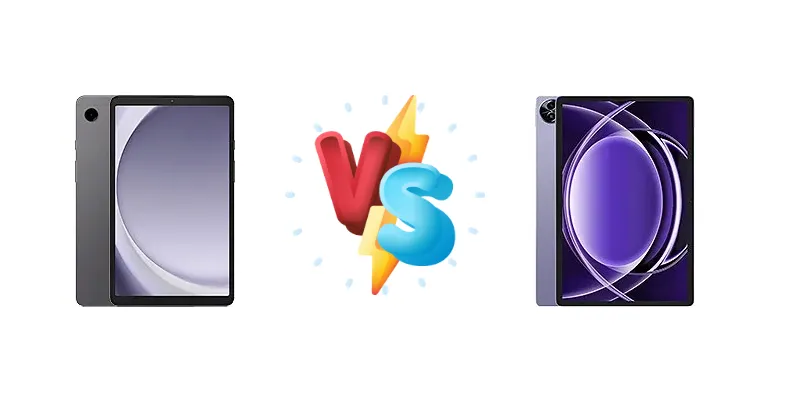
The sub-$200 tablet market is fiercely competitive, and the Samsung Galaxy Tab A9 and Realme Pad 2 Lite are two strong contenders. Both devices leverage the Mediatek Helio G99 chipset, promising similar performance on paper. However, the devil is in the details – from software experience to potential long-term support, this comparison dives deep to determine which tablet offers the best value.
🏆 Quick Verdict
For the average user prioritizing a well-established ecosystem and potentially longer software support, the Samsung Galaxy Tab A9 is the slightly better choice. However, the Realme Pad 2 Lite presents a compelling alternative, particularly for those already invested in the Realme ecosystem or seeking a potentially more streamlined Android experience.
| Network |
|---|
| 2G bands | GSM 850 / 900 / 1800 / 1900 | GSM 850 / 900 / 1800 / 1900 |
| 3G bands | HSDPA 850 / 900 / 1700(AWS) / 1900 / 2100 | HSDPA 850 / 900 / 2100 |
| 4G bands | 1, 2, 3, 4, 5, 7, 8, 12, 17, 20, 28, 38, 40, 41, 66 | 1, 3, 5, 7, 8, 20, 28, 38, 40, 41 |
| Speed | HSPA, LTE - cellular model only | HSPA, LTE |
| Technology | GSM / HSPA / LTE | GSM / HSPA / LTE |
| Launch |
|---|
| Announced | 2023, October 05 | 2024, September 13 |
| Status | Available. Released 2023, October 05 | Available. Released 2024, September 26 |
| Body |
|---|
| Dimensions | 211 x 124.7 x 8 mm (8.31 x 4.91 x 0.31 in) | 258 x 169.5 x 8.3 mm (10.16 x 6.67 x 0.33 in) |
| SIM | Nano-SIM (cellular model only) | No |
| Weight | 332 g or 333 g (11.71 oz) | 525 g (1.16 lb) |
| Display |
|---|
| Resolution | 800 x 1340 pixels, 5:3 ratio (~179 ppi density) | 1200 x 1920 pixels, 16:10 ratio (~207 ppi density) |
| Size | 8.7 inches, 214.9 cm2 (~81.7% screen-to-body ratio) | 10.95 inches, 347.7 cm2 (~79.5% screen-to-body ratio) |
| Type | TFT LCD | IPS LCD, 1B colors, 90Hz, 450 nits (peak) |
| Platform |
|---|
| CPU | Octa-core (2x2.2 GHz Cortex-A76 & 6x2.0 GHz Cortex-A55) | Octa-core (2x2.2 GHz Cortex-A76 & 6x2.0 GHz Cortex-A55) |
| Chipset | Mediatek Helio G99 (6 nm) | Mediatek Helio G99 (6 nm) |
| GPU | Mali-G57 MC2 | Mali-G57 MC2 |
| OS | Android 13, upgradable to Android 15, One UI 7 | Android 14, Realme UI 5.0 for Pad |
| Memory |
|---|
| Card slot | microSDXC (dedicated slot) | Unspecified |
| Internal | 64GB 4GB RAM, 128GB 4GB RAM, 128GB 8GB RAM | 128GB 4GB RAM, 128GB 8GB RAM |
| Main Camera |
|---|
| Features | - | Panorama |
| Single | 8 MP, AF | 8 MP, f/2.0 |
| Video | 1080p@30fps | 1080p@30fps |
| Selfie camera |
|---|
| Features | - | Panorama |
| Single | 2 MP | 5 MP, f/2.2 |
| Video | Yes | 1080p@30fps |
| Sound |
|---|
| 35mm jack | Yes | No |
| Loudspeaker | Yes, with stereo speakers | Yes, with stereo speakers (4 speakers) |
| Comms |
|---|
| Bluetooth | 5.3, A2DP, LE | 5.2, A2DP, LE |
| NFC | No | No |
| Positioning | GPS, GLONASS, BDS, GALILEO, QZSS - cellular model only | GPS, GALILEO, GLONASS, BDS |
| Radio | No | No |
| USB | USB Type-C 2.0 | USB Type-C |
| WLAN | Wi-Fi 802.11 a/b/g/n/ac, dual-band, Wi-Fi Direct | Wi-Fi 802.11 a/b/g/n/ac, dual-band |
| Features |
|---|
| Sensors | Accelerometer, proximity, compass | Accelerometer |
| Battery |
|---|
| Charging | 15W wired | 15W wired |
| Type | Li-Po 5100 mAh | 8300 mAh |
| Misc |
|---|
| Colors | Graphite, Silver, Navy | Nebula Purple, Space Grey |
| Models | SM-X110, SM-X115 | RMP2402 |
| Price | About 180 EUR | About 160 EUR |
| SAR | 0.48 W/kg (head) 0.89 W/kg (body) | - |
| SAR EU | 0.51 W/kg (body) | - |
Samsung Galaxy Tab A9
- Established Samsung ecosystem
- Potential for longer software support
- One UI feature set
- Potentially higher price
- One UI can be resource intensive
Realme Pad 2 Lite
- Potentially more aggressive pricing
- Cleaner Android experience
- Realme ecosystem integration
- Shorter software support lifecycle (potentially)
- Less brand recognition
Display Comparison
Both the Samsung Galaxy Tab A9 and Realme Pad 2 Lite are expected to feature 10.5-inch LCD panels, but detailed specifications like resolution and peak brightness are currently unavailable. Given the price point, we anticipate both will offer adequate, but not exceptional, viewing experiences. The absence of high refresh rates (90Hz or 120Hz) is expected, focusing on power efficiency. Color accuracy will likely be standard for this segment, prioritizing vibrant visuals over professional-grade color reproduction. Bezels are expected to be relatively uniform on both devices, contributing to a functional, if not premium, aesthetic.
Camera Comparison
Camera performance is unlikely to be a key differentiator in this price range. Both tablets will likely feature a single main camera and a front-facing camera for video calls. Sensor sizes and lens apertures are unknown, but we anticipate modest image quality, sufficient for casual snapshots and video conferencing. The inclusion of a 2MP macro camera on either device is largely a marketing tactic, offering limited practical benefit due to the small sensor size and lack of optical image stabilization (OIS). Image processing will likely focus on enhancing colors and contrast, rather than delivering natural-looking photos.
Performance
The core of both tablets is the Mediatek Helio G99 (6 nm) chipset, paired with an octa-core CPU configuration of 2x2.2 GHz Cortex-A76 and 6x2.0 GHz Cortex-A55 cores. This means raw processing power will be nearly identical between the two. The performance will be sufficient for everyday tasks like web browsing, video streaming, and light gaming. However, demanding titles will likely require reduced graphics settings. RAM configurations are crucial, and while not specified, larger RAM options (4GB or 6GB) will significantly improve multitasking capabilities. Both devices will likely utilize UFS storage, impacting app loading times and overall system responsiveness. Thermal management will be key; the Helio G99 is known to throttle under sustained load, and the tablet’s design will determine how effectively heat is dissipated.
Battery Life
Both the Samsung Galaxy Tab A9 and Realme Pad 2 Lite support 15W wired charging. Battery capacity is currently unspecified, but a typical range for tablets in this segment is 5000mAh to 7000mAh. The 15W charging speed will result in a relatively slow 0-100% charge time, likely exceeding 3 hours. Real-world battery life will depend heavily on usage patterns, but both tablets should comfortably last a full day with moderate use (web browsing, video streaming). The efficiency of the Mediatek Helio G99 chipset and the display panel will play a significant role in determining overall battery endurance.
Buying Guide
Buy the Samsung Galaxy Tab A9 if you need a tablet deeply integrated with the Samsung ecosystem, appreciate One UI’s feature set, and value the brand’s reputation for software updates. Buy the Realme Pad 2 Lite if you prefer a cleaner Android experience, are already invested in Realme’s product line, or are looking for a potentially more aggressive price point without sacrificing core performance.
Frequently Asked Questions
❓ Will the Mediatek Helio G99 struggle with graphically demanding games like Genshin Impact?
The Mediatek Helio G99 is capable of running Genshin Impact, but you'll likely need to lower the graphics settings to medium or low to achieve a playable frame rate. Expect some frame drops during intense combat scenarios. It's not a gaming powerhouse, but it can handle casual gaming adequately.
❓ How long will software updates be supported on the Realme Pad 2 Lite compared to the Samsung Galaxy Tab A9?
Samsung generally provides longer software support for its tablets than Realme. While Realme has improved its update commitment, the Galaxy Tab A9 is likely to receive more Android version updates and security patches over its lifespan. This is a key consideration for users prioritizing long-term software support.
❓ Can either of these tablets be used with a keyboard and mouse for productivity tasks?
Yes, both the Samsung Galaxy Tab A9 and Realme Pad 2 Lite support Bluetooth keyboards and mice. However, the tablet experience isn't a direct replacement for a laptop. The Android operating system isn't as optimized for desktop-style productivity as Windows or macOS.