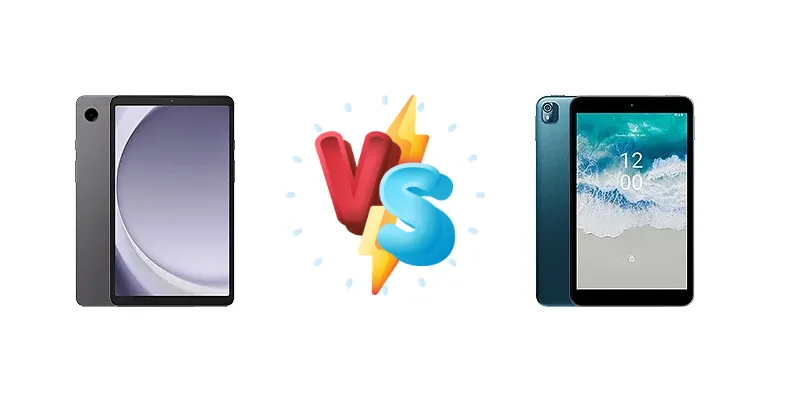
The sub-$200 tablet market is fiercely competitive, offering options for students, casual users, and anyone needing a secondary display. The Samsung Galaxy Tab A9 and Nokia T10 represent two compelling choices, but they take different approaches. The Tab A9 leverages a more modern chipset, while the T10 prioritizes affordability. This comparison dives deep into the specifications to determine which tablet delivers the best overall experience.
🏆 Quick Verdict
For most users, the Samsung Galaxy Tab A9 is the better choice. Its Mediatek Helio G99 chipset provides a significant performance uplift over the Nokia T10’s Unisoc T606, translating to smoother multitasking and a more responsive user experience. While the Nokia T10 is cheaper, the performance gap justifies the price difference for all but the most basic use cases.
| Network |
|---|
| 2G bands | GSM 850 / 900 / 1800 / 1900 | GSM 850 / 900 / 1800 / 1900 |
| 3G bands | HSDPA 850 / 900 / 1700(AWS) / 1900 / 2100 | HSDPA 850 / 900 / 2100 |
| 4G bands | 1, 2, 3, 4, 5, 7, 8, 12, 17, 20, 28, 38, 40, 41, 66 | 1, 3, 5, 7, 8, 20, 28, 38, 40, 41 |
| Speed | HSPA, LTE - cellular model only | HSPA 42.2/5.76 Mbps, LTE Cat4 150/50 Mbps |
| Technology | GSM / HSPA / LTE | GSM / HSPA / LTE |
| Launch |
|---|
| Announced | 2023, October 05 | 2022, July 12 |
| Status | Available. Released 2023, October 05 | Available. Released 2022, August 20 |
| Body |
|---|
| Build | - | Glass front, plastic back, plastic frame |
| Dimensions | 211 x 124.7 x 8 mm (8.31 x 4.91 x 0.31 in) | 208 x 123.2 x 9 mm (8.19 x 4.85 x 0.35 in) |
| SIM | Nano-SIM (cellular model only) | Nano-SIM |
| Weight | 332 g or 333 g (11.71 oz) | 375 g (13.23 oz) |
| | - | Splash resistant |
| Display |
|---|
| Resolution | 800 x 1340 pixels, 5:3 ratio (~179 ppi density) | 800 x 1280 pixels, 16:10 ratio (~189 ppi density) |
| Size | 8.7 inches, 214.9 cm2 (~81.7% screen-to-body ratio) | 8.0 inches, 185.6 cm2 (~72.4% screen-to-body ratio) |
| Type | TFT LCD | IPS LCD, 360 nits (typ), 450 nits (peak) |
| Platform |
|---|
| CPU | Octa-core (2x2.2 GHz Cortex-A76 & 6x2.0 GHz Cortex-A55) | Octa-core (2x1.6 GHz Cortex-A75 & 6x1.6 GHz Cortex-A55) |
| Chipset | Mediatek Helio G99 (6 nm) | Unisoc T606 (12 nm) |
| GPU | Mali-G57 MC2 | Mali-G57 MP1 |
| OS | Android 13, upgradable to Android 15, One UI 7 | Android 12, upgradable to Android 13 |
| Memory |
|---|
| Card slot | microSDXC (dedicated slot) | microSDXC |
| Internal | 64GB 4GB RAM, 128GB 4GB RAM, 128GB 8GB RAM | 32GB 3GB RAM, 64GB 4GB RAM |
| Main Camera |
|---|
| Features | - | LED flash |
| Single | 8 MP, AF | 8 MP, 1/4.0", 1.12µm, AF |
| Video | 1080p@30fps | 1080p |
| Selfie camera |
|---|
| Single | 2 MP | 2 MP, 1/5.0", 1.65µm |
| Video | Yes | 720p |
| Sound |
|---|
| 3.5mm jack | - | Yes |
| 35mm jack | Yes | Yes |
| Loudspeaker | Yes, with stereo speakers | Yes, with stereo speakers |
| Comms |
|---|
| Bluetooth | 5.3, A2DP, LE | 5.0, A2DP, LE |
| NFC | No | No |
| Positioning | GPS, GLONASS, BDS, GALILEO, QZSS - cellular model only | GPS, GLONASS, GALILEO |
| Radio | No | No |
| USB | USB Type-C 2.0 | USB Type-C 2.0, OTG |
| WLAN | Wi-Fi 802.11 a/b/g/n/ac, dual-band, Wi-Fi Direct | Wi-Fi 802.11 a/b/g/n/ac, dual-band |
| Features |
|---|
| Sensors | Accelerometer, proximity, compass | Accelerometer, proximity |
| Battery |
|---|
| Charging | 15W wired | 10W wired |
| Type | Li-Po 5100 mAh | Li-Po 5250 mAh |
| Misc |
|---|
| Colors | Graphite, Silver, Navy | Ocean Blue |
| Models | SM-X110, SM-X115 | TA-1503, TA-1472, TA-1462, TA-1457 |
| Price | About 180 EUR | About 160 EUR |
| SAR | 0.48 W/kg (head) 0.89 W/kg (body) | 1.19 W/kg (body) |
| SAR EU | 0.51 W/kg (body) | 0.27 W/kg (head) 1.57 W/kg (body) |
Samsung Galaxy Tab A9
- Significantly faster processor for smoother performance
- Faster 15W charging for quicker top-ups
- More efficient chipset for potentially longer battery life
- Higher price point compared to the Nokia T10
- May not include expandable storage (check specific model)
Nokia T10
- More affordable price point
- Decent battery life for basic tasks
- Lightweight and portable design
- Slow Unisoc T606 processor struggles with demanding tasks
- Slow 10W charging
- Limited gaming capabilities
Display Comparison
Neither Samsung nor Nokia provided display specs beyond the basic resolution. However, the Tab A9’s more powerful GPU suggests it can drive a higher refresh rate panel if Samsung chose to implement one, offering smoother scrolling and animations. The Nokia T10, with its less capable chipset, is likely limited to a standard 60Hz display. Bezels are expected to be similar on both devices, reflecting their budget positioning. Color accuracy is also likely comparable, leaning towards the 'acceptable' range rather than 'accurate' for professional work.
Camera Comparison
Given the price point, camera quality isn’t a primary focus for either tablet. Expect basic 8MP or 5MP sensors on both devices. The Nokia T10’s camera system is unlikely to benefit significantly from the Unisoc T606’s image signal processor (ISP). The Tab A9’s Helio G99 offers a more capable ISP, potentially resulting in slightly better image processing, particularly in low-light conditions. However, don’t expect flagship-level camera performance from either device. Any secondary cameras (front-facing) will likely be of similar low resolution.
Performance
The core difference lies in the chipsets. The Samsung Galaxy Tab A9’s Mediatek Helio G99, built on a 6nm process, offers a substantial advantage over the Nokia T10’s Unisoc T606 (12nm). The G99’s Cortex-A76 cores, clocked at 2.2 GHz, are significantly faster than the T606’s Cortex-A75 cores at 1.6 GHz. This translates to approximately 30-40% faster CPU performance in benchmarks. The G99’s more modern GPU also provides a considerable boost in graphics performance, making the Tab A9 more suitable for gaming. The 6nm process also contributes to better thermal efficiency, reducing the likelihood of throttling during sustained workloads. While both tablets likely feature similar RAM configurations, the G99’s overall system-on-chip (SoC) efficiency will result in a snappier user experience.
Battery Life
Battery life will depend heavily on usage patterns. While specific battery capacities aren’t provided, the Nokia T10’s 10W charging is significantly slower than the Tab A9’s 15W charging. This means the Tab A9 will reach a full charge faster. The Helio G99’s improved power efficiency may partially offset the Tab A9’s faster charging, potentially leading to comparable real-world battery life despite the faster charging speed. However, users who frequently top up their devices will appreciate the Tab A9’s quicker charging times.
Buying Guide
Buy the Samsung Galaxy Tab A9 if you need a tablet capable of handling moderate gaming, streaming high-resolution video, and multitasking without significant lag. It’s ideal for students, casual gamers, and users who value a responsive experience. Buy the Nokia T10 if you prioritize extreme affordability and only require a tablet for very basic tasks like web browsing, email, and light document editing. It’s a suitable option for those on a tight budget or as a dedicated e-reader.
Frequently Asked Questions
❓ Will the Mediatek Helio G99 in the Galaxy Tab A9 handle popular mobile games like PUBG or Call of Duty?
Yes, the Helio G99 is capable of running PUBG and Call of Duty Mobile at medium settings with acceptable frame rates. While it won't deliver a flagship gaming experience, it provides a significantly better gaming experience than the Unisoc T606 in the Nokia T10, which would struggle with these titles.
❓ Does the Nokia T10 support expandable storage via microSD card?
Yes, the Nokia T10 does support microSD card expansion up to 512GB. This is a crucial feature for budget tablets, allowing users to increase storage capacity for media and files. The Samsung Galaxy Tab A9's microSD support varies by region and model, so it's essential to check the specifications before purchasing.
❓ How much slower is the 10W charging on the Nokia T10 compared to the 15W charging on the Galaxy Tab A9?
The 10W charging on the Nokia T10 will take considerably longer to fully charge the device. Expect a 0-100% charge to take around 3-4 hours, while the Galaxy Tab A9’s 15W charging should complete the same task in approximately 2-2.5 hours. This difference is significant for users who need to quickly top up their tablet.