
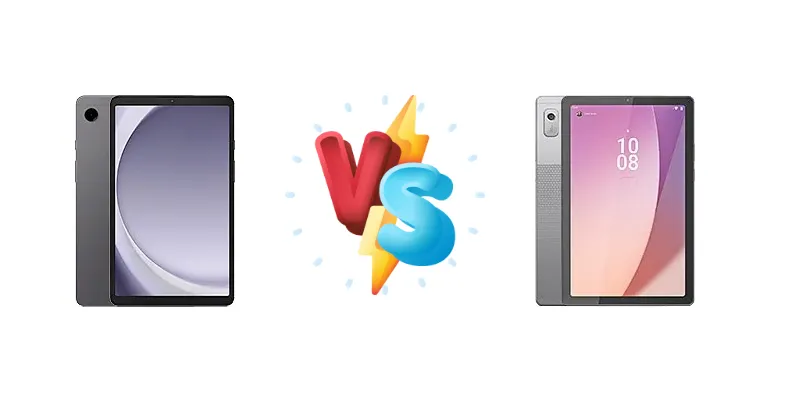
Samsung Galaxy Tab A9 vs. Lenovo Tab M9: Which Budget Tablet Reigns Supreme?
| Phones Images | |||||
|---|---|---|---|---|---|
|
🏆 Quick Verdict
For most users, the Samsung Galaxy Tab A9 emerges as the better choice. Its newer Mediatek Helio G99 chipset, built on a 6nm process, provides a noticeable performance advantage over the Lenovo Tab M9’s Helio G80 (12nm), translating to smoother multitasking and gaming. While the Tab M9 is more affordable, the A9’s efficiency and responsiveness justify the slight price premium.
| PHONES | ||
|---|---|---|
| Phone Names | Samsung Galaxy Tab A9 | Lenovo Tab M9 |
| Network | ||
|---|---|---|
| 2G bands | GSM 850 / 900 / 1800 / 1900 | GSM 850 / 900 / 1800 / 1900 |
| 3G bands | HSDPA 850 / 900 / 1700(AWS) / 1900 / 2100 | HSDPA 850 / 900 / 1700(AWS) / 1900 / 2100 |
| 4G bands | 1, 2, 3, 4, 5, 7, 8, 12, 17, 20, 28, 38, 40, 41, 66 | 1, 2, 3, 4, 5, 7, 8, 18, 19, 20, 26, 28, 38, 40, 41, 66 |
| Speed | HSPA, LTE - cellular model only | HSPA, LTE - cellular model only |
| Technology | GSM / HSPA / LTE | GSM / HSPA / LTE |
| Launch | ||
|---|---|---|
| Announced | 2023, October 05 | 2022, December 20 |
| Status | Available. Released 2023, October 05 | Available. Released 2023, March 14 |
| Body | ||
|---|---|---|
| Dimensions | 211 x 124.7 x 8 mm (8.31 x 4.91 x 0.31 in) | 215.4 x 136.8 x 8 mm (8.48 x 5.39 x 0.31 in) |
| SIM | Nano-SIM (cellular model only) | Nano-SIM (cellular model only) |
| Weight | 332 g or 333 g (11.71 oz) | 344 g (12.13 oz) |
| Display | ||
|---|---|---|
| Resolution | 800 x 1340 pixels, 5:3 ratio (~179 ppi density) | 800 x 1340 pixels, 5:3 ratio (~173 ppi density) |
| Size | 8.7 inches, 214.9 cm2 (~81.7% screen-to-body ratio) | 9.0 inches, 230.0 cm2 (~78.1% screen-to-body ratio) |
| Type | TFT LCD | IPS LCD, 400 nits (typ) |
| Platform | ||
|---|---|---|
| CPU | Octa-core (2x2.2 GHz Cortex-A76 & 6x2.0 GHz Cortex-A55) | Octa-core (2x2.0 GHz Cortex-A75 & 6x1.8 GHz Cortex-A55) |
| Chipset | Mediatek Helio G99 (6 nm) | Mediatek MT6769V/CU Helio G80 (12 nm) |
| GPU | Mali-G57 MC2 | Mali-G52 MC2 |
| OS | Android 13, upgradable to Android 15, One UI 7 | Android 12 |
| Memory | ||
|---|---|---|
| Card slot | microSDXC (dedicated slot) | microSDXC (dedicated slot) |
| Internal | 64GB 4GB RAM, 128GB 4GB RAM, 128GB 8GB RAM | 32GB 3GB RAM, 64GB 4GB RAM, 128GB 4GB RAM |
| - | eMMC 5.1 | |
| Main Camera | ||
|---|---|---|
| Single | 8 MP, AF | 8 MP, AF |
| Video | 1080p@30fps | 1080p |
| Selfie camera | ||
|---|---|---|
| Single | 2 MP | 2 MP |
| Video | Yes | 720p |
| Sound | ||
|---|---|---|
| 3.5mm jack | - | Yes |
| 35mm jack | Yes | Yes |
| Loudspeaker | Yes, with stereo speakers | Yes, with dual speakers |
| Comms | ||
|---|---|---|
| Bluetooth | 5.3, A2DP, LE | 5.1, A2DP, LE |
| NFC | No | No |
| Positioning | GPS, GLONASS, BDS, GALILEO, QZSS - cellular model only | GPS, GLONASS, GALILEO - cellular model only |
| Radio | No | Unspecified |
| USB | USB Type-C 2.0 | USB Type-C 2.0 |
| WLAN | Wi-Fi 802.11 a/b/g/n/ac, dual-band, Wi-Fi Direct | Wi-Fi 802.11 a/b/g/n/ac, dual-band, Wi-Fi Direct |
| Features | ||
|---|---|---|
| Sensors | Accelerometer, proximity, compass | Accelerometer, proximity |
| Battery | ||
|---|---|---|
| Charging | 15W wired | 10W wired |
| Type | Li-Po 5100 mAh | Li-Po 5100 mAh |
| Misc | ||
|---|---|---|
| Colors | Graphite, Silver, Navy | Arctic Grey, Frost Blue |
| Models | SM-X110, SM-X115 | TB310FU |
| Price | About 180 EUR | About 180 EUR |
| SAR | 0.48 W/kg (head) 0.89 W/kg (body) | - |
| SAR EU | 0.51 W/kg (body) | - |
Samsung Galaxy Tab A9
- Faster and more efficient Mediatek Helio G99 chipset
- Faster 15W charging
- Potentially better long-term software support from Samsung
- Slightly higher price point
- Camera performance likely remains basic
Lenovo Tab M9
- More affordable price
- Functional for basic tasks
- Lightweight and portable
- Slower and less efficient Mediatek Helio G80 chipset
- Slower 10W charging
- Potentially limited software updates
Display Comparison
Neither Samsung nor Lenovo provide detailed display specifications beyond resolution. However, the choice of chipsets suggests potential differences. The Helio G99 in the Tab A9 is often paired with displays capable of higher refresh rates (though not confirmed here), hinting at a potentially smoother visual experience. The older Helio G80 in the Tab M9 likely drives a standard 60Hz panel. Bezels are expected to be similar on both devices, given their price points. Color accuracy is likely to be standard for this segment, with neither tablet prioritizing professional color work.
Camera Comparison
Camera performance is unlikely to be a deciding factor for either tablet. Both are expected to feature basic camera setups, likely with a primary sensor and a depth or macro lens. Given the context data, detailed analysis is limited. However, the G99’s integrated image signal processor (ISP) is likely more advanced, potentially leading to slightly better image processing in the Tab A9, particularly in low-light conditions. Expect both tablets to struggle with image quality beyond basic snapshots.
Performance
The core difference lies in the chipsets. The Samsung Galaxy Tab A9’s Mediatek Helio G99 (6nm) boasts a more modern architecture with two Cortex-A76 cores clocked at 2.2 GHz, alongside six Cortex-A55 cores at 2.0 GHz. This contrasts with the Lenovo Tab M9’s Helio G80 (12nm), featuring two Cortex-A75 cores at 2.0 GHz and six Cortex-A55 cores at 1.8 GHz. The 6nm fabrication process of the G99 is crucial; it allows for higher transistor density and improved power efficiency, resulting in better sustained performance and less thermal throttling. The A76 cores in the A9 also offer a performance uplift over the A75 cores in the M9. While both use similar RAM configurations (likely LPDDR4X), the G99’s superior processing power will be the bottleneck, not the memory.
Battery Life
Battery capacity isn't specified, but both tablets will likely feature batteries in the 5000-6000 mAh range, typical for this price segment. The key difference is charging speed: the Samsung Galaxy Tab A9 supports 15W wired charging, while the Lenovo Tab M9 is limited to 10W. This means the Tab A9 will charge significantly faster, reducing downtime. The G99’s improved power efficiency also contributes to potentially longer battery life during typical usage, offsetting any potential capacity differences.
Buying Guide
Buy the Samsung Galaxy Tab A9 if you prioritize performance for everyday tasks, light gaming, and future-proofing. The Helio G99 offers a more responsive experience and better long-term software support. Buy the Lenovo Tab M9 if your primary use case is basic media consumption, reading, and light web browsing, and you're on a very tight budget. The Tab M9 provides a functional experience at the lowest possible price point.