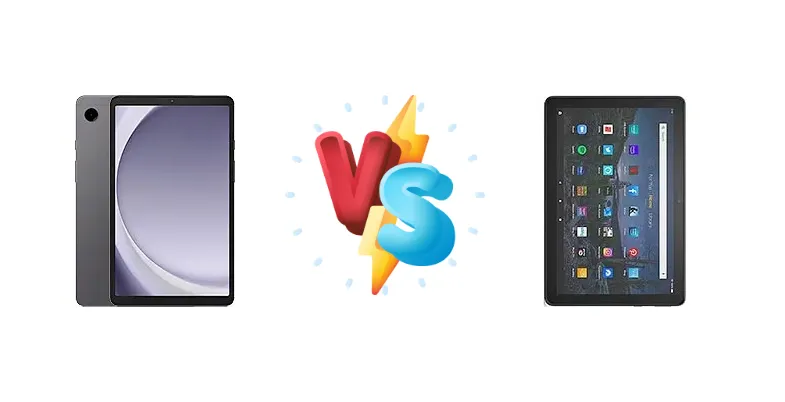
The tablet market offers a wide range of options, but finding the right balance between price and performance can be challenging. We pit the Samsung Galaxy Tab A9, a recent entrant with a modern chipset, against the Amazon Fire HD 10 Plus (2021), a long-standing budget favorite, to determine which tablet delivers the best experience for your money.
🏆 Quick Verdict
For most users, the Samsung Galaxy Tab A9 is the superior choice. Its Mediatek Helio G99 chipset provides a significant performance boost over the Fire HD 10 Plus’s Helio P60T, resulting in smoother multitasking and a more responsive user experience. While the Fire HD 10 Plus offers wireless charging, the A9’s overall performance advantage justifies the trade-off.
| Network |
|---|
| 2G bands | GSM 850 / 900 / 1800 / 1900 | N/A |
| 3G bands | HSDPA 850 / 900 / 1700(AWS) / 1900 / 2100 | - |
| 4G bands | 1, 2, 3, 4, 5, 7, 8, 12, 17, 20, 28, 38, 40, 41, 66 | - |
| EDGE | - | No |
| GPRS | - | No |
| Speed | HSPA, LTE - cellular model only | - |
| Technology | GSM / HSPA / LTE | No cellular connectivity |
| Launch |
|---|
| Announced | 2023, October 05 | 2021, April 27. Released 2021, May 26 |
| Status | Available. Released 2023, October 05 | Discontinued |
| Body |
|---|
| Dimensions | 211 x 124.7 x 8 mm (8.31 x 4.91 x 0.31 in) | 247 x 166 x 9.2 mm (9.72 x 6.54 x 0.36 in) |
| SIM | Nano-SIM (cellular model only) | No |
| Weight | 332 g or 333 g (11.71 oz) | 468 g (1.03 lb) |
| Display |
|---|
| Protection | - | Aluminosilicate glass |
| Resolution | 800 x 1340 pixels, 5:3 ratio (~179 ppi density) | 1920 x 1200 pixels, 16:10 ratio (~224 ppi density) |
| Size | 8.7 inches, 214.9 cm2 (~81.7% screen-to-body ratio) | 10.1 inches, 295.8 cm2 (~72.1% screen-to-body ratio) |
| Type | TFT LCD | IPS LCD |
| Platform |
|---|
| CPU | Octa-core (2x2.2 GHz Cortex-A76 & 6x2.0 GHz Cortex-A55) | Octa-core (4x2.0 GHz Cortex-A73 & 4x2.0 GHz Cortex-A53) |
| Chipset | Mediatek Helio G99 (6 nm) | Mediatek MT8183 Helio P60T (12 nm) |
| GPU | Mali-G57 MC2 | Mali-G72 MP3 |
| OS | Android 13, upgradable to Android 15, One UI 7 | Android 9.0 (Pie), Fire OS 7 |
| Memory |
|---|
| Card slot | microSDXC (dedicated slot) | microSDXC (dedicated slot) |
| Internal | 64GB 4GB RAM, 128GB 4GB RAM, 128GB 8GB RAM | 32GB 4GB RAM, 64GB 4GB RAM |
| | - | eMMC 5.1 |
| Main Camera |
|---|
| Single | 8 MP, AF | 5 MP |
| Video | 1080p@30fps | 720p |
| Selfie camera |
|---|
| Single | 2 MP | 2 MP |
| Video | Yes | 720p |
| Sound |
|---|
| 3.5mm jack | - | Yes |
| 35mm jack | Yes | Yes |
| Loudspeaker | Yes, with stereo speakers | Yes, with stereo speakers |
| Comms |
|---|
| Bluetooth | 5.3, A2DP, LE | 5.0, A2DP, LE |
| NFC | No | No |
| Positioning | GPS, GLONASS, BDS, GALILEO, QZSS - cellular model only | No |
| Radio | No | No |
| USB | USB Type-C 2.0 | USB Type-C 2.0, OTG |
| WLAN | Wi-Fi 802.11 a/b/g/n/ac, dual-band, Wi-Fi Direct | Wi-Fi 802.11 a/b/g/n/ac, dual-band |
| Features |
|---|
| Sensors | Accelerometer, proximity, compass | Accelerometer |
| | - | Text-to-Speech English-language content reader |
| Battery |
|---|
| Charging | 15W wired | Wireless |
| Type | Li-Po 5100 mAh | Li-Ion |
| Misc |
|---|
| Colors | Graphite, Silver, Navy | Slate |
| Models | SM-X110, SM-X115 | T76N2P |
| Price | About 180 EUR | About 150 EUR |
| SAR | 0.48 W/kg (head) 0.89 W/kg (body) | - |
| SAR EU | 0.51 W/kg (body) | - |
Samsung Galaxy Tab A9
- Significantly faster processor (Helio G99)
- More efficient chipset for longer battery life
- Modern Android experience with Google Play Store access
- No wireless charging
- Limited detailed display specifications
Amazon Fire HD 10 Plus (2021)
- Wireless charging support
- Lower initial price point
- Deep integration with Amazon services
- Outdated processor (Helio P60T)
- Less responsive user interface
- Fire OS limitations and Amazon bloatware
Display Comparison
Neither Samsung nor Amazon provide detailed display specs beyond resolution. However, the Fire HD 10 Plus’s age suggests it likely uses an IPS LCD panel with standard color reproduction. The Tab A9, while also likely IPS LCD, benefits from the newer chipset’s image processing capabilities, potentially offering slightly more vibrant colors. Bezels are expected to be similar on both devices, typical for this price bracket. The lack of high refresh rates or advanced panel technologies like LTPO on either device means display quality won’t be a major differentiator.
Camera Comparison
Camera performance is unlikely to be a deciding factor for either tablet. Both devices likely feature basic camera setups geared towards video calls rather than photography. Detailed sensor information is unavailable, but given the price points, expectations should be tempered. The focus should be on video conferencing quality, not image fidelity. Any claims of advanced camera features should be viewed skeptically.
Performance
The core difference lies in the chipsets. The Samsung Galaxy Tab A9’s Mediatek Helio G99, built on a 6nm process, is a substantial upgrade over the Amazon Fire HD 10 Plus’s 12nm Mediatek MT8183 Helio P60T. The G99’s CPU configuration – 2x2.2 GHz Cortex-A76 and 6x2.0 GHz Cortex-A55 – offers significantly improved single-core and multi-core performance compared to the P60T’s 4x2.0 GHz Cortex-A73 and 4x2.0 GHz Cortex-A53. This translates to faster app loading times, smoother multitasking, and a more responsive user interface on the Tab A9. The G99 also boasts a more capable GPU, making it better suited for light gaming. While RAM details are missing, the G99’s efficiency allows for better performance even with similar RAM configurations.
Battery Life
Both tablets offer adequate battery life for typical tablet usage. The Amazon Fire HD 10 Plus’s inclusion of wireless charging is a convenience feature, but the Samsung Galaxy Tab A9’s more efficient Helio G99 chipset may offset the difference in battery capacity. The Tab A9’s 15W wired charging is standard for this class, while the Fire HD 10 Plus’s wireless charging will likely be slower. Real-world usage will depend heavily on screen brightness and app usage, but the G99’s efficiency gives the Tab A9 an edge in longevity.
Buying Guide
Buy the Samsung Galaxy Tab A9 if you prioritize performance for everyday tasks, streaming, and light gaming, and want a more versatile Android experience. Buy the Amazon Fire HD 10 Plus (2021) if you are deeply embedded in the Amazon ecosystem, primarily consume content (books, videos), and value wireless charging and a lower initial price point above all else.
Frequently Asked Questions
❓ Will the Helio G99 in the Tab A9 handle demanding games like Genshin Impact?
While the Helio G99 is a capable chipset, Genshin Impact is a very demanding game. You'll likely need to lower graphics settings to medium or low to achieve playable frame rates on the Tab A9. The Fire HD 10 Plus’s Helio P60T would struggle significantly more with this title.
❓ How much does Amazon’s Fire OS restrict app availability compared to standard Android on the Tab A9?
Fire OS is a heavily customized version of Android that primarily directs users to the Amazon Appstore. While many popular apps are available, you may encounter some apps that are not compatible. The Tab A9, running a more standard Android build, has full access to the Google Play Store and a wider range of applications.
❓ Is the wireless charging on the Fire HD 10 Plus significantly slower than the 15W wired charging on the Tab A9?
Yes, wireless charging is generally slower than wired charging. Expect a full charge via wireless charging on the Fire HD 10 Plus to take considerably longer – potentially double or triple the time – compared to a wired charge on the Tab A9.
❓ Does the Tab A9 support expandable storage via microSD card?
While not explicitly stated in the provided specs, Samsung tablets typically include microSD card support. This is a likely feature on the Tab A9, offering flexibility for users who need more storage space. The Fire HD 10 Plus also supports microSD expansion.