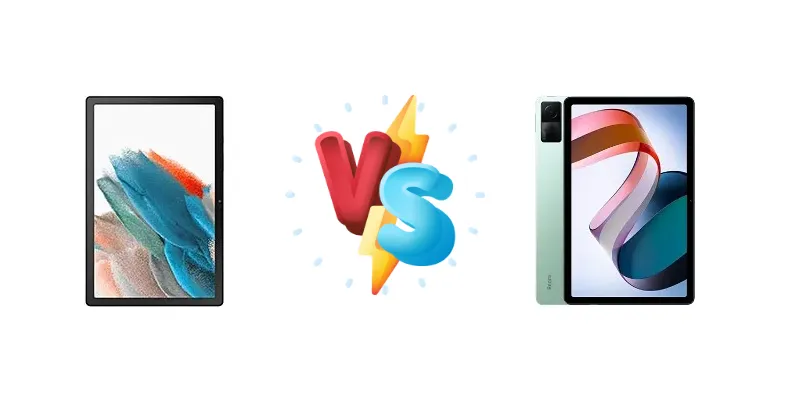
The tablet market is booming, and finding the right one can be overwhelming. Two popular contenders in the budget-friendly space are the Samsung Galaxy Tab A8 10.5 (2021) and the Xiaomi Redmi Pad. Let's dive into a detailed comparison to help you decide which one deserves your money.
🏆 Quick Verdict
The Xiaomi Redmi Pad edges out the Galaxy Tab A8 thanks to its more powerful chipset, slightly better display, and faster charging. While the Tab A8 offers Samsung's brand recognition and One UI, the Redmi Pad provides a more compelling overall package for the price.
| Network |
|---|
| 2G bands | GSM 850 / 900 / 1800 / 1900 | N/A |
| 3G bands | HSDPA 850 / 900 / 1700(AWS) / 1900 / 2100 | N/A |
| 4G bands | 1, 2, 3, 4, 5, 7, 8, 12, 17, 20, 28, 38, 40, 41, 66 | N/A |
| EDGE | - | N/A |
| GPRS | - | N/A |
| Speed | HSPA, LTE - cellular model only | - |
| Technology | GSM / HSPA / LTE | No cellular connectivity |
| Launch |
|---|
| Announced | 2021, December 15 | 2022, October 04 |
| Status | Available. Released 2022, January 17 | Available. Released 2022, October 05 |
| Body |
|---|
| Build | - | Glass front, aluminum frame |
| Dimensions | 246.8 x 161.9 x 6.9 mm (9.72 x 6.37 x 0.27 in) | 250.5 x 158.1 x 7.1 mm (9.86 x 6.22 x 0.28 in) |
| SIM | Nano-SIM (cellular model only) | No |
| Weight | 508 g (1.12 lb) | 465 g (1.03 lb) |
| Display |
|---|
| Resolution | 1200 x 1920 pixels, 16:10 ratio (~216 ppi density) | 1200 x 2000 pixels, 5:3 ratio (~220 ppi density) |
| Size | 10.5 inches, 319.7 cm2 (~80.0% screen-to-body ratio) | 10.61 inches, 320.4 cm2 (~80.9% screen-to-body ratio) |
| Type | TFT LCD | IPS LCD, 1B colors, 90Hz, 400 nits (typ) |
| Platform |
|---|
| CPU | Octa-core (2x2.0 GHz Cortex-A75 & 6x2.0 GHz Cortex-A55) | Octa-core (2x2.2 GHz Cortex-A76 & 6x2.0 GHz Cortex-A55) |
| Chipset | Unisoc Tiger T618 (12 nm) | Mediatek Helio G99 (6 nm) |
| GPU | Mali G52 MP2 | Mali-G57 MC2 |
| OS | Android 11, upgradable to Android 14, One UI 6 | Android 12, upgradable to Android 13, MIUI 14 |
| Memory |
|---|
| Card slot | microSDXC (dedicated slot) | microSDXC |
| Internal | 32GB 2GB RAM, 32GB 3GB RAM, 64GB 2GB RAM, 64GB 3GB RAM, 64GB 4GB RAM, 128GB 3GB RAM, 128GB 4GB RAM | 64GB 3GB RAM, 128GB 4GB RAM, 128GB 6GB RAM |
| | - | UFS 2.2 |
| Main Camera |
|---|
| Single | 8 MP, AF | 8 MP, f/2.0, (wide), AF |
| Video | 1080p@30fps | 1080p@30fps |
| Selfie camera |
|---|
| Single | 5 MP | 8 MP, f/2.3, 105° (ultrawide) |
| Video | 1080p@30fps | 1080p@30fps |
| Sound |
|---|
| 3.5mm jack | Yes | No |
| 35mm jack | Yes | No |
| Loudspeaker | Yes, with stereo speakers (4 speakers) | Yes, with stereo speakers (4 speakers) |
| | - | 24-bit/192kHz audio |
| Comms |
|---|
| Bluetooth | 5.0, A2DP, LE | 5.2, A2DP, LE |
| NFC | No | No |
| Positioning | GPS, GLONASS, BDS, GALILEO, QZSS - cellular model only | No |
| Radio | No | No |
| USB | USB Type-C 2.0 | USB Type-C, OTG |
| WLAN | Wi-Fi 802.11 a/b/g/n/ac, dual-band, Wi-Fi Direct | Wi-Fi 802.11 a/b/g/n/ac, dual-band, Wi-Fi Direct |
| Features |
|---|
| Sensors | Accelerometer, gyro, proximity, compass | Accelerometer |
| Battery |
|---|
| Charging | 15W wired | 18W wired |
| Type | Li-Po 7040 mAh | Li-Po 8000 mAh |
| Misc |
|---|
| Colors | Gray, Silver, Pink Gold | Graphite Gray, Moonlight Silver, Mint Green |
| Models | SM-X200, SM-X205 | 22081283G |
| Price | About 230 EUR | About 250 EUR |
| SAR EU | 0.92 W/kg (body) | 0.36 W/kg (body) |
| Tests |
|---|
| Display | - |
Contrast ratio: 1529:1 (nominal) |
| Loudspeaker | - |
-23.9 LUFS (Very good)
|
| Performance | - |
AnTuTu: 319077 (v9)
GeekBench: 1852 (v5.1)
GFXBench: 13fps (ES 3.1 onscreen) |
Samsung Galaxy Tab A8 10.5 (2021)
- Samsung Brand Recognition
- Familiar One UI Interface
- Good for Media Consumption
- Decent Build Quality
- Less Powerful Chipset
- Slower Charging
- Lower Brightness Display
- Can Feel Dated
Xiaomi Redmi Pad
- More Powerful Chipset (Helio G99)
- Slightly Brighter Display
- Faster Charging (18W)
- Competitive Price
- MIUI can be cluttered
- Camera Performance is Basic
- Less Established Brand (compared to Samsung)
Display Comparison
The Xiaomi Redmi Pad boasts a slightly brighter display (402 nits vs Tab A8's estimated 350 nits) and a similar contrast ratio (1529:1). Both offer a 10.5-inch screen, but the Redmi Pad's slightly improved brightness gives it a minor edge for outdoor visibility. Both displays are LCD panels, so don't expect OLED-level blacks.
Camera Comparison
Camera quality isn't a primary focus for budget tablets. The Galaxy Tab A8 likely has slightly better image processing due to Samsung's software optimization, but both offer basic, adequate cameras for video calls and casual snapshots. Expect grainy images in low light from both devices.
Performance
Here, the Redmi Pad takes a clear lead. Its Mediatek Helio G99 chipset (6nm) is significantly more powerful than the Galaxy Tab A8's Unisoc Tiger T618 (12nm). Expect smoother multitasking, faster app loading times, and better gaming performance on the Redmi Pad. The Cortex-A76 cores in the Helio G99 are a substantial upgrade over the Tab A8's Cortex-A75.
Battery Life
Both tablets offer decent battery life, but the Redmi Pad's slightly more efficient chipset and 18W charging give it a small advantage. The Tab A8's 15W charging is slower, meaning longer charging times.
Buying Guide
Who should buy the Samsung Galaxy Tab A8 10.5 (2021)? Users deeply embedded in the Samsung ecosystem, those prioritizing a familiar and user-friendly interface (One UI), and those who value brand reputation. Who should buy the Xiaomi Redmi Pad? Budget-conscious buyers seeking strong performance for media consumption, gaming, and general productivity, and those who appreciate a vibrant display.
Frequently Asked Questions
❓ Which tablet is better for gaming?
The Xiaomi Redmi Pad is significantly better for gaming due to its more powerful Helio G99 chipset.
❓ Is the Samsung Galaxy Tab A8 worth buying in 2024?
It's still a viable option for basic tasks and media consumption, especially if you prefer Samsung's One UI. However, the Redmi Pad offers better value for money.