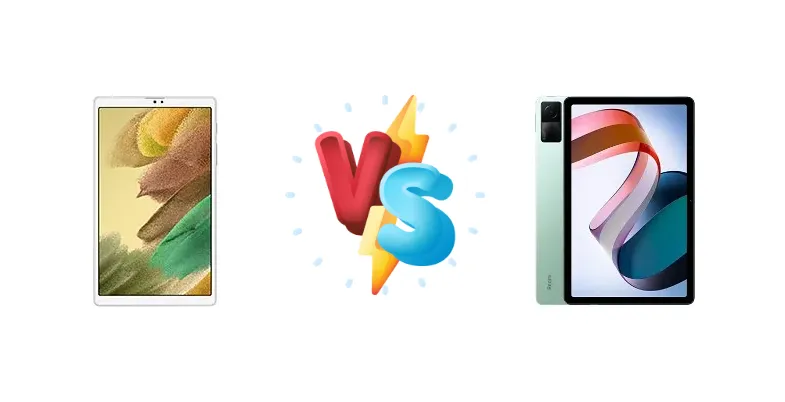
The sub-$200 tablet market is fiercely competitive, and the Samsung Galaxy Tab A7 Lite and Xiaomi Redmi Pad are two of the strongest contenders. While both aim to deliver an affordable Android experience, they take different approaches to performance, display quality, and overall usability. This comparison dives deep into the specifications and real-world implications to determine which tablet offers the best value.
🏆 Quick Verdict
For most users, the Xiaomi Redmi Pad emerges as the better choice. Its significantly more powerful Helio G99 chipset delivers a smoother experience for multitasking and gaming, while the brighter display enhances media consumption. The Tab A7 Lite remains a viable option for those prioritizing Samsung's ecosystem and a slightly more compact form factor.
| Network |
|---|
| 2G bands | GSM 850 / 900 / 1800 / 1900 | N/A |
| 3G bands | HSDPA 850 / 900 / 1700(AWS) / 1900 / 2100 | N/A |
| 4G bands | 1, 2, 3, 4, 5, 7, 8, 12, 17, 20, 28, 38, 40, 66 | N/A |
| EDGE | - | N/A |
| GPRS | - | N/A |
| Speed | HSPA, LTE - cellular model only | - |
| Technology | GSM / HSPA / LTE | No cellular connectivity |
| Launch |
|---|
| Announced | 2021, May 27 | 2022, October 04 |
| Status | Available. Released 2021, June 18 | Available. Released 2022, October 05 |
| Body |
|---|
| Build | Glass front, aluminum back, aluminum frame, plastic ends | Glass front, aluminum frame |
| Dimensions | 212.5 x 124.7 x 8 mm (8.37 x 4.91 x 0.31 in) | 250.5 x 158.1 x 7.1 mm (9.86 x 6.22 x 0.28 in) |
| SIM | Nano-SIM (cellular model only) | No |
| Weight | 366 g (Wi-Fi), 371 g (LTE) (12.91 oz) | 465 g (1.03 lb) |
| Display |
|---|
| Resolution | 800 x 1340 pixels, 5:3 ratio (~179 ppi density) | 1200 x 2000 pixels, 5:3 ratio (~220 ppi density) |
| Size | 8.7 inches, 214.9 cm2 (~81.1% screen-to-body ratio) | 10.61 inches, 320.4 cm2 (~80.9% screen-to-body ratio) |
| Type | TFT LCD | IPS LCD, 1B colors, 90Hz, 400 nits (typ) |
| Platform |
|---|
| CPU | Octa-core (4x2.3 GHz Cortex-A53 & 4x1.8 GHz Cortex-A53) | Octa-core (2x2.2 GHz Cortex-A76 & 6x2.0 GHz Cortex-A55) |
| Chipset | Mediatek MT8768T Helio P22T (12 nm) | Mediatek Helio G99 (6 nm) |
| GPU | PowerVR GE8320 | Mali-G57 MC2 |
| OS | Android 11, upgradable to Android 14, One UI 6.1 | Android 12, upgradable to Android 13, MIUI 14 |
| Memory |
|---|
| Card slot | microSDXC (dedicated slot) | microSDXC |
| Internal | 32GB 2GB RAM, 32GB 3GB RAM, 64GB 4GB RAM | 64GB 3GB RAM, 128GB 4GB RAM, 128GB 6GB RAM |
| | eMMC 5.1 | UFS 2.2 |
| Main Camera |
|---|
| Single | 8 MP, AF | 8 MP, f/2.0, (wide), AF |
| Video | 1080p@30fps | 1080p@30fps |
| Selfie camera |
|---|
| Single | 2 MP | 8 MP, f/2.3, 105° (ultrawide) |
| Video | - | 1080p@30fps |
| Sound |
|---|
| 3.5mm jack | Yes | No |
| 35mm jack | Yes | No |
| Loudspeaker | Yes, with stereo speakers | Yes, with stereo speakers (4 speakers) |
| | - | 24-bit/192kHz audio |
| Comms |
|---|
| Bluetooth | 5.0, A2DP, LE | 5.2, A2DP, LE |
| NFC | No | No |
| Positioning | GPS, GLONASS, BDS, GALILEO - cellular model only | No |
| Radio | No | No |
| USB | USB Type-C 2.0 | USB Type-C, OTG |
| WLAN | Wi-Fi 802.11 a/b/g/n/ac, dual-band, Wi-Fi Direct | Wi-Fi 802.11 a/b/g/n/ac, dual-band, Wi-Fi Direct |
| Features |
|---|
| Sensors | Accelerometer, compass | Accelerometer |
| Battery |
|---|
| Charging | 15W wired | 18W wired |
| Type | Li-Po 5100 mAh | Li-Po 8000 mAh |
| Misc |
|---|
| Colors | Gray, Silver | Graphite Gray, Moonlight Silver, Mint Green |
| Models | SM-T225, SM-T220, SM-T225N, SM-T227U | 22081283G |
| Price | About 140 EUR | About 250 EUR |
| SAR | 0.68 W/kg (body) | - |
| SAR EU | 0.64 W/kg (head) 0.99 W/kg (body) | 0.36 W/kg (body) |
| Tests |
|---|
| Display | - |
Contrast ratio: 1529:1 (nominal) |
| Loudspeaker | - |
-23.9 LUFS (Very good)
|
| Performance | - |
AnTuTu: 319077 (v9)
GeekBench: 1852 (v5.1)
GFXBench: 13fps (ES 3.1 onscreen) |
Samsung Galaxy Tab A7 Lite
- Compact and portable 8.7-inch display
- Samsung ecosystem integration
- Generally lower price point (depending on sales)
- Significantly weaker processor performance
- Likely dimmer display
- Slower charging speed
Xiaomi Redmi Pad
- More powerful Mediatek Helio G99 processor
- Brighter and larger 10.61-inch display
- Faster 18W charging
- Larger and less portable form factor
- Less brand recognition than Samsung
- Xiaomi’s MIUI software can be polarizing
Display Comparison
The Xiaomi Redmi Pad boasts a noticeably brighter display, reaching a measured 402 nits compared to an unspecified value for the Tab A7 Lite (though likely lower). This brightness advantage translates to better visibility outdoors and a more vibrant viewing experience. Both tablets share a contrast ratio of 1529:1, suggesting similar color depth. However, the Redmi Pad’s larger screen size (10.61 inches vs 8.7 inches) provides more screen real estate for multitasking and media. The Tab A7 Lite’s smaller size, however, may appeal to users who prioritize portability.
Camera Comparison
Neither tablet excels in the camera department, but the Redmi Pad likely holds a slight edge due to its more modern ISP within the Helio G99. Both tablets are expected to feature basic camera setups primarily intended for video calls and casual snapshots. Detailed camera specs are unavailable for both, but focusing on image quality is not a primary strength of either device. The absence of OIS or high-resolution sensors suggests limited low-light performance on both.
Performance
The performance gap is the most significant differentiator. The Redmi Pad’s Mediatek Helio G99, built on a 6nm process, is a substantial upgrade over the Tab A7 Lite’s Mediatek MT8768T Helio P22T (12nm). The G99 features more modern CPU cores – 2x2.2 GHz Cortex-A76 and 6x2.0 GHz Cortex-A55 – compared to the A7 Lite’s 4x2.3 GHz Cortex-A53 and 4x1.8 GHz Cortex-A53. This architectural difference, combined with the smaller process node, results in significantly improved CPU and GPU performance on the Redmi Pad, making it better suited for demanding applications and gaming. The Redmi Pad will handle multitasking and graphically intensive games with far less stuttering.
Battery Life
The Redmi Pad’s 18W wired charging is faster than the Tab A7 Lite’s 15W charging. While battery capacity isn’t specified for either device, the more efficient Helio G99 in the Redmi Pad should translate to comparable or even better battery life despite potentially having a similar capacity. The faster charging speed on the Redmi Pad also means less downtime between uses. The 6nm process node of the G99 contributes to lower power consumption, extending usage time.
Buying Guide
Buy the Samsung Galaxy Tab A7 Lite if you need a tablet deeply integrated with the Samsung ecosystem, prefer a more portable 8.7-inch display, and primarily use it for basic tasks like reading and light web browsing. Buy the Xiaomi Redmi Pad if you prioritize performance for gaming and multitasking, value a larger, brighter display for media consumption, and are looking for the best possible value for your money.
Frequently Asked Questions
❓ Will the Redmi Pad’s Helio G99 handle demanding games like Genshin Impact?
While the Helio G99 isn’t a flagship gaming chip, it’s capable of running Genshin Impact at lower settings (medium or low) with playable frame rates. The Tab A7 Lite’s Helio P22T would struggle significantly with this title, likely requiring the lowest settings and still experiencing noticeable lag.
❓ Is the larger screen size of the Redmi Pad a drawback for reading e-books?
While the 10.61-inch screen is larger, the Redmi Pad’s display supports adjustable color temperature and brightness, making it comfortable for extended reading sessions. Some users may prefer the Tab A7 Lite’s smaller 8.7-inch screen for one-handed reading, but the Redmi Pad’s larger display is beneficial for PDF documents and magazines.
❓ Does the Xiaomi Redmi Pad support stylus input?
No, the Xiaomi Redmi Pad does not officially support stylus input. While third-party styluses might work with limited functionality, it's not designed for pen-based tasks like note-taking or drawing.
❓ How does the software experience differ between the Tab A7 Lite and Redmi Pad?
The Tab A7 Lite runs Samsung’s One UI, known for its clean interface and feature-rich experience. The Redmi Pad runs Xiaomi’s MIUI, which is more customizable but can include pre-installed bloatware and a different aesthetic. Preference here is subjective.