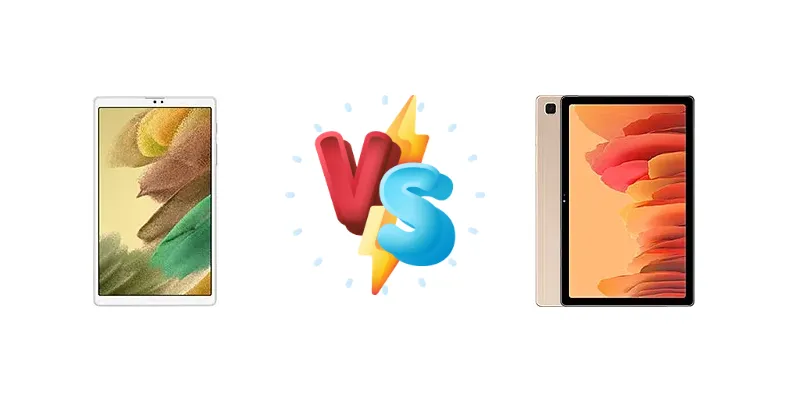
Samsung's Tab A series offers accessible Android tablets, but choosing between the newer Tab A7 Lite and the slightly older Tab A7 10.4 (2020) requires careful consideration. While both aim for affordability, they diverge in chipset choice and form factor, impacting performance and usability. This comparison dissects these differences to help you determine which tablet best suits your needs.
🏆 Quick Verdict
For most users, the Samsung Galaxy Tab A7 10.4 (2020) is the better choice. Its Snapdragon 662 chipset, built on an 11nm process, delivers noticeably smoother performance than the Tab A7 Lite’s Mediatek Helio P22T, making it more capable for multitasking and demanding apps. The larger screen is also a significant benefit for media consumption.
| Network |
|---|
| 2G bands | GSM 850 / 900 / 1800 / 1900 | GSM 850 / 900 / 1800 / 1900 |
| 3G bands | HSDPA 850 / 900 / 1700(AWS) / 1900 / 2100 | HSDPA 850 / 900 / 1700(AWS) / 1900 / 2100 |
| 4G bands | 1, 2, 3, 4, 5, 7, 8, 12, 17, 20, 28, 38, 40, 66 | 1, 2, 3, 4, 5, 7, 8, 12, 17, 20, 28, 38, 39, 40, 41, 66 |
| Speed | HSPA, LTE - cellular model only | HSPA 42.2/5.76 Mbps, LTE (2CA) Cat13 400/50 Mbps - cellular model only |
| Technology | GSM / HSPA / LTE | GSM / HSPA / LTE |
| Launch |
|---|
| Announced | 2021, May 27 | 2020, September 02. Released 2020, September 11 |
| Status | Available. Released 2021, June 18 | Discontinued |
| Body |
|---|
| Build | Glass front, aluminum back, aluminum frame, plastic ends | - |
| Dimensions | 212.5 x 124.7 x 8 mm (8.37 x 4.91 x 0.31 in) | 247.6 x 157.4 x 7 mm (9.75 x 6.20 x 0.28 in) |
| SIM | Nano-SIM (cellular model only) | Nano-SIM (cellular model only) |
| Weight | 366 g (Wi-Fi), 371 g (LTE) (12.91 oz) | 476 g (Wi-Fi), 477 g (LTE) (1.05 lb) |
| Display |
|---|
| Resolution | 800 x 1340 pixels, 5:3 ratio (~179 ppi density) | 1200 x 2000 pixels, 5:3 ratio (~224 ppi density) |
| Size | 8.7 inches, 214.9 cm2 (~81.1% screen-to-body ratio) | 10.4 inches, 307.9 cm2 (~79.0% screen-to-body ratio) |
| Type | TFT LCD | TFT LCD |
| Platform |
|---|
| CPU | Octa-core (4x2.3 GHz Cortex-A53 & 4x1.8 GHz Cortex-A53) | Octa-core (4x2.0 GHz Kryo 260 Gold & 4x1.8 GHz Kryo 260 Silver) |
| Chipset | Mediatek MT8768T Helio P22T (12 nm) | Qualcomm SM6115 Snapdragon 662 (11 nm) |
| GPU | PowerVR GE8320 | Adreno 610 |
| OS | Android 11, upgradable to Android 14, One UI 6.1 | Android 10, upgradable to Android 12, One UI 4 |
| Memory |
|---|
| Card slot | microSDXC (dedicated slot) | microSDXC |
| Internal | 32GB 2GB RAM, 32GB 3GB RAM, 64GB 4GB RAM | 32GB 3GB RAM, 32GB 4GB RAM, 64GB 3GB RAM, 64GB 4GB RAM |
| | eMMC 5.1 | eMMC 5.1 |
| Main Camera |
|---|
| Single | 8 MP, AF | 8 MP, AF |
| Video | 1080p@30fps | 1080p@30fps |
| Selfie camera |
|---|
| Single | 2 MP | 5 MP |
| Video | - | 1080p@30fps |
| Sound |
|---|
| 3.5mm jack | Yes | Yes |
| 35mm jack | Yes | Yes |
| Loudspeaker | Yes, with stereo speakers | Yes, with stereo speakers (4 speakers) |
| Comms |
|---|
| Bluetooth | 5.0, A2DP, LE | 5.0, A2DP, LE |
| NFC | No | No |
| Positioning | GPS, GLONASS, BDS, GALILEO - cellular model only | GPS, GLONASS, BDS, GALILEO - cellular model only |
| Radio | No | No |
| USB | USB Type-C 2.0 | USB Type-C 2.0 |
| WLAN | Wi-Fi 802.11 a/b/g/n/ac, dual-band, Wi-Fi Direct | Wi-Fi 802.11 a/b/g/n/ac, dual-band, Wi-Fi Direct |
| Features |
|---|
| Sensors | Accelerometer, compass | Accelerometer, gyro, proximity, compass |
| Battery |
|---|
| Charging | 15W wired | 15W wired |
| Type | Li-Po 5100 mAh | Li-Po 7040 mAh |
| Misc |
|---|
| Colors | Gray, Silver | Dark Gray, Silver, Gold |
| Models | SM-T225, SM-T220, SM-T225N, SM-T227U | SM-T500, SM-T505, SM-T505N |
| Price | About 140 EUR | About 240 EUR |
| SAR | 0.68 W/kg (body) | - |
| SAR EU | 0.64 W/kg (head) 0.99 W/kg (body) | 1.01 W/kg (body) |
Samsung Galaxy Tab A7 Lite
- More portable and lightweight design.
- Generally lower price point.
- Sleek and modern aesthetic.
- Less powerful Mediatek Helio P22T chipset.
- Potentially shorter battery life.
- Smaller screen size may be limiting for some users.
Samsung Galaxy Tab A7 10.4 (2020)
- More powerful Qualcomm Snapdragon 662 chipset.
- Larger 10.4-inch display for better media consumption.
- Potentially better thermal management.
- Less portable than the A7 Lite.
- Slightly higher price.
- May feel bulky for extended one-handed use.
Display Comparison
Both tablets feature 10.4-inch displays, but the underlying technology isn't detailed in the provided specs. However, the A7 10.4’s larger size inherently offers a more immersive viewing experience. The A7 Lite’s smaller form factor may necessitate a smaller battery to maintain a similar weight, potentially impacting endurance. While neither is expected to boast high color accuracy, the larger canvas of the A7 10.4 is preferable for viewing photos and videos.
Camera Comparison
Neither tablet is positioned as a photography powerhouse. Detailed camera specs are absent, but given their market segment, image quality is likely similar. Focusing on the chipset, the Snapdragon 662 typically includes a more capable Image Signal Processor (ISP) than the Helio P22T, potentially leading to slightly better image processing, particularly in low-light conditions. However, don't expect flagship-level results from either device.
Performance
The core difference lies in the chipsets. The Tab A7 10.4 utilizes the Qualcomm Snapdragon 662 (11nm), featuring Kryo 260 cores, while the A7 Lite is equipped with the Mediatek Helio P22T (12nm). The Snapdragon 662’s 11nm fabrication process is more efficient than the Helio P22T’s 12nm process, suggesting better thermal management and potentially sustained performance. The Snapdragon’s Kryo cores also represent a more modern architecture than the Cortex-A53 cores in the Helio P22T, translating to faster application loading and smoother multitasking. This difference will be most noticeable when switching between apps or running more demanding games.
Battery Life
Both tablets support 15W wired charging. While battery capacity isn't specified, the A7 Lite’s more compact design likely necessitates a smaller battery. The Snapdragon 662’s greater power efficiency could offset the A7 10.4’s potentially larger battery, resulting in comparable real-world battery life. However, users prioritizing all-day usage may find the A7 10.4 slightly more reliable due to its more efficient chipset.
Buying Guide
Buy the Samsung Galaxy Tab A7 Lite if you prioritize extreme portability and a lower price point, and your usage is limited to basic tasks like web browsing, email, and light reading. Buy the Samsung Galaxy Tab A7 10.4 (2020) if you value a larger display for media consumption, smoother performance for multitasking, and a more responsive user experience, even if it means a slightly higher cost and less pocketability.
Frequently Asked Questions
❓ Will the Mediatek Helio P22T in the Tab A7 Lite struggle with demanding games like PUBG?
Yes, the Helio P22T is a budget-oriented chipset. While it can run PUBG, expect lower graphics settings and potential frame rate drops, especially during intense action. The Snapdragon 662 in the A7 10.4 will provide a significantly smoother gaming experience.
❓ Does the Snapdragon 662 in the Tab A7 10.4 offer noticeable multitasking improvements over the Helio P22T?
Absolutely. The Snapdragon 662’s more modern architecture and efficient cores allow for smoother switching between apps and handling multiple tasks simultaneously. The Helio P22T may exhibit lag or slowdowns when running several apps concurrently.
❓ Is the 15W charging speed sufficient for both tablets, or will it take a long time to fully charge?
15W charging is relatively slow by modern standards. Expect both tablets to take around 3-4 hours to fully charge from 0%. The Snapdragon 662's power efficiency might allow it to reach a usable charge level slightly faster, but the difference won't be dramatic.
❓ Which tablet is better suited for reading e-books and articles?
While both are suitable, the Tab A7 Lite's smaller size and lighter weight make it more comfortable to hold for extended reading sessions. However, the A7 10.4's larger screen may be preferable for viewing PDFs or magazines with complex layouts.