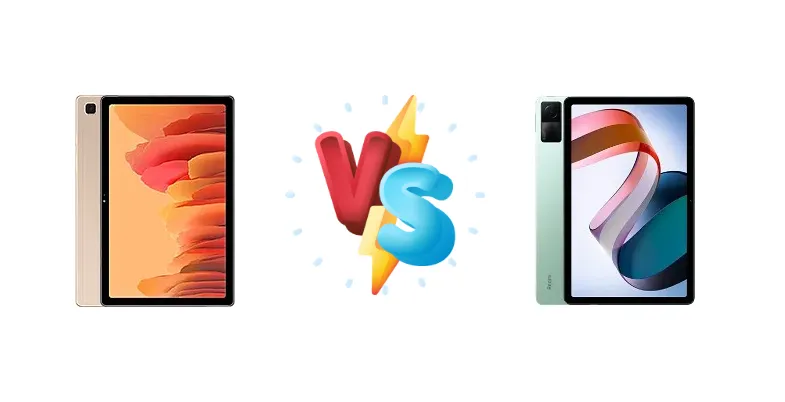
The tablet market is heating up, and two contenders are vying for your attention: the Samsung Galaxy Tab A7 (2022) and the Xiaomi Redmi Pad. Both offer compelling features at competitive prices, but which one truly reigns supreme? Let's dive into a comprehensive comparison to help you decide.
🏆 Quick Verdict
The Xiaomi Redmi Pad edges out the Galaxy Tab A7 thanks to its more powerful chipset, slightly better display brightness, and faster charging. However, Samsung's brand recognition and One UI might appeal to some. Overall, the Redmi Pad offers better value for the money.
| Network |
|---|
| 2G bands | GSM 850 / 900 / 1800 / 1900 | N/A |
| 3G bands | HSDPA 850 / 900 / 1700(AWS) / 1900 / 2100 | N/A |
| 4G bands | LTE | N/A |
| EDGE | - | N/A |
| GPRS | - | N/A |
| Speed | HSPA 42.2/5.76 Mbps, LTE (2CA) Cat13 400/50 Mbps | - |
| Technology | GSM / HSPA / LTE | No cellular connectivity |
| Launch |
|---|
| Announced | 2022, November 18 | 2022, October 04 |
| Status | Available. Released 2022, November 21 | Available. Released 2022, October 05 |
| Body |
|---|
| Build | - | Glass front, aluminum frame |
| Dimensions | 247.6 x 157.4 x 7 mm (9.75 x 6.20 x 0.28 in) | 250.5 x 158.1 x 7.1 mm (9.86 x 6.22 x 0.28 in) |
| SIM | Nano-SIM | No |
| Weight | 477 g (1.05 lb) | 465 g (1.03 lb) |
| Display |
|---|
| Resolution | 1200 x 2000 pixels, 5:3 ratio (~224 ppi density) | 1200 x 2000 pixels, 5:3 ratio (~220 ppi density) |
| Size | 10.4 inches, 307.9 cm2 (~79.0% screen-to-body ratio) | 10.61 inches, 320.4 cm2 (~80.9% screen-to-body ratio) |
| Type | TFT LCD | IPS LCD, 1B colors, 90Hz, 400 nits (typ) |
| Platform |
|---|
| CPU | Octa-core (2x2.0 GHz Cortex-A75 & 6x1.8 GHz Cortex-A55) | Octa-core (2x2.2 GHz Cortex-A76 & 6x2.0 GHz Cortex-A55) |
| Chipset | Unisoc UMS512 T618 (12 nm) | Mediatek Helio G99 (6 nm) |
| GPU | Mali G52 MP2 | Mali-G57 MC2 |
| OS | Android 12, One UI 4 | Android 12, upgradable to Android 13, MIUI 14 |
| Memory |
|---|
| Card slot | microSDXC | microSDXC |
| Internal | 32GB 3GB RAM, 32GB 4GB RAM, 64GB 3GB RAM | 64GB 3GB RAM, 128GB 4GB RAM, 128GB 6GB RAM |
| | eMMC 5.1 | UFS 2.2 |
| Main Camera |
|---|
| Single | 8 MP, AF | 8 MP, f/2.0, (wide), AF |
| Video | 1080p@30fps | 1080p@30fps |
| Selfie camera |
|---|
| Single | 5 MP | 8 MP, f/2.3, 105° (ultrawide) |
| Video | 1080p@30fps | 1080p@30fps |
| Sound |
|---|
| 3.5mm jack | Yes | No |
| 35mm jack | Yes | No |
| Loudspeaker | Yes, with stereo speakers (4 speakers) | Yes, with stereo speakers (4 speakers) |
| | - | 24-bit/192kHz audio |
| Comms |
|---|
| Bluetooth | 5.0, A2DP, LE | 5.2, A2DP, LE |
| NFC | No | No |
| Positioning | GPS, GLONASS, BDS, GALILEO | No |
| Radio | No | No |
| USB | USB Type-C 2.0 | USB Type-C, OTG |
| WLAN | Wi-Fi 802.11 a/b/g/n/ac, dual-band, Wi-Fi Direct | Wi-Fi 802.11 a/b/g/n/ac, dual-band, Wi-Fi Direct |
| Features |
|---|
| Sensors | Accelerometer, gyro, proximity, compass | Accelerometer |
| Battery |
|---|
| Charging | 15W wired | 18W wired |
| Type | Li-Po 7040 mAh | Li-Po 8000 mAh |
| Misc |
|---|
| Colors | Dark Gray, Silver, Gold | Graphite Gray, Moonlight Silver, Mint Green |
| Models | SM-T509 | 22081283G |
| Price | About 250 EUR | About 250 EUR |
| SAR EU | 1.54 W/kg (body) | 0.36 W/kg (body) |
| Tests |
|---|
| Display | - |
Contrast ratio: 1529:1 (nominal) |
| Loudspeaker | - |
-23.9 LUFS (Very good)
|
| Performance | - |
AnTuTu: 319077 (v9)
GeekBench: 1852 (v5.1)
GFXBench: 13fps (ES 3.1 onscreen) |
Samsung Galaxy Tab A7 10.4 (2022)
- Established brand reputation
- Familiar One UI interface
- Good for basic tasks
- Sleek design
- Less powerful chipset
- Slower charging
- Can feel sluggish with demanding apps
Xiaomi Redmi Pad
- More powerful chipset for better performance
- Slightly brighter display
- Faster charging (18W)
- Excellent value for money
- MIUI can be a bit cluttered
- Less established brand in some markets
Display Comparison
Both tablets feature a 10.4-inch display with a 2000x1200 resolution and a 1529:1 contrast ratio. However, the Redmi Pad boasts a measured peak brightness of 402 nits, slightly exceeding the Tab A7's likely brightness. While both offer good visuals, the Redmi Pad's slightly brighter screen provides a better viewing experience in brighter environments.
Camera Comparison
Camera quality is generally not a primary concern for tablets. The Galaxy Tab A7 likely features an 8MP main camera and a 5MP front camera. The Redmi Pad is expected to have similar specs, around 8MP main and 8MP front. Image quality will be comparable, suitable for video calls and casual snapshots, but not exceptional.
Performance
The Xiaomi Redmi Pad holds a significant advantage here. Its Mediatek Helio G99 chipset (6nm) is considerably more powerful than the Samsung Galaxy Tab A7's Unisoc UMS512 T618 (12nm). The Redmi Pad's Cortex-A76 cores offer a noticeable performance boost for demanding tasks and gaming. The Tab A7 is adequate for everyday use, but the Redmi Pad provides a smoother and more responsive experience.
Battery Life
Both tablets are expected to have a 7040mAh battery. While capacity is similar, the Redmi Pad's 18W wired charging offers a slightly faster charging speed compared to the Tab A7's 15W charging. This translates to quicker top-ups when needed.
Buying Guide
Who should buy the Samsung Galaxy Tab A7 10.4 (2022)? Users deeply embedded in the Samsung ecosystem, those prioritizing a familiar and streamlined user interface (One UI), and those who value brand recognition. Who should buy the Xiaomi Redmi Pad? Budget-conscious buyers seeking strong performance for media consumption, gaming, and general productivity, and those who appreciate a vibrant display.
Frequently Asked Questions
❓ Which tablet is better for gaming?
The Xiaomi Redmi Pad is significantly better for gaming due to its more powerful Helio G99 chipset.
❓ Is the Samsung Galaxy Tab A7 good for kids?
Yes, the Galaxy Tab A7 is a decent option for kids, especially if you prefer the Samsung ecosystem. However, the Redmi Pad's performance and value make it a strong contender as well.