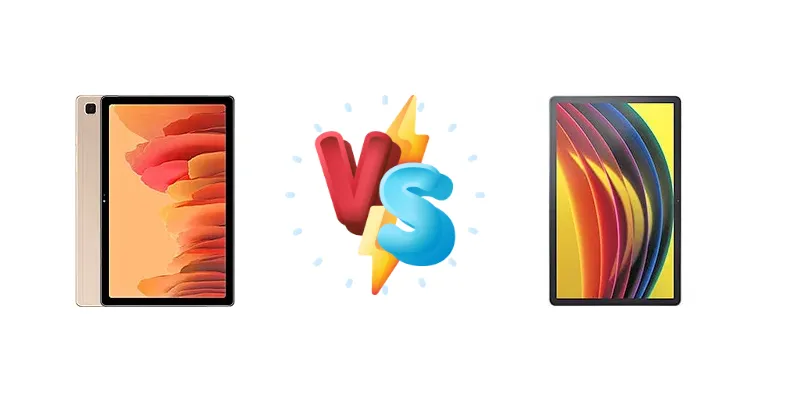
The sub-$200 tablet market is fiercely competitive, and the Samsung Galaxy Tab A7 10.4 (2022) and Lenovo Tab P11 Plus represent compelling options for budget-conscious consumers. While both aim to deliver a versatile Android experience, they diverge significantly in their core hardware, impacting performance and overall usability. This comparison dissects those differences to determine which tablet best suits your needs.
🏆 Quick Verdict
For most users, the Lenovo Tab P11 Plus is the better choice. Its MediaTek Helio G90T chipset provides a noticeable performance boost over the Samsung Tab A7 10.4 (2022)'s Unisoc T618, making it more capable for gaming and multitasking. While the Samsung offers a familiar brand experience, the Lenovo delivers superior value for the price.
| Network |
|---|
| 2G bands | GSM 850 / 900 / 1800 / 1900 | GSM 850 / 900 / 1800 / 1900 |
| 3G bands | HSDPA 850 / 900 / 1700(AWS) / 1900 / 2100 | HSDPA 850 / 900 / 1900 / 2100 |
| 4G bands | LTE | 1, 2, 3, 4, 5, 7, 8, 20, 28, 38, 40, 41 |
| Speed | HSPA 42.2/5.76 Mbps, LTE (2CA) Cat13 400/50 Mbps | HSPA, LTE - cellular model only |
| Technology | GSM / HSPA / LTE | GSM / HSPA / LTE |
| Launch |
|---|
| Announced | 2022, November 18 | 2021, June 28 |
| Status | Available. Released 2022, November 21 | Available. Released 2021, July 29 |
| Body |
|---|
| Dimensions | 247.6 x 157.4 x 7 mm (9.75 x 6.20 x 0.28 in) | 258.4 x 163 x 7.5 mm (10.17 x 6.42 x 0.30 in) |
| SIM | Nano-SIM | Nano-SIM (cellular model only) |
| Weight | 477 g (1.05 lb) | 490 g (1.08 lb) |
| | - | Stylus support |
| Display |
|---|
| Resolution | 1200 x 2000 pixels, 5:3 ratio (~224 ppi density) | 1200 x 2000 pixels, 5:3 ratio (~212 ppi density) |
| Size | 10.4 inches, 307.9 cm2 (~79.0% screen-to-body ratio) | 11.0 inches, 344.4 cm2 (~81.8% screen-to-body ratio) |
| Type | TFT LCD | IPS LCD, 400 nits (typ) |
| Platform |
|---|
| CPU | Octa-core (2x2.0 GHz Cortex-A75 & 6x1.8 GHz Cortex-A55) | Octa-core (2x2.05 GHz Cortex-A76 & 6x2.0 GHz Cortex-A55) |
| Chipset | Unisoc UMS512 T618 (12 nm) | Mediatek MT6785 Helio G90T (12 nm) |
| GPU | Mali G52 MP2 | Mali-G76 MC4 |
| OS | Android 12, One UI 4 | Android 11 |
| Memory |
|---|
| Card slot | microSDXC | microSDXC (dedicated slot) |
| Internal | 32GB 3GB RAM, 32GB 4GB RAM, 64GB 3GB RAM | 64GB 4GB RAM, 128GB 4GB RAM, 128GB 6GB RAM |
| | eMMC 5.1 | - |
| Main Camera |
|---|
| Features | - | LED flash |
| Single | 8 MP, AF | 13 MP, (wide), AF |
| Video | 1080p@30fps | 1080p@30fps |
| Selfie camera |
|---|
| Single | 5 MP | 8 MP, (wide) |
| Video | 1080p@30fps | 1080p@30fps |
| Sound |
|---|
| 3.5mm jack | Yes | No |
| 35mm jack | Yes | No |
| Loudspeaker | Yes, with stereo speakers (4 speakers) | Yes, with stereo speakers (4 speakers) |
| Comms |
|---|
| Bluetooth | 5.0, A2DP, LE | 5.1, A2DP, LE |
| NFC | No | No |
| Positioning | GPS, GLONASS, BDS, GALILEO | GPS, GLONASS, BDS - cellular model only |
| Radio | No | FM radio |
| USB | USB Type-C 2.0 | USB Type-C 2.0 |
| WLAN | Wi-Fi 802.11 a/b/g/n/ac, dual-band, Wi-Fi Direct | Wi-Fi 802.11 a/b/g/n/ac, dual-band, Wi-Fi Direct |
| Features |
|---|
| Sensors | Accelerometer, gyro, proximity, compass | Accelerometer, gyro, proximity |
| Battery |
|---|
| Charging | 15W wired | 20W wired |
| Type | Li-Po 7040 mAh | Li-Po 7700 mAh |
| Misc |
|---|
| Colors | Dark Gray, Silver, Gold | Slate Grey, Platinum Grey, Modernist teal |
| Models | SM-T509 | ZA940124SE |
| Price | About 250 EUR | About 300 EUR |
| SAR EU | 1.54 W/kg (body) | - |
Samsung Galaxy Tab A7 10.4 (2022)
- Familiar Samsung One UI experience
- Generally reliable software updates (Samsung's track record)
- Potentially wider accessory availability
- Less powerful Unisoc T618 chipset
- Slower 15W charging
- Likely lower performance in demanding tasks
Lenovo Tab P11 Plus
- More powerful MediaTek Helio G90T chipset
- Faster 20W charging
- Better value for performance
- Lenovo's software update policy can be less consistent
- Less brand recognition compared to Samsung
- Potential for bloatware (though often removable)
Display Comparison
Neither tablet boasts a particularly standout display. Both feature 10.4-inch panels, but detailed specifications like resolution and panel type are missing. However, the focus should be on performance. The display quality is likely similar, making the chipset the more important differentiator. Bezels are expected to be moderate on both, typical for this price bracket. Color accuracy is unlikely to be a strong suit on either device, geared towards casual viewing rather than professional color work.
Camera Comparison
Camera performance is unlikely to be a deciding factor for either tablet. Details on camera sensors are scarce, but tablets in this price range typically feature basic cameras suitable for video calls and occasional snapshots. Focusing on the chipset's media processing capabilities, the Helio G90T in the Lenovo Tab P11 Plus likely offers slightly better image processing due to its more powerful GPU, but expectations should remain low. The absence of OIS (Optical Image Stabilization) on either device further limits their photographic potential.
Performance
The Lenovo Tab P11 Plus holds a clear advantage in performance. Its MediaTek Helio G90T (12nm) utilizes two Cortex-A76 cores clocked at 2.05 GHz, alongside six Cortex-A55 cores at 2.0 GHz. This architecture is demonstrably more powerful than the Samsung Tab A7 10.4 (2022)'s Unisoc UMS512 T618, which features two Cortex-A75 cores at 2.0 GHz and six Cortex-A55 cores at 1.8 GHz. The Cortex-A76 offers a significant IPC (Instructions Per Clock) improvement over the A75, translating to snappier app launches and smoother multitasking. While both are 12nm chips, the architectural advantage favors Lenovo. Users who intend to play graphically intensive games or run multiple apps simultaneously will find the P11 Plus a far more responsive experience.
Battery Life
Battery life will depend heavily on usage patterns. While specific battery capacities are not provided, the Lenovo Tab P11 Plus benefits from 20W wired charging, significantly faster than the Samsung Tab A7 10.4 (2022)'s 15W charging. This means the P11 Plus can be topped up more quickly, reducing downtime. A faster charging rate is particularly beneficial for users who frequently use their tablets on the go. The difference in charging speed will likely be more noticeable than a minor difference in battery capacity.
Buying Guide
Buy the Samsung Galaxy Tab A7 10.4 (2022) if you prioritize brand recognition and a simple, streamlined user experience, primarily for basic tasks like web browsing and video consumption. Buy the Lenovo Tab P11 Plus if you need more processing power for gaming, multitasking, or demanding applications, and appreciate faster charging speeds for extended use.
Frequently Asked Questions
❓ Will the Lenovo Tab P11 Plus handle demanding games like PUBG Mobile or Call of Duty Mobile?
The MediaTek Helio G90T in the Lenovo Tab P11 Plus is capable of running PUBG Mobile and Call of Duty Mobile at medium settings with reasonable frame rates. However, don't expect a flagship gaming experience. The Unisoc T618 in the Samsung Tab A7 10.4 (2022) will struggle with these titles, requiring significantly lower settings and potentially experiencing noticeable lag.
❓ How does the software experience differ between the Samsung Tab A7 10.4 (2022) and the Lenovo Tab P11 Plus?
The Samsung Tab A7 10.4 (2022) runs Samsung's One UI, known for its polished interface and feature set. The Lenovo Tab P11 Plus runs a near-stock version of Android, which some users prefer for its simplicity. However, Lenovo's software update commitment is generally less consistent than Samsung's, meaning the P11 Plus may receive updates less frequently.
❓ Is the 20W charging on the Lenovo Tab P11 Plus a significant advantage?
Yes, the 20W charging is a notable benefit. It translates to a much faster 0-100% charge time compared to the Samsung Tab A7 10.4 (2022)'s 15W charging. This is particularly useful for users who rely on their tablets throughout the day and need to quickly top up the battery.