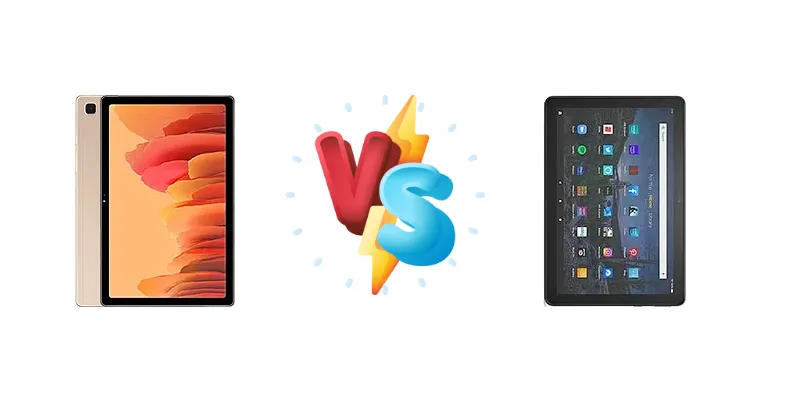
The sub-$200 tablet market is fiercely competitive, and the Samsung Galaxy Tab A7 10.4 (2022) and Amazon Fire HD 10 Plus (2021) represent compelling options. While both aim to deliver an affordable tablet experience, they diverge significantly in their approach – Samsung prioritizing a more standard Android experience and the Amazon focusing on content consumption within its ecosystem. This comparison dissects their core components to determine which tablet best suits your needs.
🏆 Quick Verdict
For users deeply embedded in the Amazon ecosystem and prioritizing media consumption, the Fire HD 10 Plus’s wireless charging and integrated services offer a compelling package. However, the Samsung Galaxy Tab A7 10.4 (2022) edges ahead for general Android usability and potentially smoother performance thanks to its newer Cortex-A75 cores, making it the better all-rounder.
| Network |
|---|
| 2G bands | GSM 850 / 900 / 1800 / 1900 | N/A |
| 3G bands | HSDPA 850 / 900 / 1700(AWS) / 1900 / 2100 | - |
| 4G bands | LTE | - |
| EDGE | - | No |
| GPRS | - | No |
| Speed | HSPA 42.2/5.76 Mbps, LTE (2CA) Cat13 400/50 Mbps | - |
| Technology | GSM / HSPA / LTE | No cellular connectivity |
| Launch |
|---|
| Announced | 2022, November 18 | 2021, April 27. Released 2021, May 26 |
| Status | Available. Released 2022, November 21 | Discontinued |
| Body |
|---|
| Dimensions | 247.6 x 157.4 x 7 mm (9.75 x 6.20 x 0.28 in) | 247 x 166 x 9.2 mm (9.72 x 6.54 x 0.36 in) |
| SIM | Nano-SIM | No |
| Weight | 477 g (1.05 lb) | 468 g (1.03 lb) |
| Display |
|---|
| Protection | - | Aluminosilicate glass |
| Resolution | 1200 x 2000 pixels, 5:3 ratio (~224 ppi density) | 1920 x 1200 pixels, 16:10 ratio (~224 ppi density) |
| Size | 10.4 inches, 307.9 cm2 (~79.0% screen-to-body ratio) | 10.1 inches, 295.8 cm2 (~72.1% screen-to-body ratio) |
| Type | TFT LCD | IPS LCD |
| Platform |
|---|
| CPU | Octa-core (2x2.0 GHz Cortex-A75 & 6x1.8 GHz Cortex-A55) | Octa-core (4x2.0 GHz Cortex-A73 & 4x2.0 GHz Cortex-A53) |
| Chipset | Unisoc UMS512 T618 (12 nm) | Mediatek MT8183 Helio P60T (12 nm) |
| GPU | Mali G52 MP2 | Mali-G72 MP3 |
| OS | Android 12, One UI 4 | Android 9.0 (Pie), Fire OS 7 |
| Memory |
|---|
| Card slot | microSDXC | microSDXC (dedicated slot) |
| Internal | 32GB 3GB RAM, 32GB 4GB RAM, 64GB 3GB RAM | 32GB 4GB RAM, 64GB 4GB RAM |
| | eMMC 5.1 | eMMC 5.1 |
| Main Camera |
|---|
| Single | 8 MP, AF | 5 MP |
| Video | 1080p@30fps | 720p |
| Selfie camera |
|---|
| Single | 5 MP | 2 MP |
| Video | 1080p@30fps | 720p |
| Sound |
|---|
| 3.5mm jack | Yes | Yes |
| 35mm jack | Yes | Yes |
| Loudspeaker | Yes, with stereo speakers (4 speakers) | Yes, with stereo speakers |
| Comms |
|---|
| Bluetooth | 5.0, A2DP, LE | 5.0, A2DP, LE |
| NFC | No | No |
| Positioning | GPS, GLONASS, BDS, GALILEO | No |
| Radio | No | No |
| USB | USB Type-C 2.0 | USB Type-C 2.0, OTG |
| WLAN | Wi-Fi 802.11 a/b/g/n/ac, dual-band, Wi-Fi Direct | Wi-Fi 802.11 a/b/g/n/ac, dual-band |
| Features |
|---|
| Sensors | Accelerometer, gyro, proximity, compass | Accelerometer |
| | - | Text-to-Speech English-language content reader |
| Battery |
|---|
| Charging | 15W wired | Wireless |
| Type | Li-Po 7040 mAh | Li-Ion |
| Misc |
|---|
| Colors | Dark Gray, Silver, Gold | Slate |
| Models | SM-T509 | T76N2P |
| Price | About 250 EUR | About 150 EUR |
| SAR EU | 1.54 W/kg (body) | - |
Samsung Galaxy Tab A7 10.4 (2022)
- Potentially smoother performance due to newer CPU architecture (Cortex-A75)
- Full Android experience with Google Play Store access
- Wider app compatibility and customization options
- Lacks wireless charging
- Limited information on display quality
Amazon Fire HD 10 Plus (2021)
- Convenient wireless charging
- Deep integration with Amazon’s ecosystem (Prime Video, Kindle)
- Hands-free Alexa integration
- Older CPU architecture (Cortex-A73) may result in slower performance
- Fire OS is a customized Android experience with limitations
Display Comparison
Neither tablet boasts a particularly impressive display. Both feature 10.4-inch panels, but detailed specifications like resolution and panel type are missing. However, the Fire HD 10 Plus benefits from wireless charging, a feature absent on the Tab A7. While not directly display-related, this convenience factor impacts the overall user experience. The lack of information on color accuracy and brightness makes a direct comparison difficult, but both are likely to be adequate for indoor viewing.
Camera Comparison
Camera performance is unlikely to be a deciding factor for either tablet. Details on camera sensors are scarce, and both tablets are positioned as budget devices. Expect passable image quality in good lighting conditions, but avoid relying on them for serious photography. The absence of Optical Image Stabilization (OIS) on either device further limits their photographic capabilities.
Performance
The core difference lies in the chipsets. The Samsung Tab A7 utilizes the Unisoc UMS512 T618, featuring a combination of 2x 2.0 GHz Cortex-A75 and 6x 1.8 GHz Cortex-A55 cores. The Amazon Fire HD 10 Plus employs the Mediatek MT8183 Helio P60T, with 4x 2.0 GHz Cortex-A73 and 4x 2.0 GHz Cortex-A53 cores. The Cortex-A75 cores in the Tab A7 represent a generational improvement over the A73 cores in the Fire HD 10 Plus, suggesting better single-core performance and responsiveness. While both are 12nm chips, the architectural advantage of the Unisoc processor should translate to a smoother experience, particularly in demanding applications. The Fire HD 10 Plus’s performance will likely be adequate for streaming and basic tasks, but may struggle with multitasking or graphically intensive games.
Battery Life
Battery capacity details are missing for both devices. However, the Fire HD 10 Plus’s inclusion of wireless charging is a significant advantage. While wired charging on the Tab A7 is rated at 15W, the convenience of simply placing the Fire HD 10 Plus on a charging pad is a compelling benefit. Without knowing the exact battery capacities, it’s difficult to definitively say which tablet offers superior battery life, but the wireless charging capability gives the Fire HD 10 Plus an edge for users who prioritize convenience.
Buying Guide
Buy the Samsung Galaxy Tab A7 10.4 (2022) if you need a tablet that runs a full-fledged Android experience, allowing for greater app compatibility and customization. It’s ideal for users who want a versatile device for productivity, browsing, and light gaming. Buy the Amazon Fire HD 10 Plus (2021) if you primarily intend to consume Amazon content – Prime Video, Kindle books, and Audible audiobooks – and value the convenience of wireless charging and hands-free Alexa integration.
Frequently Asked Questions
❓ Will the Unisoc processor in the Tab A7 struggle with demanding games like PUBG?
While the Unisoc UMS512 T618 is a capable processor, it's not designed for high-end gaming. PUBG may be playable at lower settings, but expect frame drops and potential lag during intense moments. The Fire HD 10 Plus’s Helio P60T will likely offer a similar gaming experience.
❓ How much does the Amazon Fire OS restrict app availability compared to standard Android?
Fire OS is a heavily customized version of Android, and it lacks access to the full Google Play Store. While Amazon provides its own app store, it has a significantly smaller selection. Sideloading apps is possible, but requires technical knowledge and may not be seamless.
❓ Is the 15W charging on the Tab A7 slow compared to the wireless charging on the Fire HD 10 Plus?
15W charging isn't particularly fast by modern standards, but it's still a reasonable charging speed. Wireless charging on the Fire HD 10 Plus is generally slower than wired charging, but the convenience factor often outweighs the speed difference for many users.