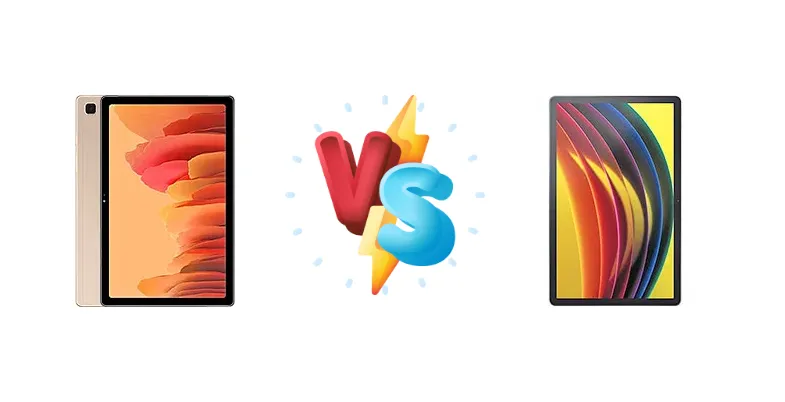
The sub-$250 Android tablet market is fiercely competitive. The Samsung Galaxy Tab A7 10.4 (2020) has been a mainstay, offering a reliable experience. However, the Lenovo Tab P11 Plus enters the fray with a more powerful chipset and faster charging, challenging Samsung’s dominance. This comparison dissects the key differences to determine which tablet delivers the best value for your money.
🏆 Quick Verdict
For most users, the Lenovo Tab P11 Plus is the better choice. Its MediaTek Helio G90T chipset provides a noticeable performance boost over the Snapdragon 662 in the Tab A7, making it more suitable for gaming and multitasking. The 20W charging is also a significant advantage, reducing downtime. While Samsung benefits from brand recognition, Lenovo delivers superior performance per dollar.
| Network |
|---|
| 2G bands | GSM 850 / 900 / 1800 / 1900 | GSM 850 / 900 / 1800 / 1900 |
| 3G bands | HSDPA 850 / 900 / 1700(AWS) / 1900 / 2100 | HSDPA 850 / 900 / 1900 / 2100 |
| 4G bands | 1, 2, 3, 4, 5, 7, 8, 12, 17, 20, 28, 38, 39, 40, 41, 66 | 1, 2, 3, 4, 5, 7, 8, 20, 28, 38, 40, 41 |
| Speed | HSPA 42.2/5.76 Mbps, LTE (2CA) Cat13 400/50 Mbps - cellular model only | HSPA, LTE - cellular model only |
| Technology | GSM / HSPA / LTE | GSM / HSPA / LTE |
| Launch |
|---|
| Announced | 2020, September 02. Released 2020, September 11 | 2021, June 28 |
| Status | Discontinued | Available. Released 2021, July 29 |
| Body |
|---|
| Dimensions | 247.6 x 157.4 x 7 mm (9.75 x 6.20 x 0.28 in) | 258.4 x 163 x 7.5 mm (10.17 x 6.42 x 0.30 in) |
| SIM | Nano-SIM (cellular model only) | Nano-SIM (cellular model only) |
| Weight | 476 g (Wi-Fi), 477 g (LTE) (1.05 lb) | 490 g (1.08 lb) |
| | - | Stylus support |
| Display |
|---|
| Resolution | 1200 x 2000 pixels, 5:3 ratio (~224 ppi density) | 1200 x 2000 pixels, 5:3 ratio (~212 ppi density) |
| Size | 10.4 inches, 307.9 cm2 (~79.0% screen-to-body ratio) | 11.0 inches, 344.4 cm2 (~81.8% screen-to-body ratio) |
| Type | TFT LCD | IPS LCD, 400 nits (typ) |
| Platform |
|---|
| CPU | Octa-core (4x2.0 GHz Kryo 260 Gold & 4x1.8 GHz Kryo 260 Silver) | Octa-core (2x2.05 GHz Cortex-A76 & 6x2.0 GHz Cortex-A55) |
| Chipset | Qualcomm SM6115 Snapdragon 662 (11 nm) | Mediatek MT6785 Helio G90T (12 nm) |
| GPU | Adreno 610 | Mali-G76 MC4 |
| OS | Android 10, upgradable to Android 12, One UI 4 | Android 11 |
| Memory |
|---|
| Card slot | microSDXC | microSDXC (dedicated slot) |
| Internal | 32GB 3GB RAM, 32GB 4GB RAM, 64GB 3GB RAM, 64GB 4GB RAM | 64GB 4GB RAM, 128GB 4GB RAM, 128GB 6GB RAM |
| | eMMC 5.1 | - |
| Main Camera |
|---|
| Features | - | LED flash |
| Single | 8 MP, AF | 13 MP, (wide), AF |
| Video | 1080p@30fps | 1080p@30fps |
| Selfie camera |
|---|
| Single | 5 MP | 8 MP, (wide) |
| Video | 1080p@30fps | 1080p@30fps |
| Sound |
|---|
| 3.5mm jack | Yes | No |
| 35mm jack | Yes | No |
| Loudspeaker | Yes, with stereo speakers (4 speakers) | Yes, with stereo speakers (4 speakers) |
| Comms |
|---|
| Bluetooth | 5.0, A2DP, LE | 5.1, A2DP, LE |
| NFC | No | No |
| Positioning | GPS, GLONASS, BDS, GALILEO - cellular model only | GPS, GLONASS, BDS - cellular model only |
| Radio | No | FM radio |
| USB | USB Type-C 2.0 | USB Type-C 2.0 |
| WLAN | Wi-Fi 802.11 a/b/g/n/ac, dual-band, Wi-Fi Direct | Wi-Fi 802.11 a/b/g/n/ac, dual-band, Wi-Fi Direct |
| Features |
|---|
| Sensors | Accelerometer, gyro, proximity, compass | Accelerometer, gyro, proximity |
| Battery |
|---|
| Charging | 15W wired | 20W wired |
| Type | Li-Po 7040 mAh | Li-Po 7700 mAh |
| Misc |
|---|
| Colors | Dark Gray, Silver, Gold | Slate Grey, Platinum Grey, Modernist teal |
| Models | SM-T500, SM-T505, SM-T505N | ZA940124SE |
| Price | About 240 EUR | About 300 EUR |
| SAR EU | 1.01 W/kg (body) | - |
Samsung Galaxy Tab A7 10.4 (2020)
- Established Brand Reputation
- Reliable Performance for Basic Tasks
- Generally Lower Price (depending on sales)
- Less Powerful Chipset
- Slower Charging Speed
- Potentially Limited Future-Proofing
Lenovo Tab P11 Plus
- More Powerful Helio G90T Chipset
- Faster 20W Charging
- Better Multitasking and Gaming Performance
- Less Brand Recognition
- Potential Software Update Delays
- May be Slightly More Expensive
Display Comparison
Both tablets feature 10.4-inch displays, but detailed specifications like resolution and panel type are missing. However, the overall user experience will likely be similar. The absence of high refresh rate panels is standard in this price bracket. Bezels are expected to be comparable, focusing on maximizing screen real estate within the budget constraints. Color accuracy is likely to be decent on both, suitable for everyday content consumption, but not professional color-critical work.
Camera Comparison
Camera performance is unlikely to be a deciding factor for most buyers in this segment. Detailed camera specs are unavailable, but both tablets likely feature basic camera setups suitable for casual snapshots and video calls. Focusing on the main sensor resolution would be misleading without knowing sensor size and lens aperture. Image processing will likely be optimized for good lighting conditions, but low-light performance will be limited on both devices. The absence of Optical Image Stabilization (OIS) is expected.
Performance
The core difference lies in the chipsets. The Lenovo Tab P11 Plus utilizes the MediaTek Helio G90T (12nm), featuring a dual-core Cortex-A76 setup paired with six Cortex-A55 cores. This architecture provides a significant advantage over the Qualcomm Snapdragon 662 (11nm) in the Tab A7, which relies on a more homogenous octa-core Kryo 260 configuration. The G90T’s Cortex-A76 cores offer higher single-core performance, crucial for responsive app launches and smoother multitasking. The 12nm process node on the G90T, while slightly larger than the Snapdragon’s 11nm, doesn’t necessarily translate to worse efficiency given the architectural improvements. Users who play graphically intensive games or frequently switch between apps will see a tangible benefit from the P11 Plus.
Battery Life
While specific battery capacities are not provided, the Lenovo Tab P11 Plus’s 20W wired charging is a clear advantage over the Samsung Galaxy Tab A7’s 15W charging. This translates to significantly faster charging times, reducing downtime and increasing usability. Even with a similar battery capacity, the faster charging speed makes the P11 Plus more convenient for users who rely on their tablet throughout the day. The efficiency of the Helio G90T chipset may also contribute to comparable or even better battery life despite the faster charging.
Buying Guide
Buy the Samsung Galaxy Tab A7 10.4 (2020) if you prioritize brand familiarity and a simple, reliable experience for basic tasks like web browsing and video consumption. Buy the Lenovo Tab P11 Plus if you want a tablet capable of handling more demanding applications, enjoy faster charging, and appreciate a more modern chipset architecture for future-proofing.
Frequently Asked Questions
❓ Will the Lenovo Tab P11 Plus handle demanding games like PUBG Mobile?
The MediaTek Helio G90T chipset in the Tab P11 Plus is specifically designed for gaming. While it won't deliver flagship-level performance, it should be capable of running PUBG Mobile at medium to high settings with playable frame rates, offering a significantly better gaming experience than the Snapdragon 662 in the Tab A7.
❓ How much faster is the 20W charging on the Lenovo Tab P11 Plus compared to the Samsung Tab A7's 15W charging?
The 20W charging on the P11 Plus can reduce charging times by approximately 30-40% compared to the Tab A7’s 15W charging. This means a full charge could take around 2-2.5 hours on the P11 Plus, while the Tab A7 might require 3-4 hours.
❓ Does the Lenovo Tab P11 Plus receive regular software updates?
Lenovo's software update track record is not as consistent as Samsung's. While the P11 Plus launched with Android 11, the frequency of major Android version updates and security patches may be less frequent than on the Tab A7. This is a potential drawback for users who prioritize long-term software support.