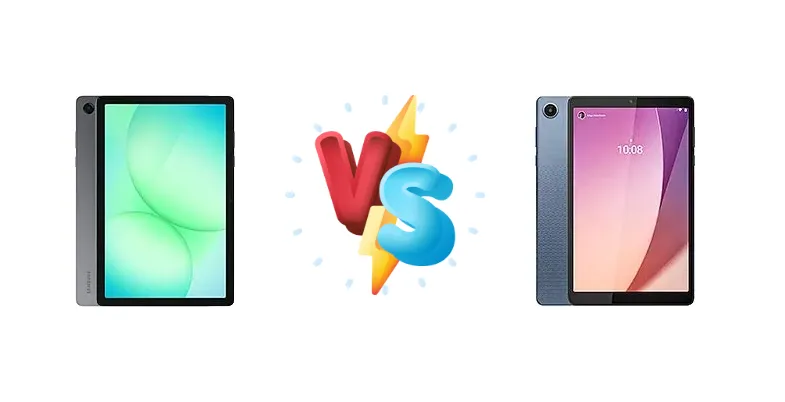
The tablet market offers a wide range of options, but finding the right balance between performance, battery life, and price can be challenging. We pit the Samsung Galaxy Tab A11+, powered by a modern Mediatek Dimensity 7300 chipset, against the Lenovo Tab M8 (4th Gen), featuring the older Helio A22, to determine which tablet best suits your needs.
🏆 Quick Verdict
For users prioritizing performance and longevity, the Samsung Galaxy Tab A11+ is the clear winner. Its Dimensity 7300 chipset and impressive 96:06h battery endurance significantly outperform the Lenovo Tab M8. However, the M8 remains a viable option for basic tasks and budget-conscious buyers.
| Network |
|---|
| 2G bands | GSM 850 / 900 / 1800 / 1900 - cellular model only | GSM 850 / 900 / 1800 / 1900 |
| 3G bands | HSDPA 850 / 900 / 1700(AWS) / 1900 / 2100 - cellular model only | HSDPA 800 / 850 / 900 / 1900 / 2100 |
| 4G bands | 1, 2, 3, 4, 5, 7, 8, 12, 13, 17, 20, 26, 28, 38, 40, 41, 66 - cellular model only | 1, 2, 3, 4, 5, 7, 8, 19, 20, 26, 28, 38, 40, 41 |
| 5G bands | 1, 3, 5, 7, 8, 20, 26, 28, 38, 40, 41, 66, 71, 77, 78 SA/NSA/Sub6 - cellular model only | - |
| Speed | HSPA, LTE, 5G - cellular model only | HSPA, LTE - cellular model only |
| Technology | GSM / HSPA / LTE / 5G | GSM / HSPA / LTE |
| Launch |
|---|
| Announced | 2025, September 29 | 2023, April 22 |
| Status | Available. Released 2025, November 02 | Available. Released 2023, May |
| Body |
|---|
| Build | - | Glass front, plastic frame, plastic back |
| Dimensions | 257.1 x 168.7 x 6.9 mm (10.12 x 6.64 x 0.27 in) | 197.8 x 119.8 x 9 mm (7.79 x 4.72 x 0.35 in) |
| SIM | Nano-SIM + eSIM (cellular model only) | Nano-SIM (cellular model only) |
| Weight | 477 g or 482 g (1.05 lb) | 320 g (11.29 oz) |
| Display |
|---|
| Protection | Mohs level 5 | - |
| Resolution | 1200 x 1920 pixels, 16:10 ratio (~206 ppi density) | 800 x 1280 pixels, 16:10 ratio (~189 ppi density) |
| Size | 11.0 inches, 350.9 cm2 (~80.9% screen-to-body ratio) | 8.0 inches, 185.6 cm2 (~78.3% screen-to-body ratio) |
| Type | TFT LCD, 90Hz | IPS LCD, 350 nits (typ) |
| Platform |
|---|
| CPU | Octa-core (4x2.5 GHz Cortex-A78 & 4x2.0 GHz Cortex-A55) | Octa-core (4x2.3 GHz Cortex-A53 & 4x1.6 GHz Cortex-A53) |
| Chipset | Mediatek Dimensity 7300 (4 nm) | Mediatek MT8768 Helio A22 (12 nm) |
| GPU | Mali-G615 MC2 | PowerVR GE8320 |
| OS | Android 16, up to 7 major Android upgrades, One UI 8 | Android 13 |
| Memory |
|---|
| Card slot | microSDXC (dedicated slot) | microSDXC (dedicated slot) |
| Internal | 128GB 6GB RAM, 256GB 8GB RAM | 32GB 3GB RAM, 64GB 4GB RAM |
| Main Camera |
|---|
| Single | 8 MP, AF | 5 MP, AF or 8MP, AF |
| Video | 1080p@30fps | 1080p |
| Selfie camera |
|---|
| Single | 5 MP | 2 MP |
| Video | 1080p@30fps | 720p |
| Sound |
|---|
| 35mm jack | Yes | Yes |
| Loudspeaker | Yes, with stereo speakers, Dolby Atmos (4 speakers) | Yes, with dual speakers |
| Comms |
|---|
| Bluetooth | 5.3, A2DP, LE | 5.0, A2DP, LE |
| NFC | No | No |
| Positioning | GPS, GLONASS, GALILEO, BDS, QZSS - cellular model only | GPS, GLONASS, BDS - cellular model only |
| Radio | No | FM radio |
| USB | USB Type-C 2.0 | USB Type-C 2.0, OTG |
| WLAN | Wi-Fi 802.11 a/b/g/n/ac, dual-band, Wi-Fi Direct | Wi-Fi 802.11 a/b/g/n/ac, dual-band, Wi-Fi Direct |
| Features |
|---|
| Sensors | Accelerometer, gyro, proximity (accessories only), compass | Accelerometer, proximity |
| Battery |
|---|
| Charging | 25W wired | 10W wired |
| Type | Li-Po 7040 mAh | Li-Po 5100 mAh |
| Misc |
|---|
| Colors | Gray, Silver | Abyss blue, Arctic grey |
| Models | SM-X230, SM-X236B | - |
| Price | About 280 EUR | About 150 EUR |
| SAR | 1.05 W/kg (body) | - |
| SAR EU | 0.31 W/kg (body) | - |
| EU LABEL |
|---|
| Battery | 96:06h endurance, 1200 cycles | - |
| Energy | Class E | - |
| Free fall | Class E (0 falls) | - |
| Repairability | Class C | - |
Samsung Galaxy Tab A11+
- Exceptional performance thanks to the Dimensity 7300 chipset.
- Outstanding battery life with 96:06h endurance.
- Faster 25W wired charging.
- More future-proofed due to modern architecture.
- Likely higher price point compared to the Lenovo Tab M8.
- May lack expandable storage (spec not provided).
Lenovo Tab M8 (4th Gen)
- Very affordable price point.
- Compact and portable design.
- Suitable for basic tasks like web browsing and video calls.
- Simple and user-friendly interface.
- Slow performance due to the older Helio A22 chipset.
- Limited battery life.
- Slow 10W charging.
- Likely lower-quality display.
Display Comparison
While display specifications are missing for the Lenovo Tab M8, the Samsung Galaxy Tab A11+’s performance is the key differentiator here. The A11+ benefits from the efficiency of its chipset, allowing for a longer-lasting display experience. The M8’s older Helio A22 likely drives a lower-resolution and less color-accurate panel, impacting the viewing experience. Bezels are likely larger on the M8 due to its lower price point, further diminishing the immersive quality.
Camera Comparison
Camera details are limited, but given the market positioning, neither tablet is expected to excel in photography. The Lenovo Tab M8 likely features basic sensors, while the Samsung Galaxy Tab A11+ may offer slightly improved image quality due to its more advanced chipset’s image signal processor. However, both tablets are best suited for casual snapshots and video calls, not serious photography.
Performance
The performance gap between these tablets is substantial. The Samsung Galaxy Tab A11+’s Mediatek Dimensity 7300 (4nm) utilizes a modern architecture – Cortex-A78 and A55 cores – delivering significantly faster processing speeds compared to the Lenovo Tab M8’s Helio A22 (12nm) with its Cortex-A53 cores. The 4nm fabrication process of the Dimensity 7300 also translates to improved thermal efficiency, reducing throttling during sustained workloads. This means the A11+ will handle multitasking, gaming, and demanding apps with ease, while the M8 will struggle with even moderate tasks.
Battery Life
The Samsung Galaxy Tab A11+ boasts a remarkable 96:06h endurance, a testament to the efficiency of the Dimensity 7300 chipset and optimized software. Coupled with 25W wired charging, it offers a convenient and rapid recharge experience. The Lenovo Tab M8 (4th Gen), with its 10W charging, will take considerably longer to reach a full charge, and its battery life will be significantly shorter, requiring more frequent top-ups.
Buying Guide
Buy the Samsung Galaxy Tab A11+ if you need a tablet capable of handling demanding applications, multitasking, and extended use without frequent charging. It’s ideal for students, professionals, and entertainment enthusiasts. Buy the Lenovo Tab M8 (4th Gen) if you prefer a highly affordable tablet for simple tasks like web browsing, video calls, and light media consumption, and aren't concerned with demanding performance or long-lasting battery life.
Frequently Asked Questions
❓ Is the Mediatek Dimensity 7300 in the Tab A11+ powerful enough for gaming?
Yes, the Dimensity 7300 is a capable chipset for mobile gaming. While it's not a flagship-level processor, it can handle most popular Android games at medium to high settings. The 4nm process also helps to minimize thermal throttling during extended gaming sessions, providing a more consistent experience.
❓ How long will it take to fully charge the Lenovo Tab M8 (4th Gen) from 0%?
With its 10W charging, the Lenovo Tab M8 (4th Gen) will take a considerable amount of time to fully charge – likely exceeding 3-4 hours. This is a significant drawback compared to the Samsung Galaxy Tab A11+'s 25W fast charging, which can significantly reduce charging times.
❓ Can the Samsung Galaxy Tab A11+ handle video editing or other resource-intensive tasks?
The Tab A11+ is capable of handling light to moderate video editing and other resource-intensive tasks. The Dimensity 7300 chipset provides sufficient processing power for basic editing workflows, but it may struggle with complex projects or 4K video editing.
❓ Is the Lenovo Tab M8 (4th Gen) suitable for students taking online classes?
The Lenovo Tab M8 (4th Gen) can be used for online classes, but its limited performance may be a hindrance for multitasking or running demanding educational apps. It's best suited for students who primarily need a tablet for note-taking, reading, and basic video conferencing.