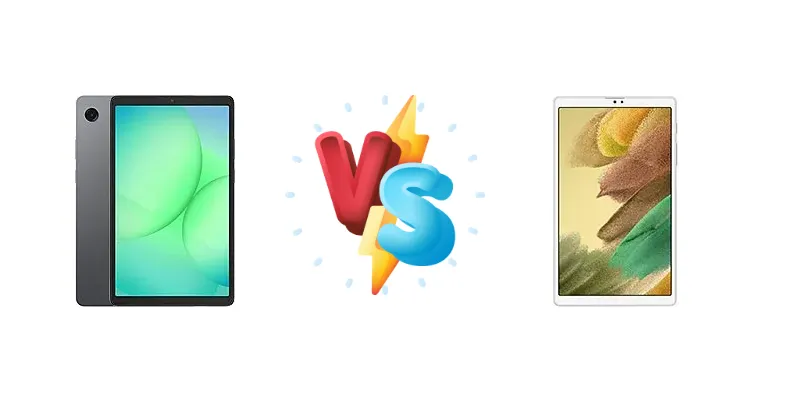
Samsung's Tab A series consistently delivers affordable Android tablets, but the A11 and A7 Lite represent distinct approaches. The A7 Lite has been a mainstay for budget-conscious users, while the newer A11 aims to elevate performance within the same price bracket. This comparison dissects the key differences between these two tablets, focusing on their processing power, battery endurance, and overall user experience.
🏆 Quick Verdict
For most users, the Samsung Galaxy Tab A11 is the superior choice. Its Mediatek Helio G99 chipset, built on a 6nm process, provides a significant performance boost over the A7 Lite’s older Helio P22T. While both offer 15W charging, the A11’s exceptional 93:40h endurance makes it the clear winner for all-day use.
| Network |
|---|
| 2G bands | GSM 850 / 900 / 1800 / 1900 - cellular model only | GSM 850 / 900 / 1800 / 1900 |
| 3G bands | HSDPA 850 / 900 / 1700(AWS) / 1900 / 2100 - cellular model only | HSDPA 850 / 900 / 1700(AWS) / 1900 / 2100 |
| 4G bands | 1, 2, 3, 4, 5, 7, 8, 12, 17, 20, 26, 28, 38, 40, 41, 66 - cellular model only | 1, 2, 3, 4, 5, 7, 8, 12, 17, 20, 28, 38, 40, 66 |
| Speed | HSPA, LTE - cellular model only | HSPA, LTE - cellular model only |
| Technology | GSM / HSPA / LTE | GSM / HSPA / LTE |
| Launch |
|---|
| Announced | 2025, September 12 | 2021, May 27 |
| Status | Available. Released 2025, September | Available. Released 2021, June 18 |
| Body |
|---|
| Build | - | Glass front, aluminum back, aluminum frame, plastic ends |
| Dimensions | 211 x 124.7 x 8 mm (8.31 x 4.91 x 0.31 in) | 212.5 x 124.7 x 8 mm (8.37 x 4.91 x 0.31 in) |
| SIM | Nano-SIM (cellular model only) | Nano-SIM (cellular model only) |
| Weight | 335 g or 337 g (11.82 oz) | 366 g (Wi-Fi), 371 g (LTE) (12.91 oz) |
| Display |
|---|
| Protection | Mohs level 5 | - |
| Resolution | 800 x 1340 pixels, 5:3 ratio (~179 ppi density) | 800 x 1340 pixels, 5:3 ratio (~179 ppi density) |
| Size | 8.7 inches, 214.9 cm2 (~81.7% screen-to-body ratio) | 8.7 inches, 214.9 cm2 (~81.1% screen-to-body ratio) |
| Type | TFT LCD, 90Hz | TFT LCD |
| Platform |
|---|
| CPU | Octa-core (2x2.2 GHz Cortex-A76 & 6x2.0 GHz Cortex-A55) | Octa-core (4x2.3 GHz Cortex-A53 & 4x1.8 GHz Cortex-A53) |
| Chipset | Mediatek Helio G99 (6 nm) | Mediatek MT8768T Helio P22T (12 nm) |
| GPU | Mali-G57 MC2 | PowerVR GE8320 |
| OS | Android 15, upgradable to Android 16, One UI 8, up to 7 major Android upgrades | Android 11, upgradable to Android 14, One UI 6.1 |
| Memory |
|---|
| Card slot | microSDXC (dedicated slot) | microSDXC (dedicated slot) |
| Internal | 64GB 4GB RAM, 128GB 8GB RAM | 32GB 2GB RAM, 32GB 3GB RAM, 64GB 4GB RAM |
| | - | eMMC 5.1 |
| Main Camera |
|---|
| Single | 8 MP, AF | 8 MP, AF |
| Video | 1080p@30fps | 1080p@30fps |
| Selfie camera |
|---|
| Single | 5 MP | 2 MP |
| Video | Yes | - |
| Sound |
|---|
| 3.5mm jack | - | Yes |
| 35mm jack | Yes | Yes |
| Loudspeaker | Yes, with stereo speakers (with Dolby Atmos) | Yes, with stereo speakers |
| Comms |
|---|
| Bluetooth | 5.3, A2DP, LE | 5.0, A2DP, LE |
| NFC | No | No |
| Positioning | GPS, GLONASS, BDS, GALILEO, QZSS - cellular model only | GPS, GLONASS, BDS, GALILEO - cellular model only |
| Radio | No | No |
| USB | USB Type-C 2.0 | USB Type-C 2.0 |
| WLAN | Wi-Fi 802.11 a/b/g/n/ac, dual-band, Wi-Fi Direct | Wi-Fi 802.11 a/b/g/n/ac, dual-band, Wi-Fi Direct |
| Features |
|---|
| Sensors | Accelerometer, proximity, compass | Accelerometer, compass |
| Battery |
|---|
| Charging | 15W wired | 15W wired |
| Type | 5100 mAh | Li-Po 5100 mAh |
| Misc |
|---|
| Colors | Gray, Silver | Gray, Silver |
| Models | SM-X133, SM-X135, SM-X135F | SM-T225, SM-T220, SM-T225N, SM-T227U |
| Price | About 180 EUR | About 140 EUR |
| SAR | 0.60 W/kg (head) 1.37 W/kg (body) | 0.68 W/kg (body) |
| SAR EU | 0.29 W/kg (body) | 0.64 W/kg (head) 0.99 W/kg (body) |
| EU LABEL |
|---|
| Battery | 93:40h endurance, 1200 cycles | - |
| Energy | Class D | - |
| Free fall | Class C (104 falls) | - |
| Repairability | Class C | - |
Samsung Galaxy Tab A11
- Significantly faster processor (Helio G99)
- Exceptional battery life (93:40h endurance)
- More efficient 6nm chipset
- Potentially better image processing
- May be slightly more expensive than the A7 Lite
- Detailed display specs unavailable
Samsung Galaxy Tab A7 Lite
- Lower price point
- Compact and portable design
- Suitable for basic tasks
- Established user base
- Outdated Helio P22T chipset
- Inferior CPU performance
- Likely shorter battery life
- Less efficient 12nm process
Display Comparison
Both tablets likely feature LCD panels, typical for this price segment. However, detailed display specs (resolution, brightness, color gamut) are unavailable. The A7 Lite’s smaller form factor may result in a slightly higher pixel density. Without specific data, it’s difficult to definitively declare a winner, but the A11’s larger screen size (assumed, based on typical A-series sizing) could offer a more immersive viewing experience.
Camera Comparison
Camera performance is unlikely to be a key selling point for either tablet. Given the market segment, both likely feature basic camera setups. Detailed sensor information is missing, but it’s reasonable to assume both have a primary rear camera and a front-facing camera for video calls. Without specific details, it’s impossible to assess image quality differences. Focusing on the chipset’s image signal processor (ISP) capabilities, the Helio G99 in the A11 likely offers superior image processing, potentially resulting in slightly better photos and videos.
Performance
The performance gap is the most significant differentiator. The Tab A11’s Mediatek Helio G99 (6nm) is a substantial upgrade over the A7 Lite’s Helio P22T (12nm). The G99 utilizes newer Cortex-A76 cores alongside A55 cores, compared to the A7 Lite’s all-Cortex-A53 setup. This translates to a noticeable improvement in CPU performance, particularly in demanding applications. The 6nm fabrication process also contributes to better thermal efficiency, reducing the likelihood of throttling during sustained workloads. The A7 Lite’s older chipset will struggle with more intensive tasks, exhibiting lag and slowdowns more readily.
Battery Life
The Tab A11 boasts an impressive 93:40h endurance, indicating exceptional battery life. While both tablets support 15W wired charging, the A11’s superior endurance means users will need to charge less frequently. The A7 Lite’s battery life is not specified, but given the less efficient chipset, it will likely fall significantly short of the A11. The A11’s 1200 charge cycles also suggest a longer lifespan before battery degradation becomes noticeable.
Buying Guide
Buy the Samsung Galaxy Tab A11 if you prioritize responsiveness for multitasking, streaming, and light gaming. Its more modern chipset ensures a smoother experience and better future-proofing. Buy the Samsung Galaxy Tab A7 Lite if your primary use case is basic media consumption and light tasks, and you're looking for the absolute lowest price point. The A7 Lite is suitable for users who prioritize portability and aren't demanding in terms of performance.
Frequently Asked Questions
❓ Will the Helio G99 in the Tab A11 handle demanding games like PUBG Mobile?
The Helio G99 is a capable chipset for mobile gaming. While it won't deliver flagship-level performance, it should be able to run PUBG Mobile at medium settings with reasonable frame rates. The 6nm process also helps mitigate thermal throttling during extended gaming sessions, providing a more consistent experience compared to the A7 Lite.
❓ How much faster is the Tab A11 compared to the A7 Lite in everyday tasks like web browsing and video streaming?
The Tab A11 will feel noticeably snappier in everyday tasks. The newer CPU architecture and faster processing speeds of the Helio G99 result in quicker app launches, smoother multitasking, and more responsive web browsing. Video streaming will also benefit from the improved processing power, particularly when dealing with higher resolutions.
❓ Is the 15W charging on both tablets slow by today's standards?
Yes, 15W charging is relatively slow compared to the faster charging technologies found in many modern smartphones and tablets. However, given the price point of these devices, it's a reasonable compromise. The Tab A11’s exceptional battery life mitigates the slower charging speed, as you won’t need to top it up as frequently.
❓ Does the Tab A7 Lite receive software updates as frequently as the Tab A11?
Generally, newer devices like the Tab A11 receive software updates for a longer period than older models like the A7 Lite. Samsung typically provides several years of security updates and OS upgrades for its tablets, but the A7 Lite is nearing the end of its support lifecycle.