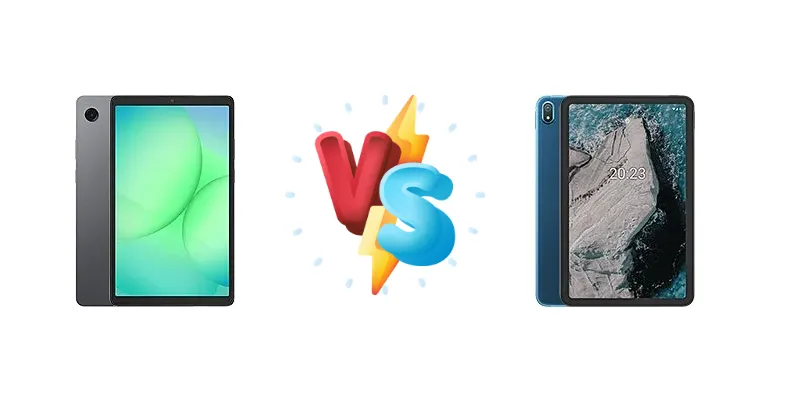
The Samsung Galaxy Tab A11 and Nokia T20 represent compelling options in the increasingly competitive budget tablet space. While both aim to deliver an accessible Android experience, they diverge significantly in their core hardware. This comparison dissects those differences, focusing on performance, battery endurance, and display quality to determine which tablet offers the best value for your money.
🏆 Quick Verdict
For most users, the Samsung Galaxy Tab A11 emerges as the stronger choice. Its Mediatek Helio G99 chipset, built on a 6nm process, provides a noticeable performance advantage over the Nokia T20’s Unisoc T610, translating to smoother multitasking and gaming. While the Nokia T20 boasts a brighter display, the A11’s superior processing power makes it the more versatile option.
| Network |
|---|
| 2G bands | GSM 850 / 900 / 1800 / 1900 - cellular model only | GSM 850 / 900 / 1800 / 1900 |
| 3G bands | HSDPA 850 / 900 / 1700(AWS) / 1900 / 2100 - cellular model only | HSDPA 850 / 900 / 1700(AWS) / 1900 / 2100 - US, LATAM |
| 4G bands | 1, 2, 3, 4, 5, 7, 8, 12, 17, 20, 26, 28, 38, 40, 41, 66 - cellular model only | 1, 2, 3, 4, 5, 7, 8, 12, 13, 17, 20, 28, 40, 66 - US, LATAM |
| Speed | HSPA, LTE - cellular model only | HSPA, LTE Cat4 150/50 Mbps - cellular model only |
| Technology | GSM / HSPA / LTE | GSM / HSPA / LTE |
| | - | 1, 3, 5, 7, 8, 20, 28, 38, 40, 41 - International |
| Launch |
|---|
| Announced | 2025, September 12 | 2021, October 06 |
| Status | Available. Released 2025, September | Available. Released 2021, November 02 |
| Body |
|---|
| Build | - | Glass front, aluminum back |
| Dimensions | 211 x 124.7 x 8 mm (8.31 x 4.91 x 0.31 in) | 247.6 x 157.5 x 7.8 mm (9.75 x 6.20 x 0.31 in) |
| SIM | Nano-SIM (cellular model only) | Nano-SIM (cellular model only) |
| Weight | 335 g or 337 g (11.82 oz) | 465 g (Wi-Fi), 470 g (LTE) (1.03 lb) |
| | - | Splash resistant |
| Display |
|---|
| Protection | Mohs level 5 | Scratch-resistant glass |
| Resolution | 800 x 1340 pixels, 5:3 ratio (~179 ppi density) | 1200 x 2000 pixels, 5:3 ratio (~224 ppi density) |
| Size | 8.7 inches, 214.9 cm2 (~81.7% screen-to-body ratio) | 10.4 inches, 307.9 cm2 (~78.9% screen-to-body ratio) |
| Type | TFT LCD, 90Hz | IPS LCD, 400 nits (typ) |
| Platform |
|---|
| CPU | Octa-core (2x2.2 GHz Cortex-A76 & 6x2.0 GHz Cortex-A55) | Octa-core (2x1.8 GHz Cortex-A75 & 6x1.8 GHz Cortex-A55) |
| Chipset | Mediatek Helio G99 (6 nm) | Unisoc T610 (12 nm) |
| GPU | Mali-G57 MC2 | Mali-G52 MP2 |
| OS | Android 15, upgradable to Android 16, One UI 8, up to 7 major Android upgrades | Android 11, upgradable to Android 13 |
| Memory |
|---|
| Card slot | microSDXC (dedicated slot) | microSDXC (dedicated slot) |
| Internal | 64GB 4GB RAM, 128GB 8GB RAM | 32GB 3GB RAM, 64GB 4GB RAM |
| | - | eMMC 5.1 |
| Main Camera |
|---|
| Features | - | LED flash |
| Single | 8 MP, AF | 8 MP, AF |
| Video | 1080p@30fps | 1080p@30fps |
| Selfie camera |
|---|
| Single | 5 MP | 5 MP |
| Video | Yes | Yes |
| Sound |
|---|
| 3.5mm jack | - | Yes |
| 35mm jack | Yes | Yes |
| Loudspeaker | Yes, with stereo speakers (with Dolby Atmos) | Yes, with stereo speakers |
| Comms |
|---|
| Bluetooth | 5.3, A2DP, LE | 5.0, A2DP, LE |
| NFC | No | No |
| Positioning | GPS, GLONASS, BDS, GALILEO, QZSS - cellular model only | GPS - cellular model only |
| Radio | No | FM radio |
| USB | USB Type-C 2.0 | USB Type-C 2.0 |
| WLAN | Wi-Fi 802.11 a/b/g/n/ac, dual-band, Wi-Fi Direct | Wi-Fi 802.11 a/b/g/n/ac, dual-band |
| Features |
|---|
| Sensors | Accelerometer, proximity, compass | Accelerometer |
| Battery |
|---|
| Charging | 15W wired | 15W wired |
| Type | 5100 mAh | Li-Po 8200 mAh |
| Misc |
|---|
| Colors | Gray, Silver | Deep Ocean |
| Models | SM-X133, SM-X135, SM-X135F | TA-1397, TA-1394, TA-1392 |
| Price | About 180 EUR | About 200 EUR |
| SAR | 0.60 W/kg (head) 1.37 W/kg (body) | 1.34 W/kg (body) |
| SAR EU | 0.29 W/kg (body) | 1.35 W/kg (body) |
| EU LABEL |
|---|
| Battery | 93:40h endurance, 1200 cycles | - |
| Energy | Class D | - |
| Free fall | Class C (104 falls) | - |
| Repairability | Class C | - |
Samsung Galaxy Tab A11
- Superior CPU performance with the Helio G99
- Exceptional battery endurance (93:40h)
- Long battery lifespan (1200 cycles)
- Display specifications are unknown, potentially lower brightness
- Camera performance likely average
Nokia T20
- Brighter display (422 nits)
- High contrast ratio (1786:1)
- Potentially more durable build quality (Nokia's reputation)
- Slower processor (Unisoc T610)
- Less efficient 12nm process
Display Comparison
The Nokia T20 distinguishes itself with a measured peak brightness of 422 nits and a 1786:1 contrast ratio, making it more suitable for viewing content in brightly lit environments. The Tab A11’s display specifications are not provided, but typically tablets in this price range prioritize cost savings over display quality. The higher contrast ratio on the Nokia T20 will deliver deeper blacks and a more vibrant image, though the absence of details regarding panel technology (like IPS or TFT) and color accuracy on both devices makes a comprehensive assessment difficult. Users sensitive to flicker will need to investigate PWM dimming rates, which are not provided for either device.
Camera Comparison
Neither tablet is positioned as a photography powerhouse, and detailed camera specifications are absent. Given the price point, image quality will likely be adequate for casual snapshots and video calls. Focusing on the processors, the G99’s integrated image signal processor (ISP) likely offers slightly better image processing capabilities than the T610’s, but the difference will be minimal in real-world usage. The absence of OIS or large sensors on either device suggests that low-light performance will be limited.
Performance
The core difference lies in the chipsets. The Samsung Galaxy Tab A11’s Mediatek Helio G99, fabricated on a 6nm process, features an octa-core configuration with two Cortex-A76 cores clocked at 2.2 GHz and six Cortex-A55 cores at 2.0 GHz. This architecture provides a significant performance uplift compared to the Nokia T20’s Unisoc T610 (12nm). The T610 utilizes two Cortex-A75 cores at 1.8 GHz and six Cortex-A55 cores, also at 1.8 GHz. The 6nm node of the Helio G99 translates to improved thermal efficiency, potentially reducing throttling during sustained workloads. While both tablets likely feature similar RAM configurations, the G99’s superior CPU architecture will result in faster app loading times and a more responsive user experience.
Battery Life
The Samsung Galaxy Tab A11 boasts an impressive 93:40h endurance rating and a 1200 cycle lifespan, indicating exceptional battery longevity. Both tablets support 15W wired charging. While the Nokia T20’s battery capacity isn’t specified, the Tab A11’s endurance suggests a well-optimized power management system. The 1200 cycle lifespan of the A11’s battery implies it will retain a significant portion of its capacity even after extended use, offering long-term value. The identical charging wattage means 0-100% charge times will likely be comparable, but the A11’s superior endurance will allow for longer periods between charges.
Buying Guide
Buy the Samsung Galaxy Tab A11 if you prioritize performance for tasks like streaming, light gaming, and multitasking. Its more powerful processor will handle demanding applications with greater ease. Buy the Nokia T20 if display brightness is paramount, particularly for outdoor use, and you primarily need a tablet for media consumption and basic productivity tasks where raw processing power isn't critical.
Frequently Asked Questions
❓ Will the Mediatek Helio G99 in the Tab A11 struggle with demanding games like Genshin Impact?
While the Helio G99 is a capable processor, Genshin Impact is a particularly demanding title. Expect to play at lower graphics settings and potentially experience some frame rate drops during intense combat scenarios. The Nokia T20’s Unisoc T610 would likely perform even worse, making the Tab A11 the preferable choice for mobile gaming, albeit with compromises.
❓ Is the 15W charging on either tablet considered slow by today's standards?
Yes, 15W charging is relatively slow compared to the 25W or higher charging speeds found on many modern smartphones and tablets. However, given the price point of both devices, it’s a reasonable compromise. Expect a full charge to take around 3-4 hours. The Tab A11’s superior battery endurance mitigates the slower charging speed to some extent.
❓ How does the Unisoc T610 handle multitasking with several apps open simultaneously?
The Unisoc T610 can handle basic multitasking, such as switching between web browsing, email, and social media apps. However, it may exhibit noticeable slowdowns when running multiple resource-intensive applications concurrently. The Tab A11’s Helio G99, with its more powerful cores and efficient architecture, will provide a smoother multitasking experience.