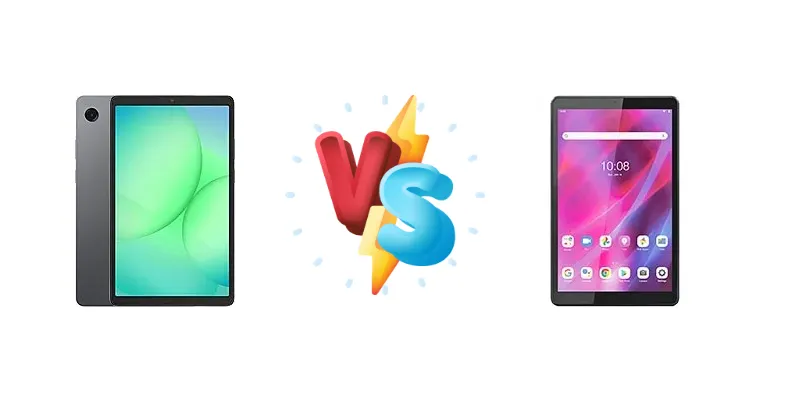
The budget tablet market is fiercely competitive, with options like the Samsung Galaxy Tab A11 and Lenovo Tab M8 (3rd Gen) vying for attention. While both aim to deliver an affordable Android experience, they differ significantly under the hood. This comparison dissects their core components to determine which tablet offers the best value for your money, focusing on the impact of their respective Mediatek chipsets.
🏆 Quick Verdict
For most users, the Samsung Galaxy Tab A11 emerges as the superior choice. Its Mediatek Helio G99 chipset, built on a 6nm process, provides a substantial performance advantage over the Lenovo Tab M8’s older 12nm Helio P22T, translating to smoother multitasking and a more responsive user experience. The A11’s impressive 93:40h battery endurance further solidifies its position.
| Network |
|---|
| 2G bands | GSM 850 / 900 / 1800 / 1900 - cellular model only | GSM 850 / 900 / 1800 / 1900 |
| 3G bands | HSDPA 850 / 900 / 1700(AWS) / 1900 / 2100 - cellular model only | HSDPA 850 / 900 / 1700(AWS) / 1900 / 2100 - International |
| 4G bands | 1, 2, 3, 4, 5, 7, 8, 12, 17, 20, 26, 28, 38, 40, 41, 66 - cellular model only | 1, 2, 3, 4, 5, 19, 7, 8, 20, 26, 28, 38, 40, 41 - International |
| Speed | HSPA, LTE - cellular model only | HSPA, LTE - cellular model only |
| Technology | GSM / HSPA / LTE | GSM / CDMA / HSPA / LTE |
| | - | 1, 3, 5, 7, 8, 34, 38, 39, 40, 41 - China |
| Launch |
|---|
| Announced | 2025, September 12 | 2021, June 28 |
| Status | Available. Released 2025, September | Available. Released 2022, February |
| Body |
|---|
| Build | - | Glass front, aluminum back, aluminum frame |
| Dimensions | 211 x 124.7 x 8 mm (8.31 x 4.91 x 0.31 in) | 199.1 x 121.8 x 8.2 mm (7.84 x 4.80 x 0.32 in) |
| SIM | Nano-SIM (cellular model only) | Nano-SIM (cellular model only) |
| Weight | 335 g or 337 g (11.82 oz) | 305 g (10.76 oz) |
| Display |
|---|
| Protection | Mohs level 5 | - |
| Resolution | 800 x 1340 pixels, 5:3 ratio (~179 ppi density) | 800 x 1280 pixels, 16:10 ratio (~189 ppi density) |
| Size | 8.7 inches, 214.9 cm2 (~81.7% screen-to-body ratio) | 8.0 inches, 185.6 cm2 (~76.5% screen-to-body ratio) |
| Type | TFT LCD, 90Hz | TDDI IPS LCD, 350 nits (typ) |
| Platform |
|---|
| CPU | Octa-core (2x2.2 GHz Cortex-A76 & 6x2.0 GHz Cortex-A55) | Octa-core (4x2.3 GHz Cortex-A53 & 4x1.8 GHz Cortex-A53) |
| Chipset | Mediatek Helio G99 (6 nm) | Mediatek MT8768T Helio P22T (12 nm) |
| GPU | Mali-G57 MC2 | PowerVR GE8320 |
| OS | Android 15, upgradable to Android 16, One UI 8, up to 7 major Android upgrades | Android 11 (Go edition) - 2 GB RAM versionAndroid 11 - 3 GB RAM version |
| Memory |
|---|
| Card slot | microSDXC (dedicated slot) | microSDXC (dedicated slot) |
| Internal | 64GB 4GB RAM, 128GB 8GB RAM | 32GB 2GB RAM, 32GB 3GB RAM |
| | - | eMMC 5.1 |
| Main Camera |
|---|
| Single | 8 MP, AF | 5 MP, AF |
| Video | 1080p@30fps | 1080p |
| Selfie camera |
|---|
| Single | 5 MP | 2 MP |
| Video | Yes | 720p |
| Sound |
|---|
| 3.5mm jack | - | Yes |
| 35mm jack | Yes | Yes |
| Loudspeaker | Yes, with stereo speakers (with Dolby Atmos) | Yes |
| Comms |
|---|
| Bluetooth | 5.3, A2DP, LE | 5.0, A2DP, LE |
| NFC | No | No |
| Positioning | GPS, GLONASS, BDS, GALILEO, QZSS - cellular model only | GPS, GLONASS, BDS - cellular model only |
| Radio | No | FM radio |
| USB | USB Type-C 2.0 | USB Type-C 2.0, OTG |
| WLAN | Wi-Fi 802.11 a/b/g/n/ac, dual-band, Wi-Fi Direct | Wi-Fi 802.11 a/b/g/n, dual-band, Wi-Fi Direct |
| Features |
|---|
| Sensors | Accelerometer, proximity, compass | Accelerometer, proximity |
| Battery |
|---|
| Charging | 15W wired | - |
| Type | 5100 mAh | Li-Po 5100 mAh |
| Misc |
|---|
| Colors | Gray, Silver | Iron Grey, Platinum Grey |
| Models | SM-X133, SM-X135, SM-X135F | - |
| Price | About 180 EUR | - |
| SAR | 0.60 W/kg (head) 1.37 W/kg (body) | - |
| SAR EU | 0.29 W/kg (body) | - |
| EU LABEL |
|---|
| Battery | 93:40h endurance, 1200 cycles | - |
| Energy | Class D | - |
| Free fall | Class C (104 falls) | - |
| Repairability | Class C | - |
Samsung Galaxy Tab A11
- Significantly faster processor (Helio G99)
- Superior battery life (93:40h endurance)
- More efficient 6nm chipset for sustained performance
- Likely similar display quality to the M8
- May be slightly more expensive than the M8
Lenovo Tab M8 (3rd Gen)
- Lower price point
- Compact and portable design
- Adequate for very basic tasks
- Outdated and less powerful processor (Helio P22T)
- Shorter battery life
- Potential for noticeable lag and slowdowns
Display Comparison
Neither Samsung nor Lenovo provide display specifications beyond size in their marketing materials. However, given the price points, both tablets likely utilize IPS LCD panels. The key difference lies in the underlying processing power driving the display. The Helio G99 in the A11 can handle higher resolutions and refresh rates more efficiently, potentially offering a smoother visual experience, even if the panels themselves are similar. Bezels are expected to be substantial on both devices, typical of this price bracket.
Camera Comparison
Camera performance is unlikely to be a deciding factor for either tablet. Both are likely equipped with basic sensors suitable for casual snapshots. Without specific sensor details, it’s difficult to make a direct comparison. However, the more powerful ISP (Image Signal Processor) within the Helio G99 of the A11 *could* result in slightly better image processing, particularly in low-light conditions, but expectations should remain low.
Performance
The performance gap is the most significant differentiator. The Samsung Galaxy Tab A11’s Mediatek Helio G99, fabricated on a 6nm process, features an octa-core CPU with two Cortex-A76 cores clocked at 2.2 GHz and six Cortex-A55 cores at 2.0 GHz. This architecture is considerably more modern and efficient than the Lenovo Tab M8’s Helio P22T (12nm), which uses four Cortex-A53 cores at 2.3 GHz and another four at 1.8 GHz. The 6nm node of the G99 allows for higher transistor density and improved thermal efficiency, meaning sustained performance is less likely to be throttled. The A76 cores in the A11 provide a substantial uplift in single-core performance, crucial for responsive app launches and general usability.
Battery Life
The Samsung Galaxy Tab A11 boasts an impressive 93:40h endurance, suggesting a well-optimized combination of battery capacity and power efficiency. While the Lenovo Tab M8’s battery life isn’t specified, the less efficient Helio P22T chipset and larger 12nm process node will inevitably lead to shorter runtimes. The A11’s 15W wired charging is standard for this class, and the longer battery life mitigates any concerns about slower charging speeds.
Buying Guide
Buy the Samsung Galaxy Tab A11 if you prioritize performance for everyday tasks, streaming, and light gaming, and value long battery life. It’s ideal for students, casual users, and anyone who wants a tablet that won’t feel sluggish after a few months of use. Buy the Lenovo Tab M8 (3rd Gen) if your needs are extremely basic – primarily web browsing and simple video playback – and you are on the absolute tightest budget. Be prepared for noticeable slowdowns with even moderate multitasking.
Frequently Asked Questions
❓ Will the Helio G99 in the Tab A11 handle demanding games like PUBG Mobile?
While the Helio G99 isn't a flagship gaming chip, it's capable of running PUBG Mobile at medium settings with reasonable frame rates. Expect some frame drops during intense action, but it's a significantly better gaming experience than the Tab M8's Helio P22T could provide.
❓ Is the 12nm process of the Helio P22T in the Tab M8 a significant drawback for long-term performance?
Yes, the 12nm process is a key limitation. It means the chip generates more heat and consumes more power than the A11’s 6nm Helio G99. This leads to thermal throttling – the chip reducing its clock speed to prevent overheating – resulting in noticeable slowdowns during prolonged use.
❓ How much faster is the Cortex-A76 CPU in the Tab A11 compared to the Cortex-A53 in the Tab M8?
The Cortex-A76 cores in the Tab A11 offer a substantial performance uplift over the Cortex-A53 cores in the Tab M8. Benchmarks show the A76 cores are roughly 35-40% faster in single-core performance, which directly impacts app launch times and overall responsiveness.
❓ Does the Tab A11 support fast charging beyond the 15W specification?
While the Tab A11 supports 15W wired charging, it doesn't appear to support any faster charging protocols like Power Delivery (PD). Expect a full charge to take around 2-3 hours.